China Digital Digest Weekly: Exploring the Chinese Digital Landscape

Hi folks, we are back with our weekly edition of China’s Digital Digest, wherein we bring you weekly updates on China’s digital space. The report takes a quick glance at China’s complex and rapidly evolving social media landscape by providing updates on the latest happenings across the social media industry. Here are the major highlights of the report.
1. Doubao Makes a Return to Phones With AI Agent Devices
ByteDance's Doubao is making its way back into phones. Ni Fei, head of ZTE's terminal business unit and president of ZTE Nubia, announced that the Nubia NaviX Ultra had received its network-access license– the "last mile" from concept to commercial production for an AI-agent phone described as the world's first. The device is expected to launch within the month.

The announcement references an earlier experiment. In December 2025, Doubao released a tech preview of its phone assistant on the Nubia M153, built with ZTE and priced at 3,499 yuan as an engineering sample aimed initially at industry users. It quickly sold out and traded at double on the second-hand market, but its reliance on reading the screen and simulating taps ran into permission blocks from third-party apps over privacy and authorization disputes, stalling the push toward the mass market.
2. Tencent Opens WorkBuddy Platform, Onboarding More Than 100 Partners
Tencent has launched the WorkBuddy open platform at open.WorkBuddy.cn, onboarding more than 100 ecosystem partners and opening its underlying agent capabilities to smart hardware, industry applications, and developers.

At launch, nine co-branded hardware devices were unveiled with partners including Plaud, Rokid, Insta360, iFLYTEK, Anker, Hollyland and JD.com's JingZao, and more than 30 industry applications were integrated across finance, law, healthcare, education, and public welfare. WorkBuddy also debuted the "Buddy App" entry point– branded AI workstations built by partners on the WorkBuddy agent base for specific industries.
3. Zhipu AI Puts Token Subscriptions on Tmall
Zhipu AI has opened a flagship store on Tmall, offering four GLM Coding Plan token packages priced between 118 and 1,078 yuan. It is the first time a listed large-model company has put its core AI products on a mainstream e-commerce shelf, making buying tokens as straightforward as topping up a phone plan.

The storefront, registered under Beijing-based Zhipu Huazhang Technology, went live on Sept 2. Packages range from a 118-yuan monthly personal tier with 10,000 weekly credits to a 1,078-yuan Max tier with 140,000 credits, plus a team plan priced at 598 yuan per seat. Users can choose monthly, quarterly or annual billing, matching the company’s official website.
4. Taobao Celebrates Women’s Craftsmanship in 2026 Qixi Campaign
Taobao has launched a Qixi campaign that shifts the focus from romance to the festival’s traditional association with female craftsmanship. The campaign film features five female Taobao merchants showcasing skills including jade repair, needle-felting, bamboo weaving and traditional crochet.

The campaign draws on Qixi’s origins as the Qiqiao Festival, when women traditionally prayed for greater dexterity and craftsmanship. Its slogan plays on the idea of skill and ingenuity being found on Taobao. The brand has also released 12 posters featuring merchants’ hands replacing hand-related elements in Chinese characters. The campaign highlights traditional crafts while putting the women behind them at the centre.
5. Chinese Watchdog Scrubs Millions of Harmful AI Posts
China is cracking down on artificial intelligence-generated “slop” – low-grade, mass-produced synthetic content cluttering social media and news feeds – as part of a sweeping campaign against the abuse of the generative technology, the country’s top internet watchdog said.
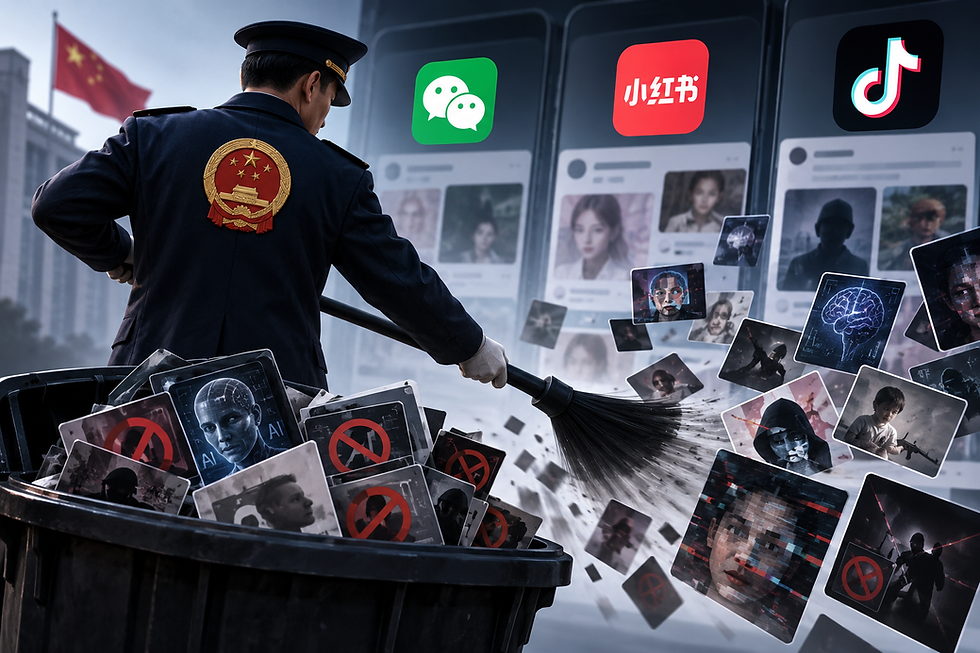
In a statement posted to its website, the Cyberspace Administration of China (CAC) said it had scrubbed more than 5.61 million pieces of harmful or illegal content and removed some 49,000 accounts during its latest enforcement drive. The clampdown swept up 2,400 websites and apps, targeting some of China’s biggest digital spaces, including TikTok’s sister app Douyin and rival Kuaishou, as well as RedNote and Tencent Holdings’ WeChat.
Wrapping Up
The vast and diverse nature of the Chinese Social Media space makes it incredibly challenging to keep a tab on the rapid developments taking place. However, China’s Digital Digest brings you all the latest updates from there to keep you abreast of all the evolving trends.
To delve deeper into the findings of our latest report, click here.



Comments