Defeating the “Call Me Back in 6 Months” Sales Timing Objection

Introduction
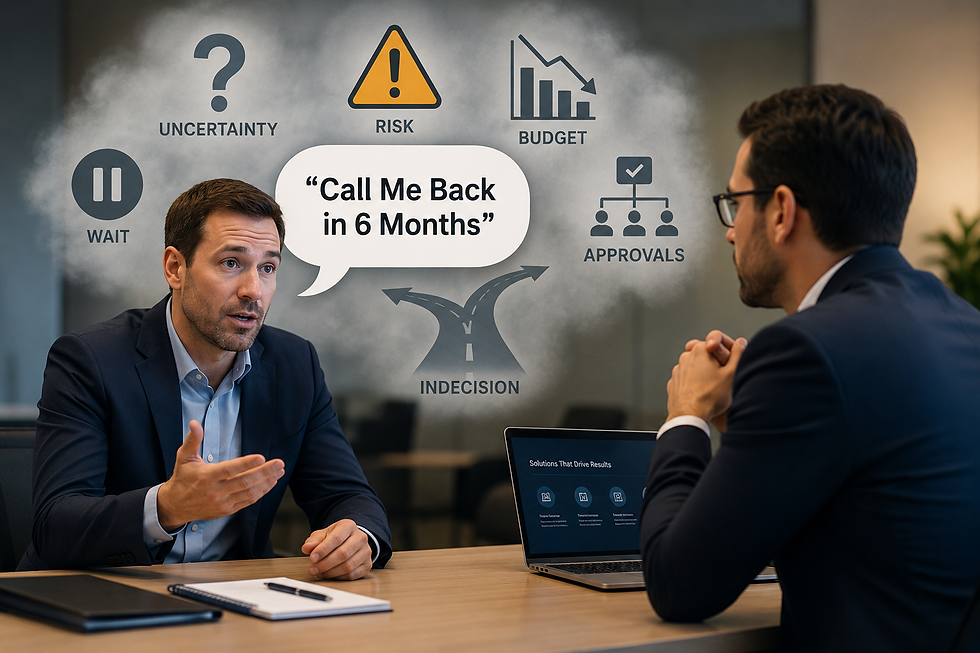
The "Call me back in 6 months" timing objection is among the most common in transactional sales, but it is also among the most deceptive.
On the surface, it appears to be a clear call to action that directs salespeople to end the discussion. Some salespeople treat this as a literal timeline and simply agree, while others try to force urgency, which can create tension.
Both these approaches overlook the real problem.
In many cases, the "6 months" period is not even a real plan. It is a convenient way to protect oneself from risks, uncertainties, or pressure, while keeping the discussion open and polite.
The best Rapid Converters know this. For them, the timing objections are never about scheduling anything. Instead, they signal hesitation, uncertainty, or a lack of understanding about the value.
In today's fast-paced sales environment, mastering the ability to deal with timing objections is not about creating urgency. It is about finding the root of the problem and helping make an informed decision on the spot.
Why Timing Objections Are So Common in Sales
Buyers frequently object on timing grounds, as they constantly balance their priorities and risks.
Even if the buyer wants your product, they may put off buying because of other pressing issues. Internal approvals, budgets, operations, and other projects delay the buyer's decision.
There are also psychological reasons why buyers say that they don't want something at the moment. They might be afraid to make the wrong choice. Putting off a decision reduces the buyer's risk.
Some typical reasons why buyers object to timing include:
Afraid of making the wrong choice
Lack of urgency and prioritizing
Uncertainty regarding the budget
Delay with internal approvals
Content with the current status
Psychological objection to change
In most cases, timing objections are never really about the actual date.
The Biggest Mistake Reps Make With Timing Objections
There are two major mistakes that sales reps can make when they receive a timing objection.
First, they can agree to the delay immediately by saying something like, "Okay, I'll reach out in six months," thus completely losing emotional momentum.
Second, they can attempt to force urgency on the buyer without understanding the reason for the delay.
Both approaches are flawed because they fail to address the real issue.
Timing objections call for curiosity rather than acceptance or urgency. Elite sales reps know that the point of timing objections is not to comply or argue with the time frame but to understand it.
What "Call Me Back in 6 Months" Really Means
When a customer says, "Call me back in 6 months," they may be saying more than what they actually mean.
Some other meanings include:
I’m not fully convinced by that idea yet.
This issue does not feel time-sensitive right now.
I would prefer to delay making a decision today.
I need more confidence before I go ahead with this.
This just isn't a priority at this time.
That's why top Rapid Converters never take things at face value. They try to understand the reason behind the delay.
Why Buyers Default to Delaying Decisions
From a psychological standpoint, the postponement of decision-making is a perfectly normal human reaction.
Generally speaking, people dislike making decisions that are considered risky, uncertain, or irreversible. When it comes to sales, this tendency is particularly pronounced because buying decisions are usually associated with financial risks, personal responsibility, and remorse.
Several psychological tendencies cause such behavior:
Loss aversion, an avoidance of losses that is more powerful than gains
Decision fatigue, being paralyzed by too many options
Status quo bias, the preference for the status quo
Behavioral economists Daniel Kahneman and Amos Tversky found that people experience losses far more intensely than equivalent gains, a phenomenon known as loss aversion. Research suggests that losses are often weighted roughly 1.5 to 2.5 times more heavily than comparable gains, helping explain why buyers frequently delay decisions even when potential benefits are clear.
Thus, putting off a decision is the go-to safety mechanism for people.
Top-notch salespeople know that unless they create a sense of urgency, consumers are likely to postpone their decisions, regardless of their interest.
How Elite Rapid Converters Respond Calmly to Timing Objections
Elite rapid converters will always remain calm when facing such an objection.
They will never express any form of disappointment or frustration. They will rather see the objection as valuable information rather than a refusal.
A sample response to such an objection would be:
"I understand. Could you help me understand why six months feels like the right timing for you?
The benefit of using such a strategy is that it serves two purposes. One, it helps validate the customer's statement. Two, it allows further discussion on the topic.
The Power of Exploring the Timing Concern
The best approach to handling a timing objection is by asking intelligent questions.
Rather than accepting the objection, top reps dig into it further:
What will be different in six months that makes waiting the better option?
What needs to be different for this to move up your list of priorities?
What is currently taking priority in your team?
These questions are intended to clarify, not to challenge or confront.
Often, the buyer realizes while answering that the issue is not one of timing at all, but of uncertainty or a lack of urgency. This presents a great opportunity to change their perspective on the timeline.
Creating Organic Urgency Without Pressure
Rapid Converters do not create urgency; they discover it.
Urgency is organic when the buyer sees the consequences of delaying the decision. Rather than forcing urgency, the rep guides the buyer to recognize what will continue to happen if they wait.
This can include things like:
More inefficiency
Lost business opportunities
Frustration
Competitive disadvantage
Wasted resource
Once the buyer understands the consequences of delay on their own, the urgency becomes organic.
If you want more information on how urgency and objections fit together, sources such as these offer valuable guidance.
Reframing the Cost of Waiting
One of the best tools for dealing with timing objections is reframing. Rather than emphasizing when to begin, elite reps emphasize the cost of not starting.
What could happen if this problem persisted over the next six months?
How is this problem impacting you right now?
What opportunities could be missed during this period?
Such reframing leads to thinking about consequences instead of scheduling.
This strategy helps buyers think about the true cost of waiting for a solution.
When Timing Objections Are Legitimate
Some timing objections are not emotional objections but genuine ones.
Such objections include:
The need to wait for a new budget period
Being under contract with another vendor
Restructuring or a change in leadership
Business cycles
The elite reps know when the objections are legitimate and when they are emotional.
In the first case, they respect the schedule while still maintaining the connection for future use. In the second one, they continue their quest for new opportunities.
Common Mistakes That Kill Momentum During Timing Conversations
Reps often ruin deals during timing conversations due to the following mistakes:
Accepting delays too easily
Using artificial urgency
Emotional pressuring of the buyer
Ignores the underlying reasons for the pushback
Concluding the discussion without clarifying
Such actions decrease trust and reduce the likelihood of re-engagement.
The best reps avoid such approaches as they remain curious, calm, and exploratory.
Coaching Sales Teams to Handle Timing Objections Effectively
Handling timing objections well takes coaching and practice. The most effective sales teams pay attention to the following things:
Delay role-playing
Missed exploration call reviews
Emotional intelligence training
Practice curiosity-based questions
Eventually, reps start to realize that timing objections doesn't mean rejection. They require further exploration.
Conclusion
The "Call me back in 6 months" timing objection is seldom about having things planned for 6 months from now. It usually means the prospect is hesitating or needs more time.
Top Rapid Converters don’t accept this objection at face value, nor do they respond with aggressive pushback. They probe into it with gentle curiosity, identify the true cause of the procrastination, and educate buyers about the cost of delaying the purchase.
In this way, they redirect the discussion from timing to consequences, thus making it easier for buyers to make decisions.
In contemporary sales, it's not about creating urgency. It's about showing buyers that sometimes delay costs more than action.


Comments