How to Build and Manage a High-Performing Remote Sales Team

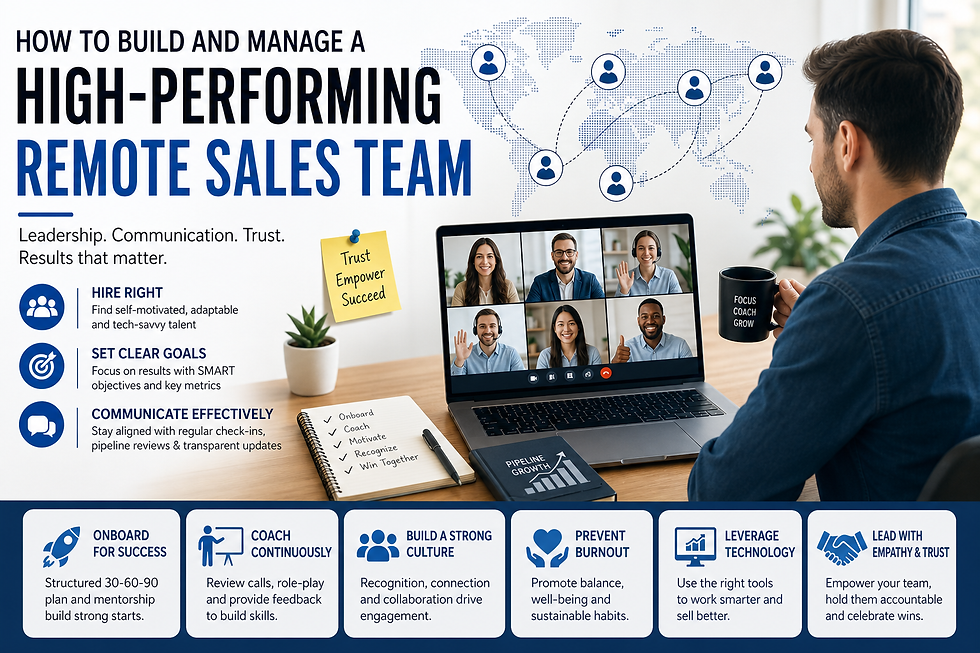
The advent of remote working has entirely revolutionized the functioning of today's sales teams. What was earlier considered a mere transition has now evolved into a permanent corporate approach adopted by businesses worldwide. Nowadays, most firms have their sales forces operating remotely from various parts of the country, continent, or globe in order to earn profits and maintain relationships with their customers.
Although remote selling offers benefits such as flexibility and access to global employees, it also presents some unique difficulties for leaders. Traditional approaches to sales team management, such as in-person meetings, desk drop-ins, and constant monitoring, are simply not applicable when working with remote teams. If poorly managed, remote sales teams may fall victim to poor communication, burnout, disengagement, and a lack of responsibility.
This is why developing an effective remote sales force is not just about providing people with computers and video conferencing equipment, but rather involves effective leadership, communication, expectation setting, and establishing a culture of trust and accountability.
Companies that have mastered remote sales management are not only enhancing their efficiency but also making themselves more flexible and responsive to market conditions. This guide will help you to understand the methods of how to recruit, manage, coach, and motivate your remote salespeople.
Reasons for Adopting New Approaches to Manage Remote Sales Teams
The management of remote sales teams involves entirely different methods as compared to those used when working with regular sales teams who work out of an office setting. When you have a sales team working in an office, you can watch their performance, conduct impromptu coaching sessions, and keep the team energized through daily engagements.
This cannot happen with remote sales teams. They operate alone and from different locations.
Management in the past was highly concentrated around supervision and monitoring processes. However, the successful practice of managing remote sales depends on results and accountability. In this respect, successful managers should not be concerned about control over each process but rather assist their representatives in achieving set performance goals.
Remote salespeople must also have better organizational skills and intrinsic motivation because, without any supervision, it will be necessary for employees to organize themselves, be productive and motivated.
Hiring the Right People for Remote Sales Success
Another major error companies make when implementing remote selling programs is thinking that all good salespeople will automatically thrive in a remote setting. Remote selling entails specific skills that go above and beyond regular sales abilities.
The ideal candidates for remote sales jobs usually:
Are self-motivated
Are organized
Are adaptable
Communicate effectively
Are technologically savvy
Are emotionally resilient
In the course of recruiting employees, it is critical to determine if the candidate would be able to work efficiently without direct supervision.
Apart from assessing sales results, focus on asking interview questions about how they perform in the absence of a boss. Questions like:
"What does your typical day look like while doing remote work?"
"What is your motivation for independent remote work?"
"What strategies do you use to communicate effectively within a team spread out geographically?"
Those individuals who exhibit high levels of accountability and self-discipline will fare much better in remote sales positions than their counterparts who require face-to-face oversight.
The company culture must not be overlooked either, since communication plays an integral role in a remote workforce's success.
Structure Remote Sales Onboarding Program
Onboarding is essential for remote sales success. In fact, many newly hired individuals might start feeling isolated, stressed, or even confused without a well-designed onboarding program.
One of the biggest mistakes remote sales managers make is overloading new hires with excessive information right away. The absence of a face-to-face interaction makes it imperative to establish onboarding procedures that would guide new employees through.
For instance, implementing an excellent 30-60-90 day program is very helpful.
In the first 30 days, new hires need to learn about:
Products/services;
CRM systems;
Sales procedures;
Communication tools;
Company culture;
The second 30-day stage should be dedicated to:
Real-life call shadowing;
Role-play sessions;
Prospecting conversations;
Pipeline development.
The last 30 days will allow new reps to start performing their work autonomously, although still under mentor supervision.
Mentorship programs could further help improve the onboarding process since having experienced sales representatives to rely on is always beneficial.
Having some early wins is crucial for building positive momentum.
Communication Is the Backbone of Remote Sales Management
Effective communication tools are crucial for developing an efficient virtual sales team. Lack of proper communication might lead to miscommunication and misalignment of remote teams.
The problem many virtual sales leaders struggle with is maintaining balance when communicating with their teams. Not enough communication leads to misunderstanding, while too much of it wastes resources.
Effective communication strategies in virtual sales management include:
Daily check-ins
Pipeline review once a week
Coaching sessions on a one-to-one basis
Stand-up meetings of the team
These are some effective means of staying aligned and holding your employees accountable.
On the other hand, asynchronous communication is just as important. Sometimes, communication doesn't necessarily need a meeting. Slack, CRM dashboard, and project management tools help maintain communication within the team while avoiding unnecessary distractions.
It's crucial to be explicit in communicating with your employees. Your expectations, deadlines, and priorities should be clearly communicated.
Another useful feature is transparency. When you open up about company goals and challenges, your team members will appreciate it.
Define Clear Objectives Without Being a Micromanager
Being a micromanager is one of the quickest ways to destroy morale within your remote sales team. Continuous surveillance causes stress, eliminates autonomy, and diminishes trust.
Rather than watching every little thing that your people do, being an effective remote sales leader means being results-oriented.
Objectives provide remote workers with clarity and accountability. Successful teams often adopt the SMART goal model, which is specific, measurable, achievable, relevant, and time-bound.
Performance metrics for a remote sales team could be:
Increasing pipeline growth
Generating conversion rates
Generating revenue
Ratios from demo to close
Retention of customers
The point is to foster accountability without micromanaging the details.
When remote salespeople have trust, they tend to be much more driven and productive.
Effective Coaching of Remote Sales Representatives
Coaching is among the most critical roles of remote sales managers; however, it is often ignored.
Managers tend to only reach out to their sales reps when something goes wrong. They develop a reactive approach, which is not the best way to manage any team.
Successful remote sales teams focus on constant coaching and skill development.
The following are some modern ways of coaching:
Examining recorded sales conversations
Analyzing virtual product demonstrations
Role-playing sessions
Providing individualized feedback
Organizing skill-building seminars
One of the most useful activities in coaching sales is reviewing their call recordings because they enable managers to analyze their representatives' communication skills, objection handling, and ability to discover new information about clients.
Coaching should be individualized, too. Every representative needs specific attention. One might need to improve their prospection skills, another one – closing, while another one – presenting virtually.
Recognition is crucial as well because it keeps employees motivated.
Create a Positive Remote Sales Culture
Remote workers tend to be plagued by feelings of isolation. Without culture-building efforts, employees may start to experience a sense of detachment not just from their coworkers, but even from their supervisors.
Culture boosts motivation, collaboration, and retention.
A great remote culture needs some intentionality. Good virtual sales leadership consists of:
Programs for team recognition
Virtual celebrations
Online casual hangouts
Sessions for peer collaboration
Communication
Leaders must also be present and accessible. People work harder and achieve more when they feel engaged and connected to their leaders.
It's essential to create an emotional connection. This isn't as obvious to many bosses as it sounds; remote sales teams who feel appreciated and connected will stick around for longer.
Avoiding Burnout for Virtual Sales Teams
Virtual sales reps are especially prone to burnout since there is very little distinction between their work and personal lives.
They may feel compelled to be continuously online. This could result in mental and physical exhaustion, as well as subpar job performance.
Indicators of burnout may include:
Low levels of motivation
Decreased engagement
Increased latency in responding
Emotional exhaustion
Poor sales results
A great leader will promote healthy work behavior over unhealthy ones. This might involve:
Being flexible with time management
Promoting rest
Valuing personal time
Setting reasonable expectations
Psychological wellness is intrinsically tied to sustained job performance—those who emphasize employee health benefit from greater retention and efficiency.
Leverage Technology for Enhanced Remote Sales Performance
Technology is an indispensable aspect of remote sales management. Contemporary salespeople depend on technology to facilitate their interactions, performance management, and customer relationship management.
Common technologies used may include:
CRM platforms
Video conferencing applications
Sales engagement tools
Analytics dashboards
Collaborative apps
Additionally, automation techniques could be leveraged for increased efficiencies by streamlining processes and enhancing transparency within sales operations.
Nevertheless, technology is only meant to augment human interaction rather than serve as a replacement. Indeed, successful remote sales teams integrate both technology and effective leadership skills.
Moreover, training is vital since failure to leverage technology effectively leads to poor results even when utilizing the most advanced tools.
Lead With Trust, Empathy, and Accountability
Command-and-control leadership styles are not very effective in remote settings. High-performing remote sales teams need leaders who exhibit a combination of accountability, trust, and empathy.
Employees seek structure and guidance, but they also seek autonomy and recognition.
Characteristics of successful remote sales leaders include:
Active listening
Clear communication
Employee development
Psychological safety
Collaboration
Empathy is important in the remote context because remote workers encounter unique struggles, such as loneliness, anxiety, and balancing their personal and professional lives.
On the other hand, accountability is still vital. Effective leaders demand high performance from their employees while coaching and communicating with them.
Conclusion
The time when remote sales teams were a temporary solution is over. The reality is that remote sales teams will be the future of selling in the modern world.
If companies seek sustainable success, they need to learn how to create effective remote sales teams. The key to this is not only technological tools but also intentional leadership, effective communication, clear expectations, continuous coaching, and an environment founded on trust.
Through hiring flexible salespeople, creating better onboarding programs, emphasizing results rather than controlling every step, and paying attention to the needs of employees, companies can establish high-performing remote sales teams that succeed in competitive business settings.
Call-to-Action
For anyone that wants any further guidance, ClickAcademy Asia is exactly what you need. Join our class in Singapore and enjoy up to 70% government funding. Our courses are also Skills Future Credit Claimable and UTAP, PSEA and SFEC approved. Find out more information and sign up here. (https://www.clickacademyasia.com/course/remote-selling-mastery)


Comments