Inside the "Deal Clinic": How Leaders Can Pressure-Test an AE’s Blind Spots

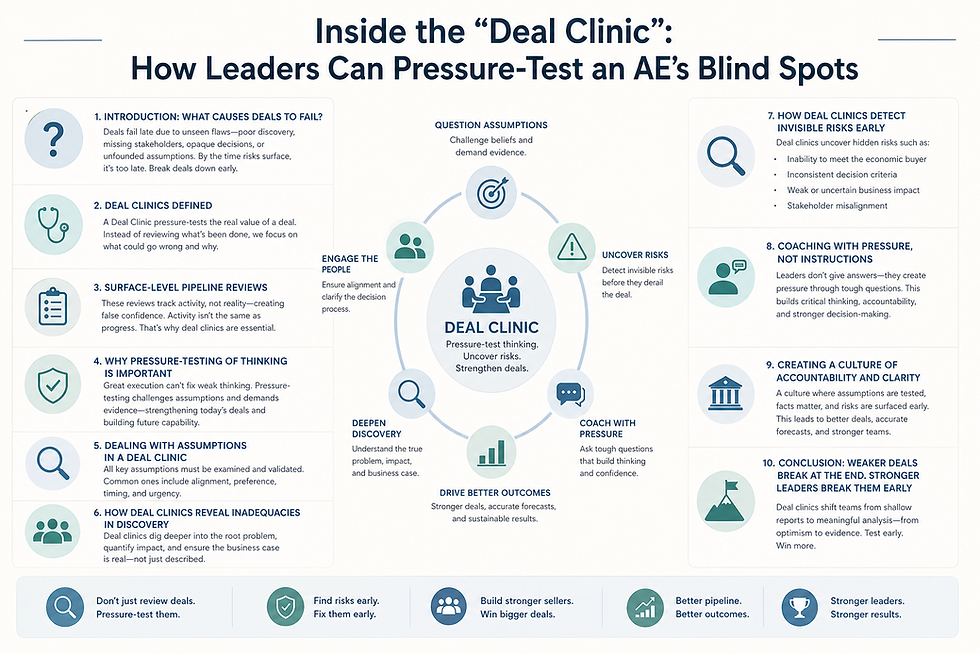
Introduction: What Causes Deals to Fail?
Very seldom do deals simply fall apart. Almost all deals fall apart late because there were some fundamental flaws in them, which never got exposed during the early stages of the deal life-cycle. On a superficial level, everything is progressing well: meetings are taking place, stakeholders are being involved, and progress is being shown through the pipeline.
The reason why deals fail at the last minute lies in the fact that risks, such as poor discovery, lack of stakeholders, opaque decision-making process, or unfounded assumptions, were not discovered prior to the failure. Traditional review approaches would not have helped either, as they are more concerned with monitoring the progress than with digging deeper into the essence of the matter.
This is exactly why the deal clinics sales training model works: by testing deals for flaws before anything else does. Since in the world of enterprise sales, deals break down at the last minute, leaders should break them down much earlier.
Deal Clinics Defined
A Deal Clinic is a discussion aimed at determining whether the real value of the deal is what was expected in the first place. It is a far cry from the regular pipeline discussions, which usually aim at gathering more details than anything else.
In a regular pipeline discussion, salespeople highlight all the steps they have already taken as well as those they intend to take. They emphasize progress and make everything sound good without going too deep into any matter. In other words, the process becomes very inaccurate because it fails to highlight all the things that should be looked into more carefully.
In a deal clinic, things get turned around completely. There is no need to talk about progress or even the results obtained thus far. Instead, everyone discusses what might happen later on and what problems may occur down the road.
Surface-Level Pipeline Reviews
A vast majority of pipeline reviews are created to provide quick results. These reviews allow the leadership to see where different deals stand and help them make the right decisions. However, such reviews cannot offer much insight because they are limited to the updates from the sales reps regarding meetings, communication, and other actions.
The main drawback of the surface-level approach to evaluating pipelines is that the activity is taken as the indicator of how successful the deals are. For instance, a deal with frequent meetings can be thought of as being good because there are many discussions. The lack of definition of the problem does not matter here.
It should be emphasized that such surface-level analysis creates a false impression about the deals. In other words, it leads to overconfidence and allows the management to think that there is nothing wrong with any deal. Once the problems start showing up, it will already be too late to deal with them.
This is why it is vital to conduct deal clinics for sales coaching.
Why Pressure-Testing of Thinking Is Important
A good sales deal must have a good foundation for success. While excellent execution might lead to some successes, the lack of good thinking will undermine even the most efficiently executed deal.
When pressure-testing the thinking, a sales leader needs to question the assumptions made by the sales representative regarding the deal. In essence, such questions would make the sales rep explain what he believes in and what evidence backs his beliefs.
For instance, if a sales rep mentions that a particular sale will go through soon, the deal-clinic leader would ask him about evidence that backs such claims. He will ask whether the economic buyer has been identified, whether the business case has been established, and whether the decision-making process is clear.
In addition to helping understand a particular deal better, such pressure-testing improves the skills of the sales representative, leading to better deals in the future.
Dealing With Assumptions In A Deal Clinic
One of the biggest sources of risk in enterprise sales happens to be assumptions. They can often be made with confidence, yet without being backed by any sort of validation. Without the right questioning process, such assumptions may lead to mistakes both for the salesperson and their leader.
During a deal clinic session, all assumptions will need to be examined, questioned and tested. Leaders will need to make sure that they are well-justified and have some level of credibility.
Some of the common assumptions that will usually be checked during a deal clinic include:
That the prospect is totally aligned
That the offer is favored
That the deal is bound to close within the expected period of time
That there is a great sense of urgency around the issue
As part of deal clinic sales coaching, leaders will ask relevant questions in order to make sure that the assumptions are correct and have some sort of confirmation from trusted sources.
How Deal Clinics Reveal Inadequacies in Discovery
A good deal will have excellent discovery at its core. When this aspect is lacking or incomplete, then everything else about the deal becomes vulnerable. But sometimes, inadequacies like these are not immediately apparent even in routine meetings.
This is where deal clinics come in. These are intended to bring out inadequacies in discovery by examining the deal at a much more profound level. The leaders ask about the extent of the problem and how it has been investigated thoroughly enough to discover the cause of the problem and its business implications.
This goes beyond asking for generalized descriptions of the situation. Rather, they inquire if the salesperson can define the problem quantitatively and demonstrate its impact on the client's business.
How Deal Clinics Detect Invisible Risks Early
The element of risk is integral in enterprise sales. The main difference between a successful deal and an unsuccessful one comes down to whether these risks are detected and handled early.
The whole concept behind deal clinics is uncovering any risks that are otherwise invisible. This is achieved through analyzing different dimensions of the deal, enabling leaders to see where there may be any underlying risks.
Some risks that typically emerge in a deal clinic include:
Inability to meet the economic buyer
Inconsistent decision criteria
Weak or uncertain business impact
Stakeholder misalignment
By recognizing these risks early, the sales team is able to handle them proactively by engaging the correct people, clarifying the decision criteria, and building a strong business case. Handling risks in a proactive manner is one of the core values behind Deal Clinic sales coaching.
Coaching With Pressure, Not Coaching With Instructions
The hallmark of a deal clinic is that it involves coaching. In other words, coaches do not offer solutions or directions to follow. They set up a situation where sales personnel are encouraged to think more critically.
How? By creating pressure. Sales personnel are required to answer tough questions. And by doing this, they sharpen their thought process and understand the deal better.
What are the advantages? This method increases confidence, decision-making skills, and accountability. Salespeople become more systematic about their thinking and recognize the possible pitfalls of the deal.
In the long run, deal clinic sales coaching produces better and more competent salespeople who can handle complicated deals effectively.
Creating a Culture of Accountability and Clarity
Deal Clinics are not just about strategy; they are about culture. Deal Clinics help to build a culture that focuses on clarity, accountability, and evidence.
In such a culture, assumptions are questioned, and statements need to be backed up by facts. Sales reps are advised to look out for problems early on and find ways to mitigate their impact. Leadership teams are tasked with getting a good grasp of the reality of each deal.
Deal Clinics will improve organizational results in all areas. Deals will be better structured, forecasts will be more accurate, and there will be increased collaboration within the teams.
The inclusion of deal clinic sales coaching within the sales cycle sets a solid foundation for success.
Conclusion: Weaker Deals Break at the End. Stronger Leaders Break Them Early
Enterprise deals don't get messed up by visible mistakes. Deals fall through because of invisible threats that never come under scrutiny till the time comes. Unfortunately, the traditional approach to pipeline review usually fails to spot such risks, as it concentrates on activity.
However, Deal Clinics can fill this gap by providing a setting where deals can be critically evaluated and analyzed. With deal clinics sales coaching, leaders will start questioning assumptions, spot discovery gaps, and unearth risks.
This is why the use of Deal Clinics fundamentally changes the way deals are handled. It shifts the sales team's attention from shallow reports to meaningful analysis and moves them from optimism to evidence.
As a consequence, sales teams become more ready to cope with complexities and close complex deals.
Deals can't succeed based on how well they're put together. Deals need to be rigorously tested.
Since weaker deals tend to break at the end. While stronger leaders break them early.



This was an insightful piece on using Deal Clinics to pressure-test enterprise deals. The contrast with traditional pipeline reviews really highlights why so many deals collapse late. I liked the focus on challenging assumptions, uncovering discovery gaps, and building real accountability. It seems like a powerful coaching tool for leaders. I came across a similar sales strategy discussion onEngland & Derbyshire Solicitors that had that same emphasis on early risk detection. Solid read.
This is a sharp reframing of pipeline reviews. The distinction between “activity” and “evidence” is especially important — too many teams equate motion with progress. I like the emphasis on pressure-testing thinking rather than prescribing answers. That shift from instruction to inquiry is where real skill development happens. The idea that leaders should “break” weak deals early instead of being surprised late is a strong takeaway. I recently read something on https://direwolfseo.co.uk/ about decision-quality over activity metrics, and this aligns perfectly. Strong sales cultures are built on clarity and accountability, not optimism alone.