International Expansion: Why Understanding the Next Asian Wave's Digital Playbook Is Essential

Introduction: The Global Center of Innovation Has Shifted
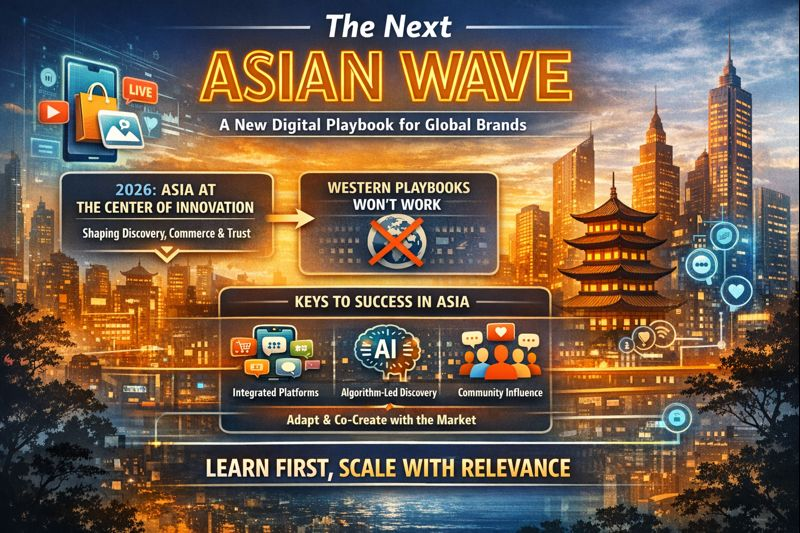
A typical pattern in global strategies has been in place for several decades. Brands had proven their success in Western markets, optimized their digital strategy, and then replicated it worldwide with only minimal adjustments. This is no longer the case. With the advent of the year 2026, the hub of all innovative aspects of the digital world is firmly in Asia.
In countries like China, Southeast Asia, India, and Eastern Asia, digital ecosystems have progressed at a faster pace, are more integrated, and are more adept at handling consumer behaviors, compared to their Western counterparts. They are not trying to catch up. They are setting the tone.
For global brands, this is both an opportunity and a potential risk. The scope is very great here. However, it is possible only for those organizations that are ready to leave behind their assumptions and learn about how such environments really work. Today, international expansion is not just about translation and buying advertising space.
Why Asian Digital Ecosystems Lead In Speed, Integration, and Experimentation
A defining feature of the Asian digital marketplace is how highly integrated it is. A consumer may buy, chat, pay, view content, and contact customer service all within the same ecosystem. This creates frictionless experiences that Western consumers are only beginning to encounter.
These environments support rapid innovation because of short feedback cycles. Brands experience an immediate outcome for a given tweak in price, message, or experience design. They get real-time consumer feedback. They improve in an iterative, continuous fashion not in versioned releases.
Such speeds are not random. These have been a result of markets that pioneered mobile-first user behavior and experimentation in their quest for growth, and have infrastructure built in a convenience-driven manner. This is why Asian digital ecosystems seem so agile and data-driven.
The Danger of Using Western Playbooks Internationally
Frequently, approaches to going global flop are due to mentality rather than implementation. Linear funnels and channel separation are characteristics of playbooks from Western companies. However, they do not work in many Asian markets.
Consumers may learn about products via live streaming rather than searching. Trust may be built via community validation rather than brand messaging. Conversion may occur via chat UI rather than websites.
By imposing known models on unknown contexts, brands can create friction where there is no need for friction to exist. They tend to miss clues about how local competitors intuitively understand those clues. In fact, they risk seeming oblivious to how people live and buy.
International expansion in 2026 will be as much about unlearning as learning.
Machine Logic in Asian Digital Systems
Specifically, the Asian digital ecosystem is much evolved in the way AI logic works across platforms. Algorithmic systems are very integrated with commerce, content, and services. AI-based recommendations are not stand-alone features. They are building blocks.
Super Apps illustrate this integration. In one platform, consumers can find information, engage socially, make transactions, and have post-purchase services. All of these happen while training artificial intelligence systems that optimize relevance with every user interaction.
For brands, there is a new set of rules that applies to discoverability. It no longer suffices that the search is optimized. Behavior patterns and real-time activity determine discoverability.
It is helpful to understand how these environments and the algorithms that operate within them interpret the value of these campaigns. This is especially the case when the campaigns have financial backing but still fail to receive much traction.
Algorithms' Role in Discovery
Discovery patterns in regional Asian markets tend to be more about implicit intention than about direct search. In these markets, users are shown products by algorithms based on behavioral patterns rather than explicit queries.
Live commerce, short-form videos, and influencer-led activities feature prominently here, too. Algorithms begin to emphasize videos or pages with high sustained levels of engagement rather than simple clicks.
This means things for strategic creativity. Messaging has to feel native. The content has to pull people in rather than push its message. Brands succeed by creating experiences recognized as valuable by algorithms and people.
Human Context Still Governs Trust
Even with the level of intelligence in machine logic, human context still holds the final keys to unlock trust. Cultural fluency is no longer nice to have. It needs to be something that must.
Language subtleties, cultural norms, humor, and symbolism can be very different from one market to another. What constitutes premium in one market can easily be perceived as strange or unauthentic in another. What constitutes trust in one marketplace can be perceived as indifference in another.
Community influence is very important. Community recommendations are often more valuable than advertised benefits. Social validation is integrated into the decision-making infrastructure.
Those brands that do not pay attention to these factors could end up being technically visible but emotionally invisible.
Community Influence & Platform Norms
Asian online platforms operate on an unwritten set of rules. Societies set boundaries on what is acceptable, credible, and desirable. One should familiarize oneself with this before engaging.
This can mean engaging with creators in a market in a partnership type of way, through an investment over time in dialogue, not in a transmission type of way.
These communities are trust filters. They help to highlight brands that add meaning and knock back those that smell of opportunistic motivations.
Experimentation at Market Speed
One of the most important things that big brands can learn from Asian markets is normalizing experimentation. Experimenting is not something you go through. It is an operating system.
Brands get scaled and started quickly, with feedback and iteration following right away. Failure is not something that is obscured. It is actually expected, and the data that is derived.
This requires cultural change within Western enterprises, which have traditionally had long planning cycles and been risk-avoiders. It is essential to achieve speed while showing respect and experimenting, with local knowledge informed to guide the process.
Adopters of this methodology acquire agility that goes beyond the market.
Lessons Global Brands Must Adopt
For international growth to succeed, it is necessary to adopt some key principles. The home team should feel empowered and not restricted. Decisions should move from HQ control to context. The data needs to be viewed from cultural perspectives and not from dashboard analytics.
First and foremost, brands need to stop exporting playbooks and start co-creating strategies. Growth comes from collaboration, not duplication.
Leadership Readiness for Global AI Markets
Asian digital ecosystems pose challenges to typical leadership principles. Leaders need to be at ease within contexts characterized by the dynamic development of digital platforms, the continuous flow of data, and cultural subtleties.
Sometimes changes are also required in organizational structures. The requirement exists because there is a need for collaboration between cross-functional teams and regions. The frameworks of governance also require flexibility while preserving brand integrity.
Leadership readiness is not about having all the answers related to the market. Leadership readiness is about creating systems that know and learn quickly.
Increasing the Role of Local Insight Over the Role of
The world's most successful brands place an emphasis on local knowledge instead of the command-and-control approach. They believe in the ability of the local teams to read the signals and understand the dynamics when it comes to the platforms they operate on.
It doesn't harm the brand. On the contrary, it increases brand strength by virtue of relevance and respect.
In 2026, scalability is about adaptability.
Conclusion: International Expansion Must Involve Learning Before Scaling
Going international is no longer about raising flags. Going global is about relevance. The Asian digital ecosystem is a forecast of the future of global mar
keting. The future is about connected platforms and AI-powered discovery. Those brands, though, who approach this market with humility end up gaining more than access? They acquire perspectives. They acquire knowledge on where machine logic and human context meet. With the world AI and complex cultural environments have constructed for us, the new strategic play is humility. Those who learn first will be the ones who learn to scale. Comprehending the Asian Wave to come is anything but optional. It is a crucial consideration for every serious organization seeking to expand in 2026 or beyond.


Comments