Judo-Flipping the “Do You Have X Feature?” Question in Sales Demos
- ClickInsights

- 13 hours ago
- 6 min read
Introduction
All SaaS sales demos inevitably come to that exact same point. Stakeholders interject by asking, "Do you have this feature?"
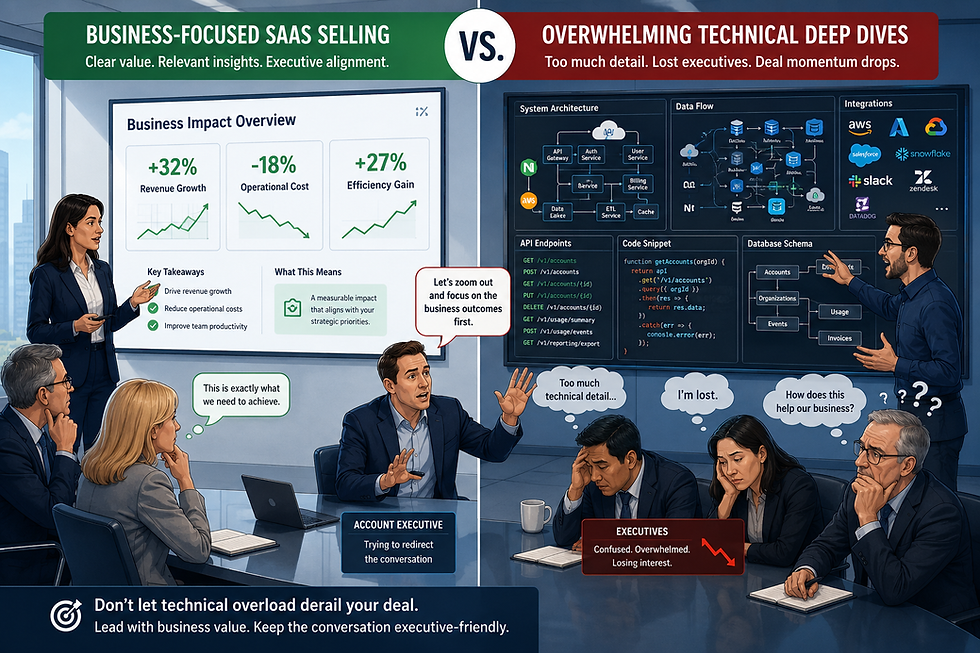
Most salespeople fall victim to this very question and end up getting sidetracked into a product features discussion. They answer the question as quickly and succinctly as possible, which completely derails their demo from strategic conversations about business value and straight into the weeds of product functionality.
This happens all the time, and yet it's one of the worst practices in enterprise sales.
What the best teams do differently is judo flip this entire interaction.
They treat each feature question as an opportunity to understand the business problem beneath it.
I call this Judo-Flipping the question because that's essentially what is happening here.
We're taking a conversation that could get us nowhere fast and flipping it on its head to create momentum for a meaningful business conversation.

Why Feature Questions Dominate Enterprise SaaS Demos
The buying behavior of today's enterprise buyers is highly driven by feature comparison.
Enterprise companies compare vendors using requests for proposals (RFPs), internal requirements documents, competing solutions' rating sheets, analyst input, and advice from peers. Research from Gartner also shows that modern B2B buying journeys involve increasingly complex decision-making processes with multiple stakeholders evaluating vendors from different strategic and operational perspectives. This is one of the main reasons enterprise demos become heavily feature-driven. Consequently, demos will include lots of feature questions that serve to mitigate risk.
Stakeholders seek assurances regarding the ability of the system to facilitate their processes, integrate seamlessly, and not disrupt operations once implemented. This is normal.
Nevertheless, feature comparisons tend to drive buyers into making shallow purchasing decisions. Buyers may begin evaluating software applications solely on features, overlooking other important factors. Once all discussions center on feature comparison, vendors will be unable to differentiate, and prices will be highly competitive.
The Problem with Answering Feature Questions Too Literally
Most sales teams answer feature questions way too literally.
The stakeholder mentions some capability, and the salesperson immediately jumps straight into an explanation or product demonstration. Even though such an approach might be seen as very useful, in reality, it often detracts from the sales conversation. Why is that so?
Well, for starters, it makes strategic positioning harder because the conversation is focused on the capabilities rather than the transformation of your customer's business.
Another issue is that the buyer's questions open up too many possibilities for a competitor to compare its offering.
Third, answering feature questions only contributes to the feature dumping problem and adds another layer of cognitive load to your customers' brains.
But by far the biggest problem with such an approach is that it misses out on what lies beneath the surface in that particular question.
What “Judo-Flipping” a Feature Question Actually Means
Judo flipping the feature question involves changing the direction of the dialogue from function to business relevance. It's not an evasive tactic; it's consultative.
Rather than providing an immediate answer about the technical capabilities of the product, high-performing AE-SE teams first consider the reason behind the need for that specific feature in terms of the client's business challenges. In essence, this completely changes the direction of the conversation.
The demo then stops being just about a check box and starts being a business discussion about solving real problems.
This approach is extremely important because enterprise clients will eventually be making decisions based on what the solution can do for their business.
The Psychology Behind Feature Requests
Feature questions are generally symptomatic of something more serious.
Some customers are worried about losing key features when they change platforms. Some are addressing a problem created by their existing system. Often enough, there is some pressure coming from within the company that the evaluation team needs to resolve first before proceeding. The competition is also an important factor here.
A customer might question a particular feature simply because another vendor had made a point of that during a past demonstration. Some of the features being asked for have nothing to do with strategic importance in the business. This is why proper discovery is critical.
The question itself is just a symptom of something else going on. Elite salespeople recognize this and dig deeper before providing an answer.
Step 1: Slow Down Before Answering the Feature Question
One of the best enterprise sales techniques involves holding back from responding quickly.
Responding quickly makes you react. The discussion becomes technical before you really know the context of the business discussion. Great sales teams know how to pause the discussion.
Rather than jump right into an explanation, they give themselves some room to discover what the buyer really needs. This not only shows that the team members are confident and professional but also allows time to understand the real concern.
Pausing can also build credibility. Vendors will be seen as more credible when their response is well-considered rather than rushed and defensive.
Step 2: Uncover the Business Problem Behind the Request
The second step involves discovering the issue related to the feature request. Top-notch account executives will always ask additional questions like:
“Can you walk me through how that impacts your work?”
“What challenge are you hoping to address with that feature?”
“How are you currently managing that process?”
This way, they move their focus from the feature itself to the problem area.
In other words, a request for an advanced reporting feature could stem from poor visibility, slow decision-making, and inaccurate forecasting among executives.
After revealing the true problem, the AE and SE will be able to sell the product more effectively.
Step 3: Reframe the Conversation Around Outcomes
Having unearthed the issue, the elite sales team pivots back towards the outcomes.
Rather than limiting their discussion to the feature alone, they articulate how it enhances efficiency, mitigates risks, boosts visibility, quickens execution, or facilitates scalability.
The impact on buyers is profound.
This is also why elite SaaS teams avoid generic product walkthroughs and instead tailor the discussion around the buyer’s environment, priorities, and operational challenges. Contextualized demos make outcome-based positioning far more persuasive because buyers can immediately connect the solution to their real business workflows. For example, this guide on contextualizing product walkthroughs explains how high-performing SaaS teams make demos more relevant and strategically aligned.
The executives’ pay more attention since the discussion revolves around business results rather than technical details. It becomes more consultative and relevant to organizational objectives.
The use of outcome-based positioning also helps differentiate your offering from the competition.
While your competitors might be able to provide a comparable feature, they might not always be able to link it to any tangible business outcomes.
Step 4: Answer Strategically, Not Defensively
In the end, the feature question will need to be answered.
The key is that top-tier sales organizations will answer strategically, rather than reactively.
Excellent answers will continue to be brief, assertive, and contextualized within business needs. If there is a feature, the SE will outline how it aligns with the customer's objectives without getting too technical.
Honesty is also essential if there are any limitations.
Too much explanation, going defensive, or promising features that don't exist yet will harm credibility in the enterprise sales environment.
Credibility improves by answering honestly while staying focused on business needs.
Handling Situations Where the Feature Does Not Exist
Missing the requested feature is not an automatic failure on your part. What really counts is how you handle the situation.
When salespeople face a missing feature, they either make false promises or deny there's any problem at all. However, top-performing salespeople handle the situation differently.
They admit that you do not have the feature but redirect the conversation from there, talking about alternative processes, your advantages, focus areas, and other aspects.
More often than not, the actual feature was just a pretext for the real problem. The actual problem was the business challenge itself.
How Feature Obsessions Hurt Enterprise Buying Decisions
Feature-centric selling frequently disrupts enterprise buying operations.
As assessments turn increasingly features-focused, buyers fall prey to paralysis by analysis. Minor functional variations start to outweigh major strategic factors like successful deployment, scalability, vendor collaboration, and overall business value.
Decision-making is significantly delayed.
Enterprises can waste months assessing individual features without ever considering the business improvements they initially sought to achieve.
Business synergy outweighs feature equivalence.
The most optimal enterprise buying process should be strategically driven rather than endlessly feature-checked.
The Role of the AE and SE in Managing Feature Questions Together
To manage feature talks effectively, there must be good coordination between AE and SE.
AE is responsible for ensuring strategic alignment throughout the discussion. SE verifies technical alignment while reinforcing the entire story.
When AE and SE coordinate well, features will be an advantage rather than a distraction.
AE ensures the discussion remains goal-oriented, while SE ensures technical alignment without bombarding the audience.
This ensures that both parties are more confident during the discussions and demos.
Conclusion
Feature questions are a given when you do a sales demo in the SaaS space for an enterprise sale.
However, the most successful sales teams know that it's more than just verifying functionality. It's about exploring the underlying business needs and enhancing strategic positioning.
And this is where Judo-Flipping the feature question comes into play.
By pausing, probing deeper with follow-up questions, and refocusing on the outcome, AE-SE teams can keep control of the discussion while establishing better alignment with the buyer.
Enterprise customers aren't buying your product or solution because of its features in isolation. They're buying it to solve real-world challenges and derive business value from it.
In today's enterprise sales environment, success isn't about listing more features. It's about leveraging technology to drive business results.


Comments