Mindset Over Mechanics: What Really Drives the Pre-Sales Process?

Introduction
There is still a prevailing notion that successful pre-sales processes are all about good mechanics. That means perfecting your demos, learning features like crazy, obtaining certifications, and giving flawless presentations. All of these things do matter, but none of them are actually driving success in the realm of enterprise SaaS sales.
Buyers today demand something different. They don't need another technical presentation; rather, they want strategic advice, an understanding of operations, and assurance that their solution fits with business goals.
This development has fundamentally transformed the way we sell.
Today's most effective Sales Engineers and Solutions Architects aren't necessarily experts in every button within the system; they simply understand how to navigate conversations strategically.
Why Technical Mechanics Alone No Longer Win Deals
The dynamics involved in enterprise software sales have changed dramatically over the last ten years. Committees now tend to be larger, competition within software categories has risen, and executives have become even more critical when it comes to spending on technology.
What that means is that generic demos and overly rehearsed presentations don't impress buyers anymore. Today's buyer wants to know what the product can do for their business and how it helps them operate more smoothly, grow more easily, and achieve real results.
That is where the problem lies with mechanically-focused pre-sale teams.
There are many Sales Engineers today who think of a demo not as a conversation about how a product can solve business issues but as a showcase of their technical capabilities.
This approach leaves no room for meaningful interactions. Sheer numbers of features don't usually sway enterprise buyers; what matters to them is confidence.
What “Mindset” Means in Modern Pre-Sales
In the realm of enterprise pre-sales, mindset describes how sales experts engage with customers and problems and communicate strategically.
Mindset does not concern itself with only having knowledge about the product. Mindset involves the way that Sales Engineers think, listen, adapt, and influence buyers in every step of the purchasing journey.
The best-of-the-best Sales Engineers work with:
Buyer-centered mindset
Strategic curiosity
Emotional intelligence
Business acumen
Adaptability
Problem-solving mindset
With this mindset, everything else chanhttps://www.clickinsights.asia/post/how-to-handle-price-objections-when-you-sell-premium-solutionsges.
No longer do they just explain how the software works, but they uncover operational pain points, find out business priorities, and make sure the solution solves business problems.
That's what makes a difference between a mere product presenter and a true Solutions Master.
Differences Between Product Presenters and Strategic Advisors
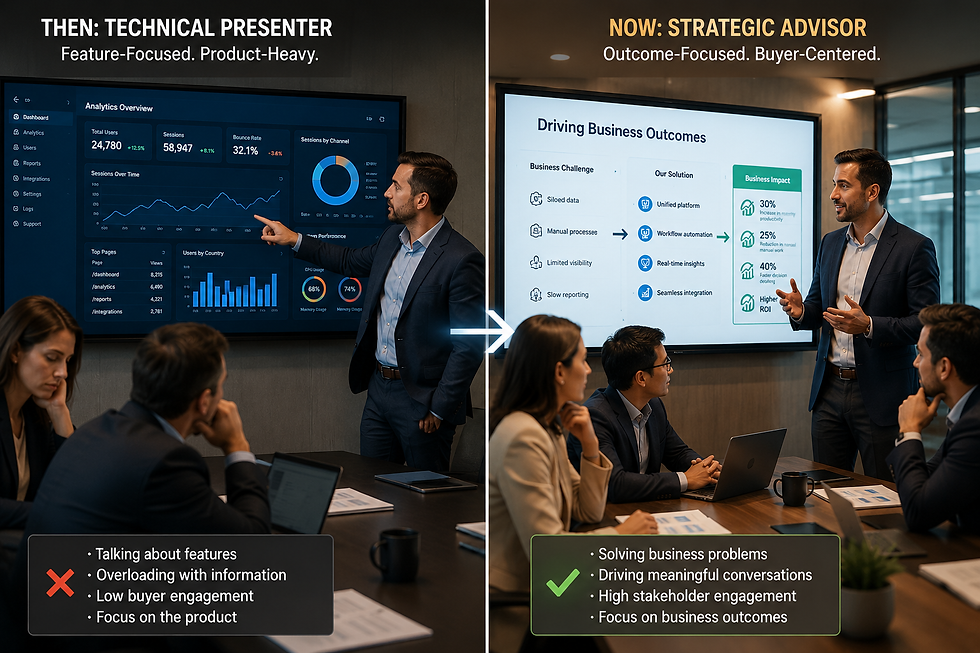
Perhaps one of the most obvious distinctions in today's world of SaaS sales is the difference between product presenters and strategic advisors.
Product presenters are primarily concerned with function. Their presentations are strictly structured, highly detailed, and accurate to a fault. Although this approach might demonstrate their proficiency, it typically results in superficial interactions with the customer.
On the other hand, strategic advisors conduct themselves in a fundamentally different manner.
They steer discussions toward business objectives, operational difficulties, and organizational impact. Rather than asking themselves, “Which features should I highlight?” they consider, "What problems is the buyer trying to solve?"
This fundamental difference transforms the entire conversation into something entirely new.
Buyers rely on advisors due to the clarity they provide. Advisors allow stakeholders to examine operational concerns, implementation factors, and business implications beyond software features.
For enterprise SaaS sales, buyers don't require any more information. They require a better understanding.
Curiosity as a Core Pre-Sales Skill
Curiosity is a skill that is often overlooked in the sales process. A skilled Sales Engineer does not ask predetermined discovery questions. He goes deeper into exploring the client's ecosystem, the problems he faces, and the objectives he pursues.
Being curious helps you discover issues that your customer is not yet aware of. You will know about inefficiencies, gaps in communications, difficulties with data analysis, etc., which impact the decision-making process.
This will enable you to personalize demonstrations and meetings with stakeholders even more.
The key to success is presenting solutions for your customers' actual problems. And if you approach the conversation with genuine curiosity, then it won't be hard for the buyer to realize how relevant it is to his organization.
Curiosity will help you build relationships, as your clients will be more open and cooperative if they feel that you want to understand them.
Adaptability: The Most Underrated Skill in Enterprise Sales
Every enterprise sale is unique.
Not all decision makers are created equal, and not all demos need to be identical.
It's why adaptability has emerged as one of the most essential pre-sales traits.
Top-tier Sales Engineers consistently tailor their language and approach throughout the sales process.
They translate complex technical information into layperson terms for executives, delve deeply into the architecture for technical reviewers, and vary their demo pace according to the level of engagement from the stakeholders.
Adaptability even enhances communication at the executive level.
The best pre-sales professionals understand when to streamline their explanation, when to go into detail about the technology, and when to pivot the discussion to strategic considerations.
Adaptability generates better dialogue and more cohesion within the purchasing committee.
In contemporary enterprise sales, inflexibility is a weakness. Adaptability builds relevance, and relevance wins deals.
Why Empathy Drives Better Pre-Sales Outcomes
Empathy is now considered an essential competitive differentiator in enterprise SaaS sales.
Great pre-sales specialists know that buyers are not just assessing technology. They are solving operational issues, cutting down friction, and making risky decisions that will affect them in the long run.
Empathy enables Sales Engineers to comprehend the emotional stress driving the purchase.
Decision-makers fear failed deployment, operational disruption, and budget management. End-users fear user experience changes and altered workflows. Managers fear adoption rates and team efficiency.
Pre-sales teams that empathize acknowledge these fears and take preemptive action.
This leads to better discovery sessions, increased stakeholder trust, and more accurate demos. The buyer feels heard because the discussion addresses their operational reality rather than the product's marketing.
Pre-sales specialists who are emotionally intelligent always outperform those who solely emphasize technical details because they build stronger human connections during the entire sales process.
The Role of Business Acumen in the Pre-Sales Process
Today's pre-sales teams need more than just knowledge of technology; they need to know business.
This means industry insights, process flows, financial considerations, and strategic intent. Customers demand that Sales Engineers tie software features to tangible business results.
A deep understanding of business makes the conversation with executives much more compelling since it enables pre-sales experts to position technology in a way that resonates with executives:
Efficiency
Scalability
Productivity
Reducing risk
Impact on revenue
Time to value
Lacking business awareness, technical discussions can become irrelevant.
The best Solution Architects turn technology features into operational efficiency and business development. This is what drives enterprise-level sales discussions.
Why Buyer Confidence Is the Real Goal of Pre-Sales
Too many organizations think of pre-sales as just product demonstrations. But the real intent of pre-sales is to establish buyer confidence.
Enterprise software sales entail a considerable amount of risk. This is because buyers don't just have to decide whether they like the product but also consider implementation, compatibility, scalability, and vendor reputation.
Effective pre-sales professionals lower the risk factor by making sense of complexity and establishing clear outcomes.
They show the stakeholders how the solution integrates within their landscape, what success would mean for them, and what benefits their organization can derive from it.
Strong buyer confidence also makes it easier to justify premium pricing during enterprise sales conversations. Companies looking to improve this aspect of solution selling can explore How to Handle Price Objections When You Sell Premium Solutions.
And when buyers feel more confident, deals move faster.
The most successful demos aren't necessarily the ones with the most technical details. They're the ones where buyers feel confident after the meeting.
Building a Mindset-Driven Pre-Sales Culture
Today's SaaS companies need to change their perception of pre-sales. The best pre-sales teams integrate technical knowledge with the ability to communicate, empathize, adapt, and strategize.
This process begins with training.
Sales Engineers should learn storytelling, discovery, executive communication, and customer-focused messaging in addition to their technical product knowledge.
SaaS companies should recognize buyer engagement, business fit, and collaborative selling over demo completion and product feature discussions.
Collaboration between Account Executives and Sales Engineers is also essential. High-functioning pre-sales teams are strategic partners working toward customer success.
The future of pre-sales lies with those who embrace mindset as well as mechanics.
Conclusion
Pre-sales success is no longer solely about mechanics.
In today's world of enterprise SaaS selling, adaptability, empathy, strategy, knowledge of business, and great communication skills are required. Technical competence is important, yet it is the mindset that determines customer experience and purchasing decision-making.
That is the difference between mediocre product demonstrations and those by Solutions Masters.
Effective pre-sales experts have deep customer insight, use strategic conversation skills to connect with customers and inspire their trust. They care more about business solutions than about software demonstrations.
In tomorrow's enterprise sales environment, those who win will not be the ones with the best demo. It will be those with effective pre-sales experts who can understand, simplify, and lead the buyer towards better business decisions.


Comments