Navigating Detractors: Winning Over the Skeptics in a Buying Committee

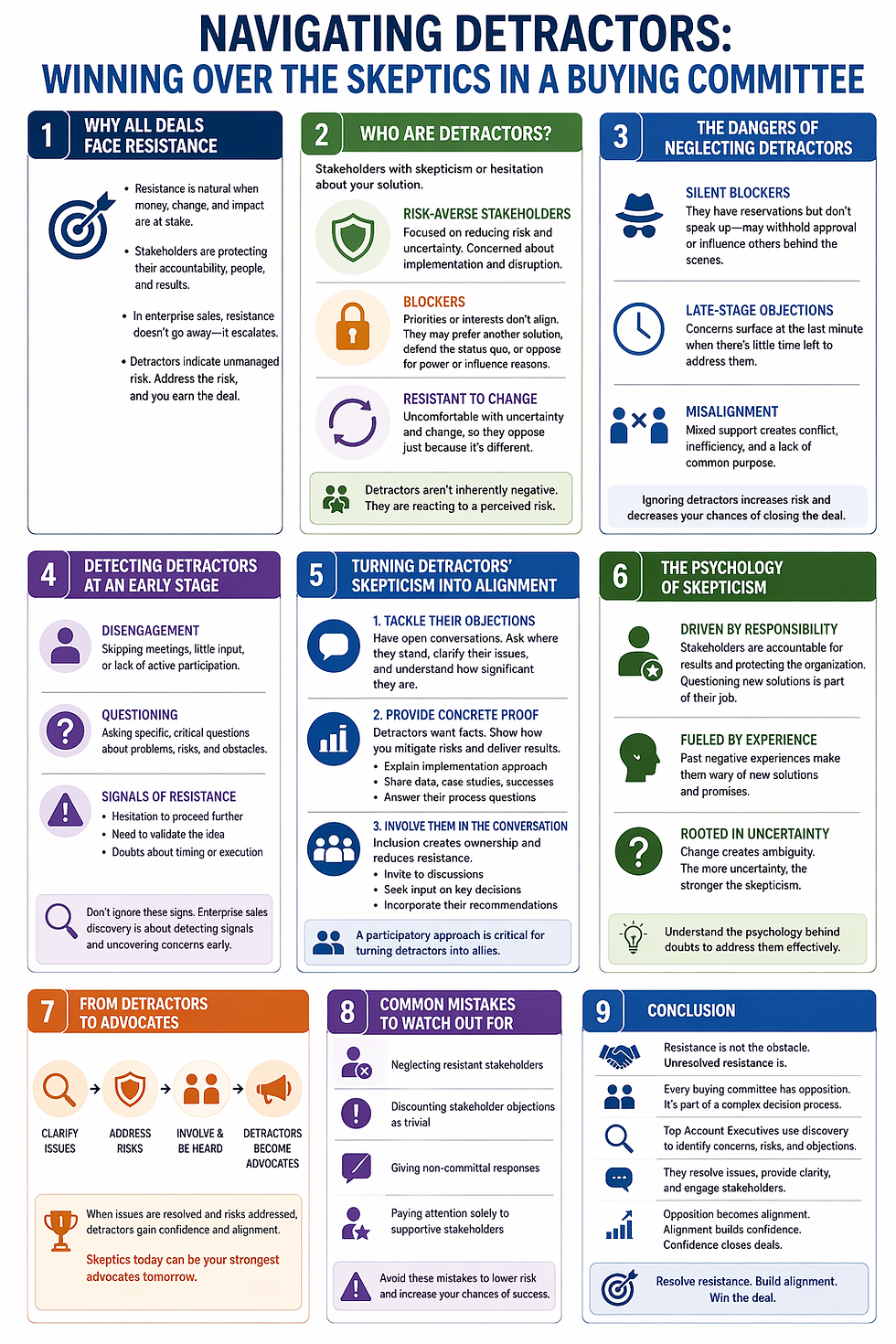
Introduction: Why All Deals Face Resistance
In any sale worth its weight in dollars, resistance doesn't signal a problem. It is a sign that something matters.
When large amounts of money, major changes, and lasting impacts are involved, it's natural for stakeholders to be skeptical. It's not enough for them to evaluate the solution; they're defending their accountabilities, their people, and their results.
Of course, in environments where big decisions have serious consequences, this makes sense.
Unfortunately, far too many salespeople take resistance as a rejection. They steer clear of tough discussions. They only talk to supportive stakeholders. And they assume that progress will overcome doubt.
But when it comes to enterprise sales, resistance doesn't go away. It escalates. Which is why learning how to deal with detractors in enterprise sales is vital.
Detractors aren't impediments to work around. They're indicators that risk has yet to be managed. And without dealing with that risk, you won't get the deal.
Who Are Detractors?
Detractors refer to the stakeholders who have some form of skepticism or hesitation when it comes to your solution.
They do not always make their opinions clear; often, they work silently behind the scenes.
Identifying your detractors is one of the initial steps to addressing them. Your detractors can be generally divided into three types.
First, they can be risk-averse stakeholders. Such stakeholders are concerned primarily with reducing any risks and uncertainties. Their concerns usually relate to implementing a solution and any disruptions that could occur from doing so.
Second, your detractors can be blockers. Such stakeholders will be those whose priorities or even interests do not align with yours. They may want different solutions, need to defend their current system, or oppose a solution for shifting the power balance within the organization.
Lastly, your detractors can be resistant to change. Change implies uncertainty, which not all stakeholders embrace. Therefore, some detractors might oppose your solution just because it means change.
What is critical to understand is that your detractors are not inherently negative. They are reacting to a perceived risk.
This understanding is key when handling detractors in enterprise sales.
The Dangers of Neglecting Detractors
Neglecting the views of detractors in enterprise sales is a very frequent and damaging error.
While ignoring skepticism might seem innocuous at first glance, it is quite dangerous. It transforms into an obstacle.
One of the dangers associated with such neglect is the existence of silent blockers. These are individuals who have reservations about the deal but do not show any opposition publicly. In addition, they might make reservations known during private discussions or hold back approval without making it clear.
As a result of this approach, their objections are harder to detect.
Another danger that arises from neglecting detractors is late-stage objections. Since their viewpoints have been overlooked throughout the selling process, detractors tend to reveal their concerns at the last minute. There will be very little time to act when this happens.
Misalignment might occur, another risk associated with this mistake.
In particular, if some stakeholders support the deal while others disagree with its terms, the company will not have a unified goal. As a result, conflict and inefficiency can arise.
Detecting the Detractors at an Early Stage
The management of detractors starts with detecting them at an early stage.
Detractors usually don't self-disclose. Rather, they disclose their position by behavior and communication patterns.
Disengagement is one of the most frequent signs of being a detractor. When stakeholders show a lack of interest in the process, they tend to skip meetings, provide little input during discussions, or have no active participation in the process.
Questioning is another sign. Questions asked by detractors are usually specific and critical. Detractors pay attention to possible problems and obstacles. Even if you don't like such questions, you can obtain essential information about your opponent's worries.
Signals of resistance are equally valuable.
Resistance is shown by:
Hesitation to proceed further
Need to check the idea for further validation
Doubts regarding timing and/or other aspects of execution
Don't ignore these signs. They are very helpful in learning about stakeholders' worries.
Enterprise sales discovery is all about detecting such signals and proceeding with your story.
Turning Detractors' Skepticism into Alignment
Managing detractors is not about removing their skepticism. Rather, it should lead to changing it to alignment. It starts by tackling their objections.
Avoiding tough conversations makes them more uncertain. Instead, you must speak to detractors openly. You need to ask questions to know where they stand. You clarify what issues they have and how significant those are.
The second thing you need to do is provide concrete proof. Your detractors want facts. They wish to know the way you mitigate risks. They also seek details on how the solution will make things work.
Such proofs could be:
An explanation of implementation procedures
Statistics or case studies on your successes
Responses to their questions regarding the process
Finally, it would help if you involved them in the conversation. People who feel left out tend to oppose ideas. Getting them involved gives them ownership. It also removes any resistance they might feel.
You could involve them by doing the following:
Inviting them to attend discussion forums
Seeking their suggestions on major decisions
Including their recommendations in the solution strategy
This participatory process is vital when dealing with enterprise detractors.
The Psychology of Skepticism
To deal with skeptics successfully, one needs to know the psychology behind their actions.
Firstly, skepticism is often driven by responsibility. As the name implies, stakeholders are responsible for certain results. They ensure the safety of the organization. Doubting innovative solutions is one of their duties.
Secondly, stakeholders' skepticism is often fueled by experience. If they had a negative experience with other products, they would be skeptical about yours.
Lastly, there is an uncertainty factor in the process. Any change causes ambiguity. Therefore, the higher the level of uncertainty, the stronger the skepticism.
Knowing the psychology behind stakeholders' doubts will help you cope with them.
From Detractors to Advocates
When handled properly, detractors will become advocates.
It is not achieved by merely persuading detractors. But by clarifying and aligning with them.
When all the issues are resolved, all the risks addressed, and the stakeholders involved feel heard, their skepticism will lessen.
In time, these detractors will go from being skeptical about the solution to advocating for it.
This is very important because when stakeholders who have been critical of the solution finally see the merits in it that is when they will be advocates.
And this is what enterprise sales hopes to achieve with detractors.
Common Mistakes to Watch Out For
Even seasoned salespeople are not immune to mistakes when handling their detractors.
Some of the most typical ones include:
Neglecting resistant stakeholders
Discounting stakeholder objections as trivial
Giving non-committal responses
Paying attention solely to supportive stakeholders
Making such mistakes will raise your risk level and lower the chances of sealing the deal.
It takes an intentional and systematic approach to avoid these mistakes.
Conclusion: Winning the Deal Is About Resolving Resistance, Not Avoiding It
In the realm of enterprise sales, resistance is not the obstacle. Resistance left unresolved is.
There will always be doubts in any negotiation process. Every buying committee consists of some form of opposition. This is part of a complicated decision-making process.
The key to success is how this resistance is handled. The most effective Account Executives don't run away from their opposition. They talk to them.
They employ enterprise sales discovery to identify concerns, potential risks, and underlying objections. They resolve those problems, give clarity, and engage the parties involved in the process.
By doing so, they convert opposition into alignment. As resistance gets resolved, more confidence is gained. More confidence brings about alignment. And once alignment occurs, deals are made. This is how deals in enterprise sales get won.


Comments