Organic Traffic: The End of an Era? The Transformation of the Search Experience: How AI Changes B2B Marketing

Introduction: The Search Click is No Longer the Goal
Traditionally, B2B marketing relied on a well-known formula: content marketing, SEO, organic visits, and lead generation from the website. The search engines were merely a gateway tool helping users find relevant websites capable of answering their questions or providing solutions.
The search process powered by AI changes the game entirely. Instead of just showing the user several links related to their query, modern AI can give a summary, an explanation, a comparison, and even recommendations without leaving the search page. Sometimes users do not need to visit several websites to find the answer, as the search experience gives enough information.
This is a new challenge for B2B marketers. It does not mean that there is something wrong with content marketing or SEO if the number of organic website visits falls. It means that a deeper transformation takes place, and it affects the whole process of searching and receiving information.

From Search Results to Direct Answers
Traditional search engines were focused on discovery. The user entered a query, got a list of relevant results, clicked on one of them, opened the website, and got more information. Website traffic thus became an obvious performance metric for a search engine.
An AI search engine works differently. AI-driven systems can analyze a user's question, synthesize all necessary information, and return it as an answer without sending the user to any other page. This allows the user to avoid browsing several pages and get information immediately in the search engine itself.
This alters the connection between search visibility and visits. It becomes possible for a brand to give information to the buyer without a direct click each time.
This is the essence of zero-click search. Users receive benefits without going through the stage that used to be the key to a marketer's success: visiting a website.
For B2B businesses, websites will still remain crucial for getting detailed information about products, examples of their usage, prices, demos, and conversions. What changes is the role of search before that.
How AI Search is Reshaping B2B Buying Behavior
B2B buyers already do substantial research into their issues before reaching out to any vendor. AI search can facilitate this research by allowing B2B buyers to ask comprehensive questions and receive synthesized results in one place.
Think about the first steps in the process of B2B buying. A potential buyer can research causes and effects, possible options, comparisons, and industry jargon before thinking about particular vendors. Typically, this involves visiting several websites.
AI search can allow the visitor to skip some of these websites because they get explanations, comparisons, and suggestions without opening each link behind them.
It means that B2B content can be valuable even if it does not result in a website visit from a buyer. Increasingly, the value of B2B content is determined not only by the fact that it got clicked by a buyer, but by the fact that it provided valuable information.
The Birth of the Zero-Click Research Process
A zero-click research process is a situation where a person can get useful information on a search or platform without clicking through to the actual website.
This is the kind of challenge faced by B2B marketers in which a prospect can come across any information relating to a company, understand the company's perspective, and remember the company's expertise without ever showing up in the company's analytics as an organic visitor.
The business implications will be seen at a later stage when the prospect actively searches for the company, goes straight to the company's website, or contacts the company in cases of urgency.
This makes visibility and recognition more critical components of B2B content marketing.
Reasons Why B2B Organic Traffic Is Becoming More Difficult to Get
There are other factors besides AI-generated answers making it difficult to capture B2B organic traffic.
Answers Generated by AI in the Search Results
AI-generated answers can synthesize the information that previously required users to navigate through multiple pages. If a search experience delivers a relevant answer right away, there will be fewer people clicking through to find out the source of the content.
That is especially true of informational searches related to definitions, explanations, simple comparisons, and preliminary research.
In other words, showing up on the first page of search results for an informational search no longer means the same amount of website traffic.
More Information Within the Search Experience
Search engines have developed additional capabilities that enable users to learn about something without immediately navigating to a webpage. The AI in search helps to take this approach one step further and allows it to answer more complex questions within the search.
This leads to a different type of connection between search visibility and website visits.
A brand can become part of the information space associated with the search but will not receive a measurable visit from each user interacting with this information. This is critical to know for B2B marketers.
Fewer Clicks Don't Automatically Equate to Less Visibility
Measuring web traffic is pretty simple. Measuring visibility in an evolving search experience isn't.
A prospective customer could come across a brand while researching something about an industry problem, read an AI-generated response that speaks to the company's know-how, or benefit from information that's connected to the brand without clicking at all.
That doesn't mean every exposure is worth money. What it does mean is that marketers need to understand that visibility doesn't equal traffic.
AI search makes that distinction crucial because the old model of going from a search result to a website is no longer assured.
What That Means for B2B Content Marketing Strategy
The emergence of AI search doesn't mean B2B brands shouldn't continue their SEO efforts or produce in-depth content. Instead, it alters the purpose of the content.
It can't be dependent on a click to deliver its core value. If the valuable insight is behind the click or buried under extraneous details, someone else will get there first.
In other words, B2B content marketers must craft content that is valuable even if it gets consumed elsewhere.
From Traffic Generation to Information Visibility
Classic SEO may include efforts aimed at attracting users to a company's website. But when it comes to using artificial intelligence for search purposes, marketers should think about making sure that information they share is relevant, helpful, and unique enough to be useful for the entire process of searching.
This means providing answers and explanations to the right questions, demonstrating expertise.
The idea here is not just to make yet another page ranked. The idea is to create something that would help a buyer see the problem more clearly.
From Teasers to Instant Value
The zero-click model also contradicts the idea of a teaser.
Marketers no longer need to tell users that the answer can be found if they follow the link. The information itself can become part of the experience. A social media post can share the lesson. Email can include the insight. An SEO article can give the answer to the question right away.
The information should stay valuable regardless of whether readers click somewhere else.
From General Information to Unique Expertise
AI-powered search makes general information easier to obtain. If thousands of sites contain basically the same explanations, an AI engine will be able to generalize this information without favoring one particular source over the others.
Thus, unique expertise becomes crucial.
Innovative studies, proprietary data, personal experience, domain expertise, unique frameworks, and insights can help B2B brands distinguish themselves among other content.
The future of search visibility thus no longer revolves around the publication of general information. The future lies in the contribution of unique information with its right to be seen and remembered.
Steps B2B Marketers Can Take Right Now
Firstly, B2B marketers must realize that organic traffic changes should be understood in the context of the bigger picture when it comes to the development of AI search engines. Not every dip in traffic means bad SEO work.
Secondly, content should be more useful. Brands should avoid dragging their audience through an introduction that leads to the key piece of knowledge only at the end of the article.
Thirdly, businesses should try to accumulate real expertise. It will provide the opportunity to create content that is worth more than a simple retelling of facts.
Fourthly, marketers can use not only websites to distribute their knowledge but also search engines, AI interfaces, professional social media platforms, newsletters, and other online environments.
The purpose of all those efforts is to create an ecosystem of content that will raise the awareness of the brand and its expertise before a customer is ready to engage with the company.
The New B2B Content Equation
A typical content process looks like this:
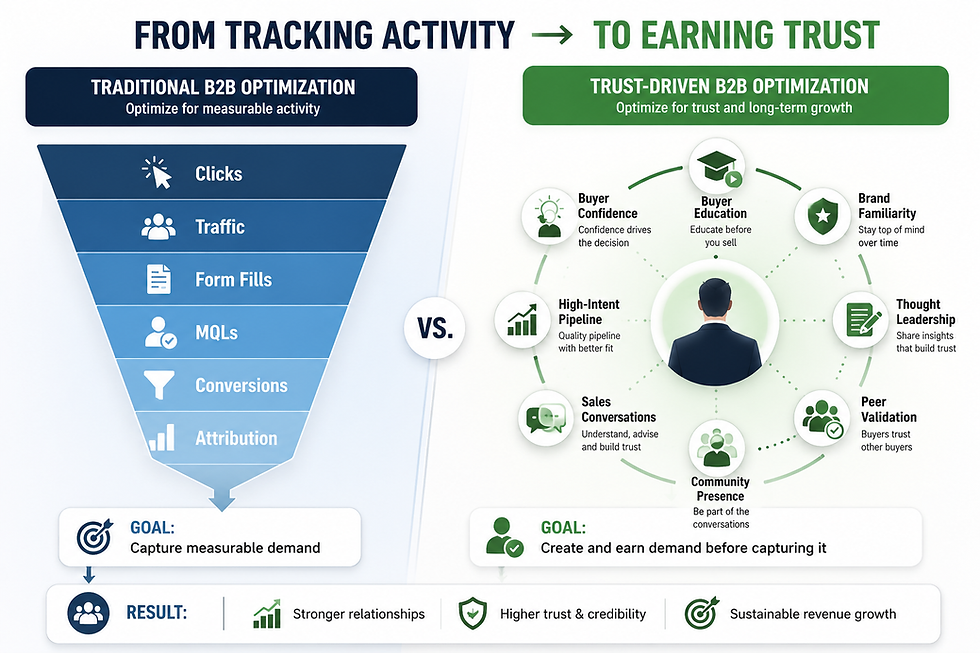
Content -> Search Ranking -> Click -> Website -> Conversion
But the above process is still relevant in many scenarios where the buyers are compelled to visit websites. But then there is AI search, which presents yet another possible scenario:
Content -> AI/Search Visibility -> Buyer Awareness -> Trust -> Future Action
While the new process doesn't render websites, SEO, and conversion meaningless, it acknowledges the fact that there could be a reduction in dependence on immediate clicks for connecting content exposure and commercial actions.
This is the basis of zero-click content, where the content forms a part of the buyer's experience as opposed to just being an invite to another destination.
In B2B marketing, the question is increasingly not just about how to get this person to our website but also what valuable information can we provide to this person now?
Conclusion: Organic Traffic is Evolving, Not Fading Away
The concept that organic traffic is simply fading away oversimplifies what is going on here. Search is moving from a system geared towards directing users to websites to one in which AI technology will be able to offer the information directly.
From the perspective of B2B marketers, this is a major paradigm shift. Decreased website sessions due to information searches do not necessarily mean that SEO and content marketing have failed but indicate changes in consumption habits.
The solution does not lie in giving up on search optimization. It lies in redefining what organic visibility looks like for brands.
Organic content should be designed not only to draw in traffic but to answer questions, show expertise, and bring value even in situations when a click never occurs. The most effective strategy would not be fully based on information that is locked behind a web link.
In the age of AI search, the goal has expanded beyond just traffic generation. It involves becoming a reliable source of valuable information regardless of the location of B2B buyers.


Comments