Red Flags in Sales Interviews: Why Complainers Make Terrible Founding AEs

Attitude Predicts Performance
Hiring top-performing salespeople involves more than simply assessing their abilities and backgrounds. It is easy to train someone to do something and learn processes, but changing their mindset is much harder. Which is why the best recruiters are very careful with how they approach candidates' attitudes during interviews.
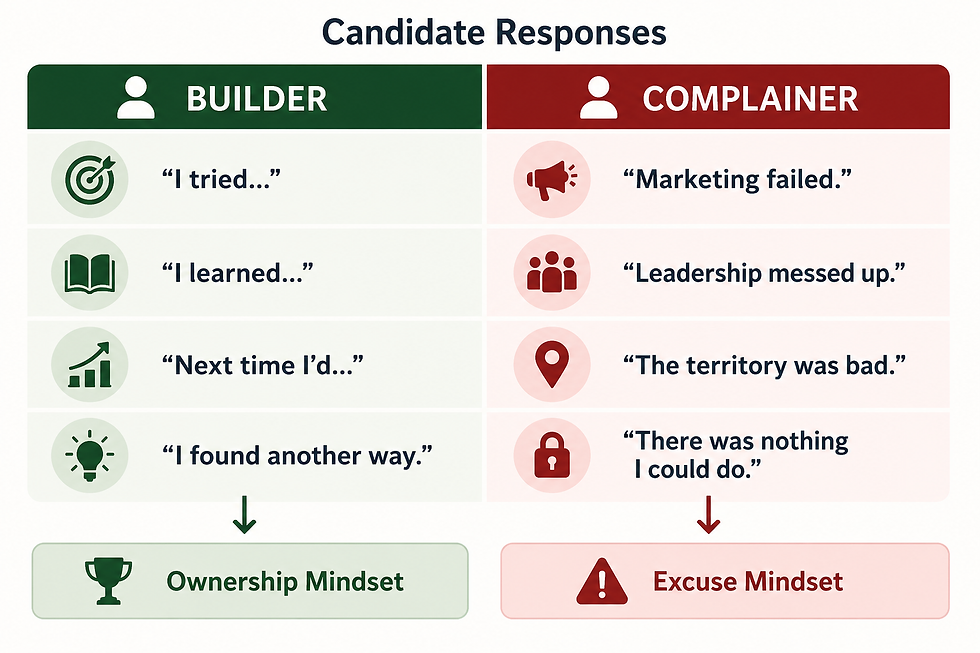
A red flag that immediately pops up is the tendency to blame things outside of themselves whenever things don't go well. Candidates who constantly complain about bad marketing, bad leadership, bad territory, bad bosses, etc., are usually masking bigger problems of owning and taking responsibility.
It is especially important to watch out for these red flags when dealing with startups.
Being a Founding AE is all about being flexible in an environment rife with uncertainty.
Why Complaining Signals Risk
How candidates talk about their experience in the past tells a lot about what they will do in the future. If candidates always like to blame people for any misfortunes, chances are that they have trouble taking responsibility for what happens. This kind of mentality makes implementation slow.
Whenever there is a problem, the complaining candidate would want someone else to solve it. Time would be wasted on explaining how unfair things are instead of figuring out ways to proceed.
Blaming is also detrimental because it discourages accountability. Those who think that everything can be blamed on external forces seldom learn how to better themselves. As a result, they won't make any progress in life.
This would eventually hamper individual and group performance. This is the reason why attitude should never be overlooked when recruiting employees.
Research published in the Journal of Business Ethics suggests that accountability is a key driver of individual and team effectiveness, reinforcing the importance of hiring people who take ownership rather than shifting blame.
Red Flags in Interviews
One of the most frequent red flags in interviews is whining about marketing issues.
When a candidate talks about falling short of quotas for the same reasons, like bad lead generation or weak campaigns, they may show that a lot of assistance is needed to succeed. Though marketing difficulties do take place, world-class sellers should never identify themselves based on those.
Criticizing leaders is also an obvious red flag. Those candidates who tend to point out how bad managers or executives were at making decisions are definitely not accountable enough. No matter what challenges occurred, winners always concentrate on the lessons gained from their experience rather than blaming someone for what happened.
Making excuses is also a serious problem during an interview. Phrases such as "My territory sucked," "It's too hard because of pricing," or "The product was at fault" could indicate that one tends to avoid their responsibilities.
The problem doesn't lie in the existence of those factors themselves. The problem is in making excuses for everything happening due to these very factors. Full-Cycle Mavericks, however, always think of other options they might have used instead.
Why Founding AEs Need Ownership
Ownership is one of the most important attributes in a seller's arsenal when it comes to startup sales. Lack of resources is something almost always present in any organization. Budgets change, processes vary, and sometimes, there are not enough people working in support departments. In this situation, sellers do not have much time to look for excuses.
Uncertainty brings more troubles. Changes occur rapidly, and many things require solutions. Founding AEs must be able to work under such conditions and continue making sales.
Finding solutions becomes their job. This is why an ownership mentality is required.
Full-Cycle Mavericks know that ideal circumstances rarely exist. What matters is focusing on the things that are within their control and adjusting to new conditions.
This enables them to function effectively without having many resources at hand. It is this mindset that sets apart builders from whiners.
How Elite Candidates Respond Differently
Superior candidates handle difficulties differently from other individuals.
Instead of blaming others, they assume the blame for whatever role they may have played. They acknowledge problems without making these problems an excuse for failing to reach the desired outcome.
This attitude leads to a problem-solving way of handling challenges.
Elite performers tend to talk about what they have done in tough situations and how they have turned those experiences into advantages. Resilience can be seen in top-notch candidates as well.
Sales professionals must know that there will always be rejections, tough negotiations, and challenging markets. Superior performers do not become despondent but keep going no matter what.
It comes out in their words. Builder says what they did. Complainer says what happened. Sometimes, recruiters learn everything they need from this.
Screening for Positive Accountability
Establishing ownership depends on the kind of questions asked.
Behavioral interviews are especially valuable, as they prompt people to share real-life situations they've been through. Asking them to describe a situation in which they didn't meet their goals or what steps they took in a challenging situation can be quite revealing regarding their thought patterns.
Even more so, scenario interviews allow recruiters to get much better insights into applicants' thought processes.
The well-known "Zero Leads" test is a good example of such an interview question. If applicants show interest in account mapping, networking, and reaching out to potential clients, then they have positive accountability. On the other hand, if they complain about a lack of marketing activities, it means that applicants don't have this type of accountability.
However, there are also some common themes that recruiters can look for.
Do applicants always talk about actions taken?
Do they share their key learning points?
Are they concerned with solutions rather than problems?
Patterns are crucial. Positive accountability is likely to recur when listening to stories told by top-performers.
Why Negativity Spreads Quickly
Just one negative employee can make quite an impression.
Whiners are infectious. Groups tend to affect each other, and employees who frequently find fault in outside circumstances can erode accountability throughout the business.
Gradually, an environment that tolerates excuses emerges, and there is reduced accountability.
Conversely, this is not the case with builders.
Constructive attitudes, accountability, and perseverance foster better cultures and higher standards. This motivates people to be accountable even during challenging times.
This is one reason why mindsets must be taken seriously as a competitive advantage.
Successful cultures are made by those who are accountable. And not those who refuse to be.
Conclusion: Builders Solve Problems, They Don't Complain
Red flags in interviews can tell you much more about candidates than resume items or quotas. Candidates who constantly complain about marketing, leadership, and even previous employers might show their inability to take responsibility, which is critical when it comes to startups. Blaming slows down progress and impedes personal development.
This is the difference between Full Cycle Mavericks.
These people are solution-focused, take responsibility for their actions, learn from mistakes, and continue to work despite hard conditions. This mindset makes these people thrive in places where others fail. Because builders do not spend time wondering whose fault this problem is, they solve it. That is why they are perfect founding AEs.



Run 3 offers an amazing combination of platform gameplay, fast reflex challenges, and creative level design. The gravity mechanics make the game feel unique compared to other runner games. It’s a perfect online game for players who love skill-based challenges!