Setting Competitive Landmines During Your Product Demonstration

Introduction
Product demonstrations for SaaS offerings within the Enterprise space are never just a neutral exchange.
Even if your competitor is not sitting in the meeting, they are still influencing the sales conversation. Buyers will compare your solution to everything else out there. They'll weigh your features up against all the other products they've looked at before.
This means every SaaS product demo is, by its very nature, a competitive event.
What sets successful teams apart is that they do not rely solely on direct comparisons or criticism of competitors. Rather, they take a more strategic approach known as competitive landmining, whereby they set traps for their competition in the course of the product demo.
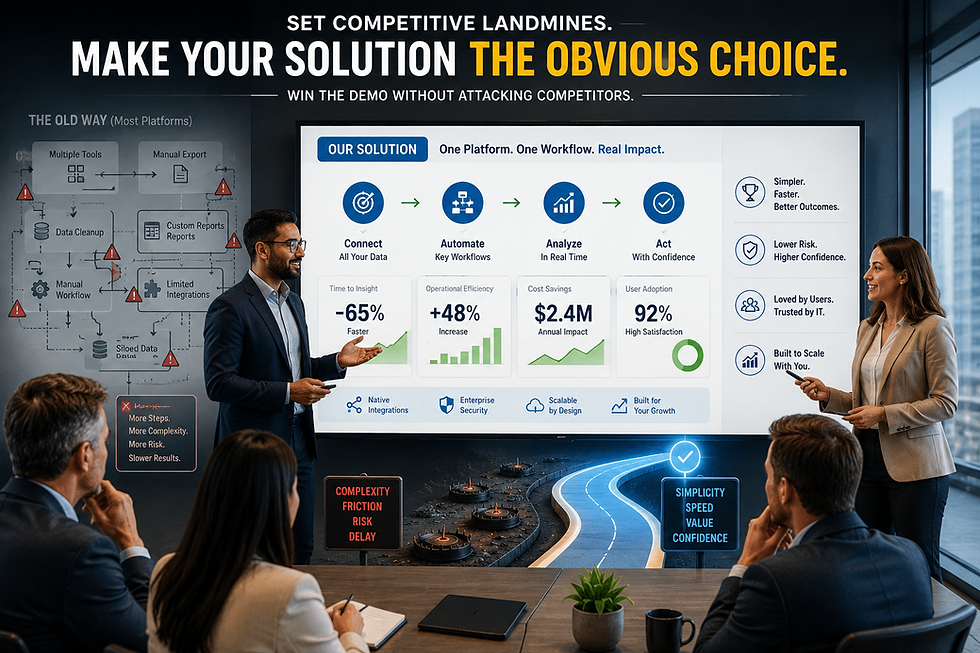
This involves setting up carefully constructed scenarios in the demo in which their product looks better than the competition without mentioning a single competitor.
The key isn't to beat down your competitors but to position yourself as the best possible choice through storytelling and framing.
Why Competitive Pressure Is Built Into Every Enterprise Demo
In the context of enterprise software sales, a buyer virtually never considers a single solution alone.
The vast majority of enterprises have formal purchasing processes which involve multiple vendors, evaluations through comparison against RFP specifications, stakeholder analysis, and analyst reports. Modern enterprise software purchases involve a highly complex B2B buying process with multiple stakeholders evaluating risk, usability, and long-term value.
Though a company may be the only competitor named at the time of a demonstration, all others will inevitably factor into the purchasing equation on some level.
What this implies is that every aspect of the demo is already being analyzed and compared in the user's mind to competing options.
Questions like these are being asked continuously throughout:
Is this easier to use than our current tool?
Is this more scalable than our current platform?
Will this simplify the process over competitors?
Competitive messaging, therefore, is inevitable.
What Are "Competitive Landmines"?
"Competitive landmines" are strategic points of positioning within a demonstration that inherently show the benefits of your offer versus the norm.
They are not overt criticisms of your competitor.
Instead, they are subtle references in which you show the common weaknesses of other solutions via context, process, or outcomes.
In essence, instead of referring to a competitor as being "too slow" or "complicated," you may show in your product demonstration how it takes multiple steps on other platforms to do something that you can accomplish in one single process.
The customer draws their own conclusion based on their observations.
Why Direct Competitor Bashing Backfires
Salespeople tend to attack competitors directly while attempting to secure their deal. This tactic is bound to fail most of the time.
Most enterprise buyers are unlikely to respond positively to negative remarks about competing companies. At times, such negativity might make people feel like the salespeople are unprofessional.
It could even turn potential customers against them and towards the competitor being attacked.
Furthermore, an attack only serves to divert the discussion away from the customer's issue at hand and onto a competition between vendors, which might not do much good for their decisions.
Enterprise-level sales rely on building trust. This can easily be destroyed by aggressive positioning.
The Psychology of Competitive Decision-Making
Enterprise customers are not only analyzing capabilities. They are managing risk.
Every decision made by enterprise customers involves operations risk, monetary risk, and risk on other levels.
As a result, customers face certain pressure to choose the least risky solution rather than the one with the greatest number of capabilities.
In turn, this means that the psychology behind the process is also important.
Customers require assurance that the chosen solution will allow them to manage risks effectively. Moreover, customers require that this choice be justified internally.
Narrative framing is so crucial exactly because of this.
Customers often see the positioning of the solution as much value-creating as its capabilities themselves. This is why personalized SaaS demos are highly effective at making solutions feel strategically aligned with buyer priorities.
Moreover, customers require that this choice be justified internally.
Narrative framing is so crucial exactly because of this.
Customers often see the positioning of the solution as much value-creating as its capabilities themselves.
Types of Competitive Landmines in SaaS Demos
There are many kinds of ways one can create a competitive contrast without mentioning a competitor in their demo.
Outcome gaps would be one of those things. They could show how particular workflows decrease inefficiency in the process and help make decisions faster.
Then, the complexity of a workflow is another thing to compare to. Old solutions often involve a lot more processes than modern ones.
The lack of flexibility when it comes to integrations is also one of the most effective contrast points in a demo. While some software struggles to integrate well with other services, others are built around it.
The scalability issue is something that can be solved using such landmines in a way that doesn't involve explicit comparison.
Another good contrast to use in a demo is time-to-value differences between various solutions.
How to Set Competitive Landmines Without Naming Competitors
Competitive positioning that does not directly mention competitors is often the most effective.
As opposed to comparing your offering against particular competitors, top salespeople make comparisons through situational storytelling and demonstration of processes.
Using phrases like "in many legacy systems" or "in some platforms, you have to perform several actions," the prospect can compare their experience or the demonstration of their competition against what is being presented to them.
The reason for this approach is that buyers tend to make their comparisons internally.
Instead of being instructed about which one is better, they figure it out from the process itself.
The Role of the AE and SE in Competitive Positioning
Successful competitive positioning involves effective coordination between the Account Executive and Sales Engineer.
The Account Executive sets the context in which the strategic story is told. They lead the discussion into business results and the criteria by which decisions are made.
The Sales Engineer enhances this story by showing the customer how the technology achieves these results.
If coordination exists between the two, then competitive landmines become automatically part of the demo without being intrusive or overly aggressive.
Coordination becomes particularly vital when dealing with objections or mentions of competitors that come up during the demo.
Common Mistakes When Trying to Outperform Competitors
Most sales teams undermine their competitive positioning efforts without realizing it due to some common mistakes.
The first one is over-emphasizing direct attacks against competitors. This makes salespeople less credible and may make them lose sight of customer concerns.
It is also a mistake to distort the abilities of competitors since even subtle mistakes can harm the credibility of salespeople if the customer knows about alternatives.
Salespeople may spend most of the presentation time emphasizing feature parity without concentrating on what customers expect to achieve.
Presentations full of technology-specific comparisons tend to confuse non-technical buyers.
And finally, failing to personalize messages according to the buyer's situation undermines competitive positioning efforts.
Using Storytelling to Create Competitive Contrast
One of the most powerful ways of creating competitive distinction is through the use of storytelling.
Elite teams do not compare or list features but rather design demonstrations based on practical processes and problems faced by organizations.
They emphasize the weaknesses in other techniques without comparing them directly.
For instance, the demonstration of how the user will accomplish an activity through an efficient process can be contrasted against other complicated processes followed by conventional applications.
In addition, stories bring theoretical distinctions into concrete terms.
Furthermore, stories prevent the focus from drifting to technical specifications.
Maintaining Credibility While Competing Aggressively
Even in the most competitive negotiations, credibility should serve as the cornerstone of all interactions.
Enterprise customers place greater importance on integrity, openness, and professionalism than on competitive positioning.
The best sales organizations exhibit confidence and objectivity. They articulate their strengths without overstating others' weaknesses. This dual strategy fosters trust.
It also guarantees that competitive positioning strengthens rather than weakens the vendor's image.
For enterprise sales, credibility can be the determining factor between competing products.
Conclusion
No SaaS enterprise demo is taking place in an ecosystem where competition thrives.
Customers are always on the lookout for other choices, comparing options, and forming a picture of the contrasts among companies. Yet, succeeding in such tests doesn't mean you have to engage in brutal rival-bashing and comparison.
The best sales professionals know how to leverage competitive landmines.
They craft stories and design workflows in such a way that demonstrates what makes their solutions better, without even mentioning rivals.
In today's market for enterprise software, the best competitive edge isn't more noise about other vendors but better stories that make your offering the obvious choice by experience rather than persuasion.
Introduction
Product demonstrations for SaaS offerings within the Enterprise space are never just a neutral exchange.
Even if your competitor is not sitting in the meeting, they are still influencing the sales conversation. Buyers will compare your solution to everything else out there. They'll weigh your features up against all the other products they've looked at before.
This means every SaaS product demo is, by its very nature, a competitive event.
What sets successful teams apart is that they do not rely solely on direct comparisons or criticism of competitors. Rather, they take a more strategic approach known as competitive landmining, whereby they set traps for their competition in the course of the product demo.
This involves setting up carefully constructed scenarios in the demo in which their product looks better than the competition without mentioning a single competitor.
The key isn't to beat down your competitors but to position yourself as the best possible choice through storytelling and framing.
Why Competitive Pressure Is Built Into Every Enterprise Demo
In the context of enterprise software sales, a buyer virtually never considers a single solution alone.
The vast majority of enterprises have formal purchasing processes which involve multiple vendors, evaluations through comparison against RFP specifications, stakeholder analysis, and analyst reports. Though a company may be the only competitor named at the time of a demonstration, all others will inevitably factor into the purchasing equation on some level.
What this implies is that every aspect of the demo is already being analyzed and compared in the user's mind to competing options.
Questions like these are being asked continuously throughout:
Is this easier to use than our current tool?
Is this more scalable than our current platform?
Will this simplify the process over competitors?
Competitive messaging, therefore, is inevitable.
What Are "Competitive Landmines"?
"Competitive landmines" are strategic points of positioning within a demonstration that inherently show the benefits of your offer versus the norm.
They are not overt criticisms of your competitor.
Instead, they are subtle references in which you show the common weaknesses of other solutions via context, process, or outcomes.
In essence, instead of referring to a competitor as being "too slow" or "complicated," you may show in your product demonstration how it takes multiple steps on other platforms to do something that you can accomplish in one single process.
The customer draws their own conclusion based on their observations.
Why Direct Competitor Bashing Backfires
Salespeople tend to attack competitors directly while attempting to secure their deal. This tactic is bound to fail most of the time.
Most enterprise buyers are unlikely to respond positively to negative remarks about competing companies. At times, such negativity might make people feel like the salespeople are unprofessional.
It could even turn potential customers against them and towards the competitor being attacked.
Furthermore, an attack only serves to divert the discussion away from the customer's issue at hand and onto a competition between vendors, which might not do much good for their decisions.
Enterprise-level sales rely on building trust. This can easily be destroyed by aggressive positioning.
The Psychology of Competitive Decision-Making
Enterprise customers are not only analyzing capabilities. They are managing risk.
Every decision made by enterprise customers involves operations risk, monetary risk, and risk on other levels.
As a result, customers face certain pressure to choose the least risky solution rather than the one with the greatest number of capabilities.
In turn, this means that the psychology behind the process is also important.
Customers require assurance that the chosen solution will allow them to manage risks effectively.
Moreover, customers require that this choice be justified internally.
Narrative framing is so crucial exactly because of this.
Customers often see the positioning of the solution as much value-creating as its capabilities themselves.
Types of Competitive Landmines in SaaS Demos
There are many kinds of ways one can create a competitive contrast without mentioning a competitor in their demo.
Outcome gaps would be one of those things. They could show how particular workflows decrease inefficiency in the process and help make decisions faster.
Then, the complexity of a workflow is another thing to compare to. Old solutions often involve a lot more processes than modern ones.
The lack of flexibility when it comes to integrations is also one of the most effective contrast points in a demo. While some software struggles to integrate well with other services, others are built around it.
The scalability issue is something that can be solved using such landmines in a way that doesn't involve explicit comparison.
Another good contrast to use in a demo is time-to-value differences between various solutions.
How to Set Competitive Landmines Without Naming Competitors
Competitive positioning that does not directly mention competitors is often the most effective.
As opposed to comparing your offering against particular competitors, top salespeople make comparisons through situational storytelling and demonstration of processes.
Using phrases like "in many legacy systems" or "in some platforms, you have to perform several actions," the prospect can compare their experience or the demonstration of their competition against what is being presented to them.
The reason for this approach is that buyers tend to make their comparisons internally.
Instead of being instructed about which one is better, they figure it out from the process itself.
The Role of the AE and SE in Competitive Positioning
Successful competitive positioning involves effective coordination between the Account Executive and Sales Engineer.
The Account Executive sets the context in which the strategic story is told. They lead the discussion into business results and the criteria by which decisions are made.
The Sales Engineer enhances this story by showing the customer how the technology achieves these results.
If coordination exists between the two, then competitive landmines become automatically part of the demo without being intrusive or overly aggressive.
Coordination becomes particularly vital when dealing with objections or mentions of competitors that come up during the demo.
Common Mistakes When Trying to Outperform Competitors
Most sales teams undermine their competitive positioning efforts without realizing it due to some common mistakes.
The first one is over-emphasizing direct attacks against competitors. This makes salespeople less credible and may make them lose sight of customer concerns.
It is also a mistake to distort the abilities of competitors since even subtle mistakes can harm the credibility of salespeople if the customer knows about alternatives.
Salespeople may spend most of the presentation time emphasizing feature parity without concentrating on what customers expect to achieve.
Presentations full of technology-specific comparisons tend to confuse non-technical buyers.
And finally, failing to personalize messages according to the buyer's situation undermines competitive positioning efforts.
Using Storytelling to Create Competitive Contrast
One of the most powerful ways of creating competitive distinction is through the use of storytelling.
Elite teams do not compare or list features but rather design demonstrations based on practical processes and problems faced by organizations.
They emphasize the weaknesses in other techniques without comparing them directly.
For instance, the demonstration of how the user will accomplish an activity through an efficient process can be contrasted against other complicated processes followed by conventional applications.
In addition, stories bring theoretical distinctions into concrete terms.
Furthermore, stories prevent the focus from drifting to technical specifications.
Maintaining Credibility While Competing Aggressively
Even in the most competitive negotiations, credibility should serve as the cornerstone of all interactions.
Enterprise customers place greater importance on integrity, openness, and professionalism than on competitive positioning.
The best sales organizations exhibit confidence and objectivity. They articulate their strengths without overstating others' weaknesses. This dual strategy fosters trust.
It also guarantees that competitive positioning strengthens rather than weakens the vendor's image.
For enterprise sales, credibility can be the determining factor between competing products.
Conclusion
No SaaS enterprise demo is taking place in an ecosystem where competition thrives.
Customers are always on the lookout for other choices, comparing options, and forming a picture of the contrasts among companies. Yet, succeeding in such tests doesn't mean you have to engage in brutal rival-bashing and comparison.
The best sales professionals know how to leverage competitive landmines.
They craft stories and design workflows in such a way that demonstrates what makes their solutions better, without even mentioning rivals.
In today's market for enterprise software, the best competitive edge isn't more noise about other vendors but better stories that make your offering the obvious choice by experience rather than persuasion.


Comments