Social Media Buzz Weekly: Roundup of Social Media Updates

Welcome to Social Media Buzz Weekly, your weekly bulletin of the latest social media updates. With the social media landscape evolving with each passing day, it can be challenging to keep a tab on the rapid developments. Well, not anymore, as we have taken it upon ourselves to keep you abreast of every happening in the social media space.
So, without any further ado, let’s look at some of the most significant developments from the last week in the world of social media.
1. Meta Expands Access to AI Business Assistant
Meta has announced an expansion of its Meta AI business assistant to advertisers and agencies across major global markets, with local language support across the U.S., EMEA, the Asia-Pacific region and Latin America.

The expansion will enable more Meta business partners to access its latest artificial intelligence tools in order to guide their business process. The update features enhanced support for more creators and helps improve the value and viability of the tool. Meta launched its AI assistant within Meta Ads Manager last year as a means to provide immediate answers to questions relating to business performance in Meta’s apps. That will help businesses resolve common issues quickly, without having to wait for a human Meta staff member to respond, and without having to trawl through the Meta help noticeboards to find answers.
2. Meta Accounts Center Now Includes More Apps and Devices
Meta announced an update to its Accounts Center, the centralized management platform for all users’ accounts. Now, Meta is adding Threads profiles, AI glasses accounts and other Meta-related products, making it easier to manage everything in one place.

Meta Accounts Center already enables users to manage their Facebook, Instagram, Messenger and WhatsApp login details and account management tools in one place. The update will also incorporate additional products such as Meta AI and Meta Quest headsets. The update aims to streamline account management and access across apps, while the centralized control tools will enable users to manage their security and content controls in a centralized location. This could be especially valuable for parents because it will make it easier to oversee teens’ supervised accounts without having to switch between apps.
3. Meta Will Let Parents See Their Teens’ AI Queries
Meta announced an update to its teen supervision tools, which will now enable parents to view what their kids are asking its artificial intelligence chatbot.

The update was included as a new element in Meta’s Family Center tools, allowing parents to access a list of their kids’ Meta AI queries. Meta said that these topics are automatically categorized by AI, so the list provides a fairly broad overview of queries, rather than specific details. The idea is that this will give parents some level of transparency, in case their kids are researching areas of concern. Meta’s new AI chatbot insights are now available for parents supervising Teen Accounts in the U.S., U.K., Australia, Canada and Brazil, with further expansion coming soon.
4. China Blocks Meta’s Manus Acquisition
Meta could be forced to divest Manus, the artificial intelligence platform that it acquired in January, after China’s National Development and Reform Commission ruled that the acquisition is invalid, and must be reversed.

This ruling comes despite Meta having already incorporated Manus’ tools into its ads platform. Meta acquired Singapore-based Manus in January as part of a $2 billion deal. Since then, Meta has integrated Manus’ agentic AI tools into its ad creation process, as another means to help advertisers maximize their ad performance and better understand opportunities. While Manus is based in Singapore now, the company was founded in China. As such, the business entity still comes under China’s tough cybersecurity laws, which include review of any foreign investment.
5. Meta Announces Plans to Collect Solar Energy in Orbit
Meta has announced a partnership with Overview Energy for the development of a plan to collect solar energy in orbit, reducing downtime for solar power collection.

The new approach will facilitate constant solar power connection, maximizing power output, and boosting the capacity of solar energy approaches. The concept is similar to the orbital data centers being proposed by SpaceX, which, instead of bringing that solar power to Earth, would put the data centers themselves in space, in order to maximize the sun’s output. Meta’s proposal seems more viable, utilizing the current infrastructure, which, as Meta said, could see it come online faster, helping to power its AI projects without sucking power supply from the consumer grid.
6. EU Commission Says Meta’s Age Restriction Systems are Inadequate
Meta may face another big fine in the EU, after the European Commission announced the preliminary findings of its investigation into the company’s efforts to keep young users out of its apps.

The commission’s findings said that Meta’s current age checking and detection systems were inadequate and failed to meet obligations under the Digital Services Act. The potential penalty in this case could be up to 6% of the company’s total worldwide turnover. Meta will now have an opportunity to respond to the findings and explain its position. The European Commission said that Meta’s measures do not adequately prevent minors under the age of 13 from accessing their services nor promptly identify and remove them, if they already gained access.
7. Meta Assists FBI in Major Scam Center Crackdown
Meta assisted the FBI in an operation that resulted in the arrests this week of at least 276 people involved in an online scam operation. U.S. law enforcement worked with police across various jurisdictions to take down a network of at least nine scam centers contributing to a range of illegal activities.

As reported by the U.S. Department of Justice, Meta was among several groups that contributed to the operation, with the social media giant providing critical information leading to the arrests. The operation was led by the Dubai Police, who undertook the majority of the arrests. The DOJ said the initial investigation was led by the FBI after identifying multiple companies and individuals managing scam compounds conducting cryptocurrency investment fraud schemes.
8. Meta’s Daily Active User Count Declined in Q1 2026
Meta has published its Q1 2026 performance update, which revealed that its daily active user count dropped for the first time ever in Q1, with 3.56 billion using its apps in the period.
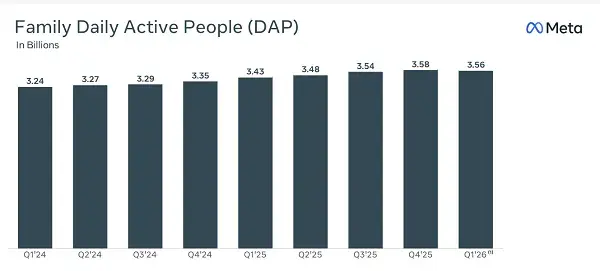
Meta, despite adding more opportunity to gain users through new apps like Threads and its Meta AI app, actually saw a decrease in usage in the period. Meta said that the decline was driven by internet disruptions in Iran, as well as a restriction on access to WhatsApp in Russia. Russia has banned WhatsApp, as well as many other messaging apps, as it looks to force users to use its state-owned messaging tool instead, while Meta may also have lost some users in Australia due to its new teen social media restrictions.
9. Meta Launches AI Ad Connectors That Work With Outside Chatbots
Meta is looking to make it easier for brands to utilize their preferred artificial intelligence tools to power ads approaches. The platform’s new set of AI connectors will enable external providers to plug Meta ads data into another AI system, in order to help drive improved campaign performance.

That means that if a brand or agency has integrated Claude or ChatGPT as their AI tool of choice, they’ll now be able to feed Meta ads data directly into the chatbot so they can pose more specific account queries using these tools. Meta’s AI connectors will facilitate enhanced reporting on campaign performance, and provide expanded Meta ad management capacity, all of which users will be able to activate via natural language comments. The tools will also enable ad partners to generate product catalogs, using a business’s existing product data to enhance their Meta ads display.
10. TikTok Adds Campus Hub Feature for US College Students
TikTok has announced an expansion of its student connection options in-stream, which will provide more ways for verified students of U.S. college campuses to stay in touch with the latest trends among alumni, as well as engage with local events and opportunities.

Utilizing TikTok’s Campus Verification feature, which enables students to verify their student status via third-party provider Unidays, TikTok’s new Campus Hub display will showcase college group chats and content feeds, which are designed to help college students stay connected to campus communities. TikTok’s college groups will enable campus-verified students to create and join group chats with up to 300 classmates, while its college feed option will provide students with a personalized feed that surface content posted by verified students and content related to their university.
11. TikTok Lets Users Add Relevant Keywords to Metadata
TikTok has added a new way to help creators manage how their videos are discovered in the app. The update enables creators to add and remove keywords assigned to their clips, which can help better align their content with user searches.

TikTok will still maintain oversight over any suggestions, so creators don’t add non-relevant terms to their videos. But it could provide another means to guide TikTok algorithms in matching content with audiences. It could be valuable to provide manual input into key terms, and this option could help expand audience reach and relevance. Users can also use TikTok Trends to research relevant terms that match their content.
12. Meta Expands Instagram Management APIs
Meta has announced updates for Instagram’s APIs, giving third party social media management platforms more capacity to facilitate platform posting and analysis.

First, Meta has added support for its partnership ads label in the Instagram Content Publishing API. The change will enable third-party platforms to publish organic posts with a paid partnership disclosure label directly at publish time. Meta has also added new metrics to the Instagram Graph API in order to give developers a more complete and accurate picture of content performance. Moreover, Meta has added aggregated metrics for views, likes and comments, which will combine data across all placements where content appears, including Instagram, crossposted Facebook, and boosted media. That will give marketers access to more info on total views, likes and comments.
13. Instagram Brings Simplified AI Video to Edits
Instagram is making it easier to use its latest artificial intelligence tools to generate video clips, via a new integration with Edits that will enable users to generate video posts from text prompts in-stream.

The explainer details how users can tap on the plus icon, then the AI option, in order to generate a video clip using various inputs. The update will make it easier for users to create whole video clips, without needing to record any video themselves, which could facilitate all new creative trends in the app. Meta is intent on getting more people to try its generative AI tools, which makes sense, since the company is actively investing hundreds of billions of dollars into the development of AI technology.
14. Instagram Updates Algorithm to Benefit Original Creators
Instagram has announced a major algorithm update that could have a significant impact on content reach in the app. It is implementing a new system that will no longer recommend photos and carousel posts from aggregator accounts within Explore and other surfaces.

Instagram will now give original content higher priority, while penalizing the reach of re-posting profiles that can sometimes end up generating even more traction than the original. The update is an expansion of the system Instagram implemented for Reels in 2024, which has already driven significant reach benefits for creators. Instagram further noted that the update will not change how it displays content to followers of an account. This update will also not impact a set of publishers we’ve identified who have licensing agreements and/or explicit permissions from content creators.
15. Snapchat Launches Loyalty Badges for Snap Map Locations
Snapchat added a new feature designed to encourage repeat visits to locations listed on the Snap Map with the app’s place loyalty badges, which celebrate the places each user visits most frequently.

The loyalty badges will showcase places on a map where a user is the top visitor, based on activity, which could make this another competitive, compulsive in-app feature, similar to Snap Streaks. Snapchat will award gold, silver and bronze badges for the top visitors to key locations, showcasing the people who regularly return to the same spot. These badges will not be publicly viewable on the Snap Map, but will instead only be displayed to individual users. However, top visitors will be able to generate a shareable sticker they can post in the app in order to showcase their leadership positions.
16. Snapchat Launches Sponsored AI Chatbots
Snapchat has launched a new kind of ad that will bring sponsored artificial intelligence chatbots into users’ inbox and let users talk to the promotional bots in-stream. The new option is an extension of Sponsored Snaps, with the custom branded AI chatbots to appear among the ad recipient’s other Snaps.

Snapchat users will be able to talk to the chatbots using suggested prompts and ask follow-up questions to learn more about the brand and products. This could be somewhat risky, in that these promotions will be intrusive, within Snap DMs, where users may not like being disrupted by promotions. But Snap said that bringing these chatbots into the flow of everyday conversation will make the interaction more immediate, personal, and useful.
17. Pinterest Launches Connected TV Ad Placement via tvScientific
Pinterest has announced the first step in its expanded connected TV push via tvScientific, with Pinterest ad partners now able to extend their campaigns to consumers’ home TV sets through enhanced CTV placement.

Pinterest acquired tvScientific in December. The performance ad platform is specifically designed for connected TV sets via streaming content, and Pinterest advertisers will now have the capacity to expand their promotions via these ad spots. These enhanced placements and targeting options could be a powerful complement to Pin campaigns. Pinterest said that on average, when tvScientific AI is enriched with Pinterest’s high-intent signals, it leads to a +27% increase in outcomes driven per $100 in spend, with purchases up +65%.
18. X Introduces Topic-Based Custom Timelines
X has launched a Custom Timelines option, which will enable X users to pin topic-based feeds to their home tab, and could potentially help expand usage behaviors.

The new Custom Timelines option will allow X users to choose from lists built around 75 of the most discussed topics in the app. They’ll then be able to add those topics as alternative feeds that they can swipe to in-stream. X’s Head of Product Nikita Bier said this is one of the biggest changes the app has undergone, although it seems very similar to the swipeable topic feeds that Twitter experimented with in 2019. Both features provided another means to engage with a broader range of topics in the app.
19. X Officially Launches X Chat
X has launched its separate X Chat app, providing a dedicated home for X DMs, as well as a new way for users to engage outside of the main app.

The X Chat app is now available for iOS, which X is promoting as having no ads and no tracking. X has had several issues in its development of end-to-end encryption, with various researchers highlighting potential vulnerabilities and flaws in the system X is using. In November last year, software engineer David Nepozitek published an overview of X’s encryption system on his blog, and outlined several security flaws with the process. However, potential security issues aside, the new X Chat app will provide another way for X users to access their DMs, and engage with each other in a separate forum outside the main X app.
20. X Introduces Rebuilt AI-Powered Ad Platform
X has announced the launch of its rebuilt ad platform, which will now utilize the latest artificial intelligence models from xAI to power improved targeting and performance for campaigns.
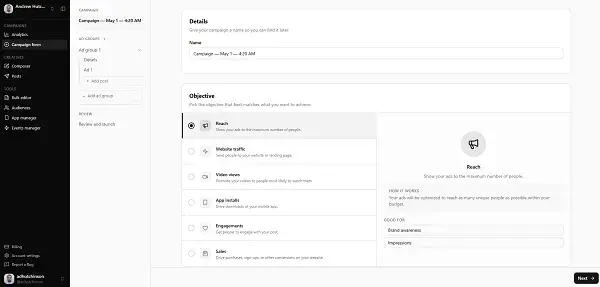
The updated ad platform is built around three core pillars: simplicity, control and improved ad performance, driven by enhanced AI relevance matching. X said its reformed ad platform is the biggest ad system update in the company’s history, “reflecting the boldness and speed of innovation that defines both X and xAI. X has been working on this updated approach for some time. Digiday reported that X’s owner Elon Musk told prospective ad partners in August 2025 that xAI’s Grok system would eventually enable full advertising automation on the platform. As per Digiday, Musk made the claim on an X Spaces live chat, in which he also claimed that Grok would be able to assess content for brand safety.
21. LinkedIn’s New Tool Lets You Test the Outputs of Various AI Models
LinkedIn is trying out a new tool that enables users to try out the latest artificial intelligence models from various providers, as a means to “taste test” their outputs, and find the best AI tool for their needs.

LinkedIn’s Crosscheck is designed to help users find the right AI tools for their needs, while also feeding relevant information back to AI developers. Crosscheck, which is now live for LinkedIn Premium members in the U.S., enables members to try out the latest models from OpenAI, Anthropic, Google, Microsoft and others, all in one source. Within Crosscheck, Premium users can share any prompt, which will then be matched with the various AI tools that Crosscheck can access. The system will then provide two responses from different AI tools, without identifying which models were chosen, and users can then rate those responses for quality.
22. LinkedIn CEO Transitions to New Role Focused on AI Development
After holding the role for the last six years, LinkedIn CEO Ryan Roslansky announced he’s stepping down in order to take on a new position focused on artificial intelligence transformation within parent company Microsoft.

Roslansky oversaw a period of solid growth for LinkedIn after taking over the role from Jeff Weiner in 2020. Since then, LinkedIn has continued to grow its ad business and expand its global footprint, though over the last year or so, Roslansky has been increasingly focused on AI. That pivot even resulted in him publishing a book on how AI will impact the workforce. Now, Roslansky will make AI his primary focus. Like most of the staff at LinkedIn, and Microsoft more broadly, Roslansky is betting on AI being a transformative technology that will change the way that people live, and more importantly work, on a broad scale.
23. LinkedIn Adds Option to Filter Replies by Verified Users
LinkedIn is looking to add another incentive to get people to verify their information, by enabling users to prioritize engagement from verified users. An updated page in LinkedIn’s Help Center outlines how users can sort comments by verified users, in order to focus on those who’ve confirmed their info.

Unlike Meta or X, LinkedIn verification is available free of charge, with users able to confirm their ID via third-party support partners, by sharing their government ID info. LinkedIn reported in December that more than 100 million members had verified their identity in the app. The platform said it added an additional layer of trust and helped to combat spammers and bots. Now, LinkedIn appears to be looking to make verification a bigger focus.
24. LinkedIn Expands Off-Platform Event Promotions
LinkedIn has added another element to its Event Ads, with brands now able to promote off‑platform events. This update will allow brands to use LinkedIn’s on-platform event ads tools for non-LinkedIn events, providing additional promotional potential.

LinkedIn said its expanded event promotions will enable marketers to promote any event type, including webinars, field events and hybrid experiences on external platforms. This means that off-platform event promotions will now be able to use the Event Ad format, which includes event‑based CTAs, accelerated delivery and lead gen objectives. According to LinkedIn, this will give promotions more relevance and intent in the app.
25. Turkey Passes Bill to Restrict Social Media Access For Under-15s
Turkish lawmakers have passed a bill that includes restricting access to social media platforms for children under 15. The legislation is the latest in a global trend to protect young people from dangerous online activity.

Its passage came a week after a 14-year-old boy killed nine students and a teacher at a middle school in Kahramanmaras, southern Turkey, in a gun attack. Police are investigating the online activity of the perpetrator, who also died, in a bid to uncover his motivation for the attack. The bill will force social media platforms to install age-verification systems, provide parental control tools and require companies to rapidly respond to content deemed harmful, the state-run Anadolu news agency said.
26. Sweden Targets Social Media Giants Over ‘Murder Adverts’ Recruiting Children
Sweden’s government has said that it plans to introduce legislation requiring social media platforms like TikTok and Snapchat to take down criminal gangs’ ‘murder adverts’ within an hour or face hefty fines.

Criminal gangs active in Sweden increasingly use social media to recruit people to commit murders and other violent acts amid a surge in “crime as a service”. The recruits are often children under the age of 15, Sweden’s age of criminal responsibility, meaning the youngsters cannot be prosecuted and fall under the responsibility of social services, making them valuable assets to the gangs.
27. Gaming Platform Roblox to Require Facial Scans for Users Under 16 in Indonesia
Roblox, a gaming platform popular with kids, has announced that children under 16 in Indonesia will be required to undergo facial scans to verify their age to comply with new restrictions on minors’ use of social media and digital platforms in the country.

Nicky Jackson Colaco, Roblox’s vice-president and global head of public policy, announced the changes in a press conference in Jakarta, describing them among the strictest that the company has implemented anywhere in the world. She said the company has introduced tailored, age-based accounts in Indonesia: Roblox Kids for ages 5 to 12 with no chat features and Roblox Select for ages 13 to 15, with chat features limited to parents or approved family and friends.
Wrapping Up
And that was a wrap of this week’s Social Media Buzz. We’ll be back next week with more news and updates for you from the social media world. Till then, stay tuned!
If you want to read more on the latest developments taking place in the social media space, take a look at ClickInsights’ Social Media Buzz, wherein we bring to you monthly reports on everything going on in social media, ranging from platform updates to policy changes that influence the way we market.


It’s fascinating to see how AI and regulatory shifts are reshaping every major social platform, and tools like fontstylegenerator even let creators tweak their content vibe to match these fast-changing trends.