Stop Putting Prospects to Sleep: How to Deliver Engaging Virtual Demos

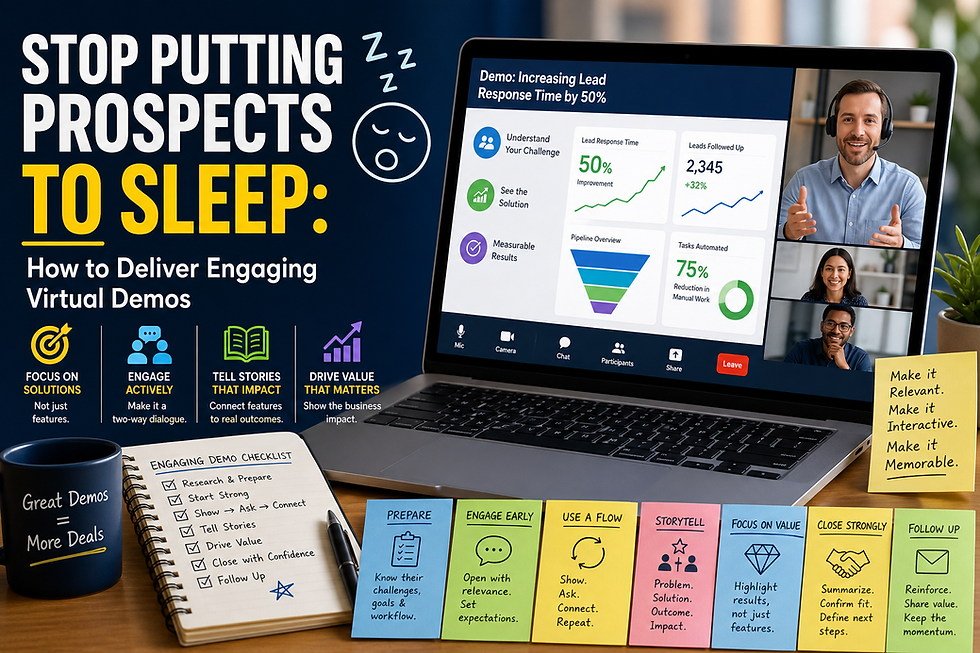
As technology advances, virtual demos become more prominent in today's sales practices. Irrespective of whether you sell SaaS, services, or complicated solutions, a demonstration may be the key to deciding on next steps – the prospect either moves further or loses interest entirely. But, despite their importance, virtual demos often suffer from the same issue – boredom.
With remote selling, a lot of things change, including the audience's attention span. While in-person meetings allow building rapport and engagement through subtle non-verbal cues, in virtual environments, this connection needs to be established much faster. Moreover, since prospects tend to juggle between multiple tasks or attend several meetings at once, if the presentation lacks engaging elements, you lose their interest almost right away.
This is why any sales or customer success professional needs to understand how to create an engaging virtual demo that can drive conversions.
But how do you make virtual demos engaging? Here is what you need to know.
Why Most Virtual Demos Do Not Work
Most virtual demos do not work not because of poor products, but because of lousy presentations. While most salespeople concentrate solely on demonstrating all features of a certain product, it does not mean prospects have gathered just to see what it is about. Actually, prospects gather to learn whether this product will solve their issues.
What is wrong with most virtual demos? First of all, they turn out to be nothing but an endless flow of information from a salesperson to prospects without any feedback. Second, virtual demos involve people who usually cannot pay much attention to anything for long.
Finally, virtual demos often involve too many features and information at once, which leaves prospects confused instead of being enthusiastic. Information overload leads to confusion, which in turn leads to slow decision-making.
The bottom line here is simple regardless of how great your product may be, virtual demos can still kill your deal.
Change Your Perspective: From a Presenter to a Solution Provider
If you want your virtual presentation to be improved, start by changing your mind. Instead of being a presenter who tells what the tool does, become a problem solver who leads a customer to a solution.
It will influence the structure of your demo from beginning to end.
Instead of saying, “Let me show you what my product can do,” you shift to asking, “How can I help this prospect overcome the challenge they’re facing right now?”
The focus on solutions makes you stay away from talking about features. Customers don't buy products; they buy solutions. For instance, a CRM system won't interest a customer just because of the dashboard it has. Its value will depend on helping a team sell better, automate more tasks, or send follow-ups faster.
This perspective will make your demo much more valuable.
Preparation Is the Foundation of an Engaging Virtual Demo
Great demos don't begin when you're on the call. Great demos begin with preparation, which is what makes them so unique.
When preparing any demo, there are several things to consider:
Main challenges of the prospect
Current workflow of the prospect
Goals of their company
Pain points of the prospect
This way, you can prepare your demo according to these factors rather than preparing the same old demo each time.
For instance, if your demo is being attended by a marketing manager who finds it hard to convert leads, make sure your demo centers around improving conversions.
Another thing that needs to be done before the call is setting expectations. Sending a brief agenda ahead of time will allow prospects to prepare better.
As a result, a good demo will seem like a conversation rather than a presentation.
The First Five Minutes Make or Break Everything
Your opening lines in the virtual demo are critical in the whole process. Once you lose them at the start of the call, regaining their interest will become quite challenging.
You should not open with introductions or lengthy explanations, but should begin with relevance.
An example of an opening line is,
“Given the challenges you mentioned with lead follow-ups, I’ll show you how this platform helps teams reduce response times by up to 50%.” In addition, I will explain how it would integrate with your existing work process."
With the above lines, you will do three things:
Demonstrate that you understand their challenges.
Set a clear expectation regarding the demo.
Generate curiosity.
Alternatively, you could ask a straightforward validating question such as,
“Is this aligned with what you were hoping to see in this demo?”
These lines help engage the customer early and turn the session into a two-way dialogue.
Use a Structured, Engagement-Driven Demo Flow
To conduct an effective virtual presentation, one tip would be to minimize the monologues and use interaction loops. The most effective technique would be the "Show → Ask → Connect" method.
In this case, you start by showing something. You ask a related question and conclude by making a connection between your presentation and prospects' circumstances.
For example:
Show: Show how you assign leads automatically
Ask: “How do you currently assign leads to your team members?”
Connect: “That would remove unnecessary steps and speed up the follow-up process.”
Such an interaction pattern allows keeping your prospects actively engaged through your demonstration.
By breaking down your demonstration into short sections, you can prevent your prospects from getting mentally overloaded.
Transform Your Features Into Stories With Impact
Among the best approaches to improving virtual demos is storytelling. Stories have a much greater retention rate compared to a list of product features.
Rather than telling what the feature does, show how it has made life easier for an actual customer.
For instance, rather than stating:
"Our platform supports automated reporting."
It would be better to state:
"A sales team that we were working with was wasting over 10 hours each week preparing reports manually. With our platform, they were able to automate their workflow and save 10+ hours weekly, which allowed them to focus more on closing deals."
Such storytelling not only personalizes your demo but also makes it more emotionally engaging.
Here's a simple formula that you can follow when crafting your story:
Problem: What challenge was the client facing?
Solution: How was it resolved with your product?
Outcome: What positive results were achieved?
Turn the Prospect into an Active Party
The major distinction between regular and great virtual demos is interactivity. If prospects are passive participants in a demo, they will soon lose their attention.
Therefore, you should actively involve the prospect through the means of asking questions and receiving feedback throughout the demonstration.
Some basic questions may be as follows:
"Does this fit with your existing process?"
"Where do you think this step belongs within your workflow?"
"What do you think about this approach?"
This way, your demo turns into a dialogue rather than a monologue, making it easier for you to engage prospects and keep their attention focused.
If certain aspects are irrelevant for them, skip them. Otherwise, elaborate on everything relevant to them.
How To Re-Engage If Attention Dips
Even the most well-prepared virtual demonstrations will have periods where attention wanes. You may be able to see this in terms of silence on the line, brief replies, or other signs of lack of engagement from the prospect.
If this occurs, it is vital that you engage again rather than continue with your presentation as planned.
This can be done by:
Posing a direct question
Moving on to a relevant use case
Presenting a quick success story
Discussing an impactful business benefit
For instance, saying "I'm going to show you how one of your competitors successfully tackled this problem" can immediately capture the audience's attention once again.
Shift Focus from Features to Value
Another principle that should be considered while conducting virtual selling activities is that features do not win any sales; value wins.
While presenting features, the presenter needs to associate them with results, such as:
Time saving
Increase in income
Elimination of manual efforts
Efficiency increase
Some examples of a valuable statement would include:
"This feature decreases manual efforts, resulting in a three times faster response rate."
When customers understand the effect that your offer will have on their business processes, they become highly motivated to act.
Close Virtual Demos Strongly
Another common mistake made by sales professionals is related to the way in which virtual demos are closed. Questions like "What do you think about it?" or "I will contact you later" leave room for doubt.
Closing must always be done strongly, starting with an overview of what has been said throughout the demo. Follow up with a clear question, such as:
"How do you find our discussion? Does it make sense to continue with this?"
It guides the customer in a non-aggressive way through the decision-making process. Define the next steps after the meeting.
Follow-Up: Where the Deals Get Made
Your efforts don't cease after you conduct the virtual demo; in many cases, they don't even begin there! Follow-up often makes or breaks the deal.
In a good follow-up email, there should be:
Summary of discussion points raised
Relevant resources, such as case studies
The next course of action
The personal touch is also very important. Mentioning the demo discussions indicates that you paid attention and are reliable.
Timely follow-up can keep things moving in the right direction as well.
Conclusion: Transform Virtual Demos into Sales Machines
Great virtual demonstrations do not need fancy slides or numerous functionalities. Instead, they require clarity, engagement, storytelling, and relevancy.
As soon as you change your perspective from showcasing something to solving problems, you automatically become better at conducting conversations. With proper preparation, early engagement of prospects, effective demo flows, and a focus on value, you will be able to turn your virtual presentation into an efficient sales engine.
In the modern digital age, being able to conduct engaging virtual demonstrations is a valuable asset that will set you apart from your competitors. Salespeople who are adept at giving engaging virtual demos will have no trouble holding their prospects' attention and closing more deals.
Call-to-Action
For anyone that wants any further guidance, ClickAcademy Asia is exactly what you need. Join our class in Singapore and enjoy up to 70% government funding. Our courses are also Skills Future Credit Claimable and UTAP, PSEA and SFEC approved. Find out more information and sign up here. (https://www.clickacademyasia.com/sales-mastery-for-nurturing-leads-and-closing ).


I’ve been seeing jalwa game mentioned here and there, so I decided to read a bit about it. The basic information was enough to clear up a few things I was wondering about.
This was a very useful read. The balance between useful information and readability is excellent. Many resources cover similar topics, but few manage to present them this naturally. Not long ago I discovered https://proshtuchnyiintelekt.com/, and the practical approach reminded me a lot of what you're doing here. The practical nature of the content makes it much more valuable than many similar articles online. Looking forward to reading more from you.
I enjoyed reading this. I honestly didn't expect to spend so much time on it, but the way everything is explained makes it surprisingly engaging. Many resources cover similar topics, but few manage to present them this naturally. I recently came across https://101pryvitannia.com/ while looking for additional ideas, and I had a similar impression there. What I appreciate most is that both resources focus on helping people in real situations rather than just filling space with generic advice. Looking forward to reading more from you.
Thanks for sharing this. The topic is presented in a very clear and approachable way, which makes it easy to stay interested. While reading, I was reminded how difficult it can be to find good examples and practical ideas online. I recently came across https://krasatazdorovia.com/ while looking for additional ideas, and I had a similar impression there. It's always refreshing to find content that feels genuinely useful instead of written just for clicks. Thanks again for taking the time to share this.
I enjoyed reading this. The balance between useful information and readability is excellent. It actually made me think about how often people struggle to find reliable inspiration. I found https://novynypoltavy.com/ during my search for more examples, and it offers the same kind of clear and useful guidance. What I appreciate most is that both resources focus on helping people in real situations rather than just filling space with generic advice. Keep up the great work.