Stop Rushing the Demo: Why the Best Reps Delay the Solution

Introduction Overreliance on Product Demos
In enterprise selling, there is no better feeling than setting up a demo.
This is because it means you have reached a significant milestone.
Not only does it indicate progress in your journey, but it also implies that you are engaging your prospect.
As a sales professional, once you schedule the demo, you get the impression that you are closing the deal.
This could not be further from the truth.
In a typical enterprise sale, timing the demo is way more important than the actual product demo.
When you schedule it at the right time, you build momentum for your deal.
However, when you schedule it too early, you change the direction of the conversation, which will hurt your deal.
And this is precisely why you need to master demo timing in enterprise sales.
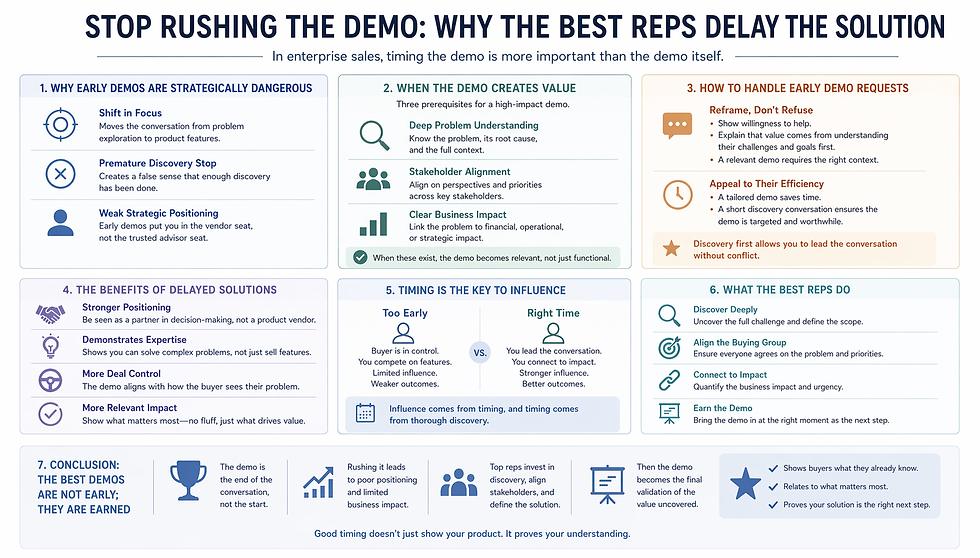
Why Early Demos Are Strategically Dangerous
On first impression, providing early demos looks like a good idea. It allows you to show your product and its value.
There are, however, multiple strategic risks inherent in this approach.
Firstly, there is a shift in focus.
An early demo changes the emphasis from problem identification to the discussion of the product itself. It moves the conversation away from an examination of the customer's landscape into a discussion of the product features.
This restricts the discovery process in enterprise sales.
Secondly, there is a premature termination of the discovery process.
Since both sides have agreed to schedule the demo, there is an unwritten assumption that enough discovery has been done. This leads to a premature halt of the discussion before all relevant aspects of the problem have been covered.
Thirdly, strategic positioning becomes difficult.
By giving demos early, you place yourself in the position of a vendor. Instead of being seen as an expert on complex business challenges, you turn out to be just another salesman showing his products.
Enterprise sales require a more sophisticated approach.
When the Demo Actually Creates Value
However, a demo itself doesn't always lack effectiveness. Its power emerges once presented in the proper moment.
Three prerequisites should be present for the creation of demo value.
The first one is the problem of understanding.
For sure, it is necessary to know what the client's problem is. But it is even more important to understand its cause and context.
Otherwise, a demo can turn out to be vague and misaligned.
The second prerequisite is stakeholder alignment.
An enterprise deal is complicated by the fact that there are many parties involved in it. These stakeholders can have various priorities concerning the problem. Thus, their perspectives need to be aligned.
The third prerequisite is the definition of business impact.
The problem in question needs to be linked with a certain business impact. For example, it can relate to financial issues or operational problems.
This way, the demo can be made valuable rather than functional.
Under these prerequisites, timing a demo in enterprise deals gains significance on the strategy level.
How to Handle Early Demo Requests
One of the main obstacles in B2B selling is dealing with early demo requests.
It is perfectly normal for buyers to request a demo as a way of exploring options and gathering data. At the same time, agreeing to do so may compromise your control over the discussion.
Instead of refusing the request, you need to change its meaning.
Firstly, show that you are willing to comply with the request.
Secondly, stress the importance of finding out how you can add value to their business.
For instance, you can respond by stating that for the demo to be worthwhile, you should first find out what challenges they face and what goals they want to achieve.
A second way to handle this challenge is to appeal to the buyer's sense of efficiency.
You can argue that a custom-tailored demo is much more beneficial than a general presentation and that having a brief discovery discussion will save their time.
Enterprise sales discovery enables you to steer the discussion without causing any conflicts.
The Benefit of Delayed Solutions in Enterprise Sales
It is crucial to remember that delays in the demo are not necessarily about delaying the deal itself. Rather, they are about making the deal much stronger.
Firstly, delaying the demo gives a great advantage when it comes to positioning. By taking more time to conduct discovery activities, a sales professional can position themselves as a partner in decision-making rather than just another product vendor.
Secondly, delays show that one is an expert in their domain and is capable of addressing all potential issues associated with a solution being developed.
Thirdly, delayed demos allow gaining more deal control. When a demo is scheduled strategically, it matches the customer's perception of their own problem much more.
Lastly, when one uses delays to conduct a demo at a specific moment, the latter becomes more relevant for the client. In other words, there is no need to demonstrate everything one can do using their product.
What Makes Timing the Key to Influence in Enterprise Deals
When selling enterprise deals, influence does not necessarily stem from the messaging but from the timing of the messaging.
Timing your presentation of the demo too early puts the buyer in charge. In effect, they start judging your product in comparison to others in terms of features.
Timing your demo at the optimal time ensures that you can take control of the discussion.
You show the buyer that your solution can solve their problems. You define its impact. Your solution becomes the clear next move.
Such control only occurs when there has been enough discovery.
Enterprise deals rely heavily on discovery and timing for demos because timing is only effective when you have conducted proper discovery first.
Both of these will help you win the deal.
Conclusion: The Best Demos Are Not Early; They Are Earned
For Enterprise Sales, the demo isn't the start of the discussion; it is the end.
Jumping to a demo might seem to be making great headway, but this can lead to poor positioning and limited impact.
Instead, the top Account Executives take an alternative course.
They dedicate time to conducting enterprise sales discovery. They clarify the challenge and establish the scope of the solution.
Then and only then, they bring in the demo.
What does this mean for demo timing in Enterprise Sales?
It means the demo becomes something much more powerful than simply demonstrating capabilities.
It becomes the final validation of the value uncovered during discovery.
It shows buyers what they already know. It relates directly to what is important for them. It proves that what you've discussed makes sense.
This is why demo timing in enterprise sales is so important.
Because the best demos aren't about creating value from scratch.
They are about validating it.


Comments