Stop Selling Implementation Speed; Start Selling Time-to-Value

Introduction
One of the most frequent messaging errors in enterprise SaaS sales is promoting the rapidity of implementation.
The idea of "fast implementation" seems impressive at face value since it implies efficiency and low friction in deploying the product. However, the question the buyer is really asking in their purchasing cycle is more complex than that.
It is not whether the software can be implemented quickly. Instead, it is whether the business will experience improvements in its operations soon after the implementation. And that difference should not be underestimated.
In the modern enterprise environment, stakeholders want to know when they will be able to measure the value provided by their investment. This is why the notion of time-to-value is significantly more relevant than the speed of implementation.
Pre-sale communications need to change gears from talking about how fast something can be done to when something valuable will happen.
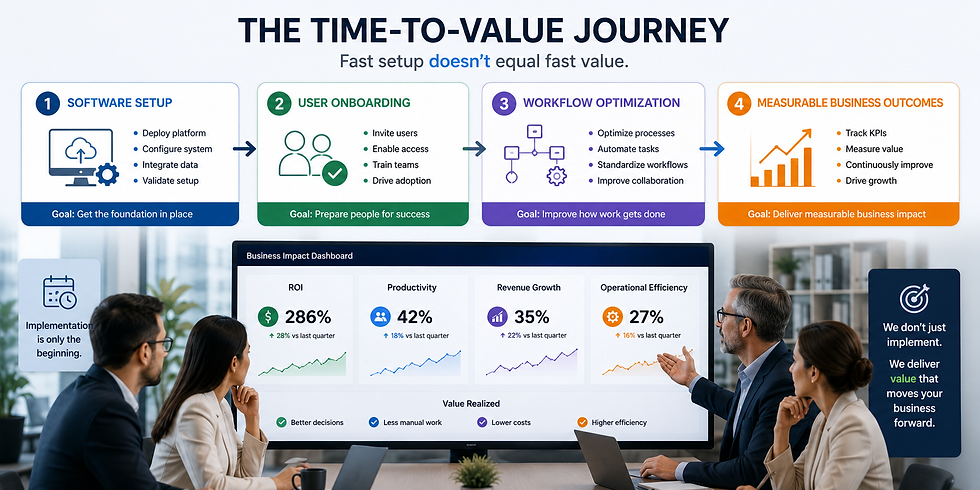
Why “Implementation Speed” Is a Misleading Sales Metric
Implementation speed is frequently touted as a primary selling proposition for SaaS products; however, in reality, it may have little to do with the real success of the product in question.
A solution may be implemented within the shortest period possible, but this doesn't mean it will ever be fully embraced by the company or properly configured. It only means that it has been installed.
The corporate environment is too complicated for the quick implementation of any new tool to have any effect on its use by the company.
Organizations need time to ensure proper configuration and integration and to make any other adjustments required.
Such a situation leaves room for the discrepancy between implementation speed and real performance.
Executives always see it immediately. Therefore, a simple claim that the product allows one to implement a system quickly is considered insufficient. It can hardly replace another more interesting question: What's next?
Understanding Time-to-Value in Enterprise SaaS
Time-to-value indicates how much time elapses between the customer's purchase and the beginning of receiving tangible business results.
While implementation speed measures the process of setting up the software, time-to-value looks at its results.
These can include increased efficiency, higher productivity, quicker decision-making, enhanced reporting capability, less manual work, and revenue impact.
In an enterprise context, these factors play a more crucial role than completing the setup process.
A product that has been successfully installed but not used will have no value at all. In contrast, a product that may take a little longer to set up but provides operational improvements quickly will be much more valuable.
Time-to-value is the moment when software starts adding value to the business.
Why CFOs and Executives Care About Time-to-Value
Both CFOs and executives judge software implementations according to their economic implications.
Executives increasingly evaluate software investments based on measurable business outcomes rather than implementation alone, a pattern reinforced by research from McKinsey on digital transformation success.
It means that their major interest is not the speed of installation but the period in which the system begins to bring benefits for the company. Benefits like ROI, cost efficiency, decrease in risks, increase in productivity, etc.
Sometimes it is more beneficial to install a solution a bit later, but to achieve the value quicker and avoid possible risks.
Executives pay attention to the loss of efficiency due to every postponed benefit brought by software. They also care about any additional costs that result from this.
Time-to-value affects investment confidence. The better the investors understand when and how much they may get from software, the quicker they give consent.
That is why discussing SaaS implementations in the context of time-to-value brings better results than just speaking about time-to-install.
The Problem with Overemphasizing Implementation Speed
An implementation speed-focused marketing approach can cause several negative consequences.
For one thing, it can create unrealistic buyer expectations. Consumers may believe that they will see value right away after the implementation process, although such a situation is hardly ever the case in enterprise settings.
Moreover, this approach takes the focus away from adoption, integration, and actual usage. While these steps are essential to the product's ultimate success, they tend to be overlooked during a speed-focused sales pitch.
Lastly, an implementation speed-based approach makes it difficult to maintain a strategic position within the market. Competitors are likely to offer products that can be implemented even faster than yours, making your product less unique.
Most importantly, fast implementation alone does not guarantee positive results for the customer's business.
That is why it is important for enterprise software companies to adjust their messaging in line with the current trends.
How to Shift the Conversation From Speed to Value
Sales Engineers and pre-sales teams change focus from the speed of implementation to value delivery.
Rather than emphasizing the time it takes to install an application, they emphasize the speed at which the application will start creating value in terms of workflow improvement, visibility, better decision-making, and greater efficiency.
The shift begins at the discovery stage. It is vital to define what constitutes value for all involved parties. For some clients, value might mean accelerated reporting; for others, it might translate into enhanced forecasting precision or decreased manual workload.
With value defined, the implementation process becomes the means to achieving outcomes, not a singular technical achievement.
This also facilitates the alignment of technical and business stakeholders. IT professionals know how to roll out the solution, while business executives see when and how their organization will benefit from it.
This approach allows Sales Engineers to foster clearer communication and improved alignment with buyer needs.
Mapping Implementation Steps to Business Outcomes
One of the best methods to demonstrate time-to-value is to map each stage of implementation to a distinct business benefit.
Instead of explaining the technical process, an efficient pre-sales team maps each milestone to a business advantage.
For instance:
Integration of the system equates to better data visibility
Configuring the software translates to process optimization
Onboarding users equates to higher productivity
Turning on automation saves money and labor
Using such a mapping technique enables visualization of the path to success.
Executives learn not only what can be expected during the implementation process but also how each milestone leads to a business benefit.
The Role of Pre-Sales in Accelerating Time-to-Value
Pre-sales teams need to influence both perceived and real time-to-value.
A great sales engineer sets realistic expectations upfront in the sales process. He makes sure that the stakeholders not only know what they will get from the product, but also how and when they will see tangible benefits from it.
He can also help streamline implementation because he takes care of technical design alignment with the buyer's business needs from the beginning.
A proper demo storytelling approach can also contribute to the achievement of this goal because if the presentation is focused on business processes and outcomes, the buyer will understand what kind of benefits can be achieved through the product.
Pre-sales is not simply about showcasing the software; it is about making buyers adopt it successfully.
Common Mistakes That Delay Time-to-Value Messaging
A number of SaaS businesses can be found making the following errors in their messaging regarding value delivery.
The first one entails over-promising results that will come about instantly, even when it is quite hard to meet such expectations, when implementation and adoption have been taken into account.
In addition, most SaaS businesses tend to focus only on the installation phase of their offerings while failing to consider the post-deployment phases of implementation.
Failure to outline key performance indicators early on means that customers will find it hard to measure their success at any one stage.
Moreover, there is a failure by most organizations to regard implementation as only the starting point towards a successful business change process.
Such failures make it difficult to provide clear messages about the process.
Why Time-to-Value Is a Stronger Differentiator Than Speed
In highly competitive software-as-a-service spaces, there will be no shortage of players who are capable of matching, or even outdoing one another, when it comes to speed of deployment.
Time to value, on the other hand, is much more significant because it speaks to real-world benefits rather than mere technical execution.
A focus on time to value enhances buyer confidence, since it ensures that the technology being sold actually delivers results. In addition, it promotes executive alignment because business leaders care less about how quickly something was installed and more about what it does.
Finally, it contributes to customer happiness by aligning expectations with outcomes.
Conclusion
Deployment speed sounds like a powerful selling point in marketing language, but it's often far from the reality of what enterprise customers really need.
Enterprise executives are not searching for rapid deployment alone; they seek rapid delivery of tangible results.
For this reason, the concept of time to value is among the most critical ideas in today's enterprise SaaS sales environment.
Great pre-sales teams know how to refocus the dialogue from discussion around deployment speed to discussion around measurable benefits like increased efficiency, productivity, and performance.
They guide buyers to think less about the speed at which the solution can be implemented and more about the speed at which it delivers true business value.
In today's enterprise software sales market, success will not come to the fastest deployers, but to those who deliver value the quickest.

Comments