The Action Gap: Why Your LLMs Aren't Driving Revenue (Yet)

Introduction: When Intelligence Fails to Convert
Across sectors, the leadership teams are coming to the same puzzling conclusion. Their organizations use large language models productivity increases. Teams work at a faster rate. However, the growth rate of revenue remains the same.
This is a contradiction that is not accidental.
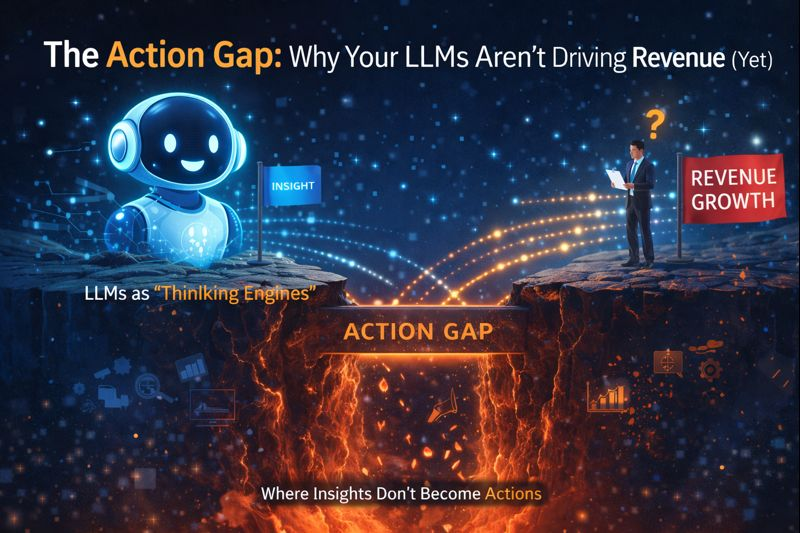
Most companies have applied LLMs to act as thinking engines rather than execution engines. These engines produce insights, suggestions, and content. They do not take responsibility to the extent that they act. This is what many executives are experiencing today: intelligent engines that are underperforming.
It is this distance between insight and implementation that we refer to as the action gap. Until leaders bridge this gap, Artificial Intelligence will be relegated to the role of a supporting function instead of a growth engine.
The Potential of LLMs versus Their Actual Impact on the P&L
Large language models are very efficient at processing information. They can summarize news articles, compose e-mails, generate insights, and solve complex questions in a split second. The first pilots showed efficiency gains.
But when the leadership examines the profit and loss statement, the situation is different. Revenue growth is not scalable. There is little change in the conversion rates. Customer retention is marginally better.
This is not due to their ineffectiveness. It is due to their never being intended to possess ownership of execution. They facilitate decision-making but never make decisions or act upon them. Consequently, their economic potential is not maximized.
The problem is not with intelligence. It is with follow-through.
Defining Action Gap
The action gap is the interval between knowing what should be done and doing it.
Typically, in organizations, LLMs firmly fall on the insight side of that spectrum. They point to next steps, point to opportunities, and point to risks. However, it is up to humans to interpret that information.
Each handoff adds delay, inconsistency, and friction. Knowledge obsolesces rapidly when it is not turned into action. In today's fast-paced market, timing is more important than accuracy.
When the execution entirely relies on the human follow-through, the best intelligence finds it hard to convert into revenue.
Why LLMs Alone Are Insufficient to Generate Revenue
There are some structural issues associated with the implementation of LLMs in a commercial context.
First of all, they don't own workflows. They can't independently advance deals, update systems, and launch follow-up actions.
Second, they require human initiation. Without people asking the right questions or doing something with the output, nothing will happen.
Third, they cannot work constantly. The generation of revenues needs determination, follow-through, and tracking. The above models cannot handle these issues on their own.
These are the reasons why many AI projects stagnate. The tool generates insights, but the organization does not have the infrastructure to act on them.
The Hidden Cost of Insight Without Execution
The action gap not only impedes the growth process, but it also destroys value.
Conversion rates are lower for delayed follow-ups. Unnoticed buying opportunities result in the entry of competitors, and inconsistent delivery results in margin erosion and churn.
When it comes to sales, speed to action can be the determining factor in winning the business. In the world of marketing, timing influences engagement. In the area of customer success, acting quickly can mean the difference between retention and churn.
When the insights come, yet the actions do not follow, the opportunities pass by silently. Over time, this leads to the creation of a false impression that AI is ineffective, when in fact it never got the chance to deliver.
From Assistance to Agency: Bridging the Action Gap
The action gap can be bridged by transitioning from assistance to agency. These agentic AIs not only offer suggestions, but they also assume liability for the results. They convert their findings into processes, integrate their operations, and work within certain bounds.
This is not to say that humans should be taken out of decision-making. It is to say that humans should be taken out of repetitive execution tasks that require speed and consistency.
When organizations empower AI, they translate intelligence into momentum. Work proceeds without waiting for human involvement. This is where economic value starts to compound.
The Shift That Economists Must Acknowledge
The true promise of AI, however, is not efficiency. It is leverage.
As execution becomes more automated and scalable, growth becomes less dependent upon scaling headcount. Revenue growth accelerates as more things happen faster, more reliably, and around the clock.
This is why agentic AI is an economic change and not simply a technology change. It allows a digital workforce to augment human teams and offload operational work.
Those who realize this transition early establish a structural benefit that is difficult for others to replicate.
Early Indicators of When You're Caught Up in the Action Gap
If you're experiencing
Many institutions are already feeling the effects of the action gap.
Follow-up on AI insights is done manually.
Teams are overwhelmed even when using AI.
They hold promise but do not scale.
The revenue statistics are the same.
These are not indicators of failure. Rather, these are indicators that intelligence has surpassed the ability to execute.
Conclusion: Intelligence Is Not the Same as Impact
The impact of large language models has brought about a radical shift in the way organizations think, analyze, and communicate. This is an achievement. However, thinking alone does not generate revenue.
The key to impact is execution. It is about acting on insights rapidly, consistently, and at a large scale. As long as AI is limited to recommendations and responses, its economic value addition is going to be limited.
This is why there are so many AI projects that get stuck after their initial success. The problem of the action gap is created because insight without ownership begets dependence on human follow-through. A paradigm shift is needed to bridge the action gap. Leaders should shift their focus from how intelligent the AI is when it talks to how much it accomplishes. This is from using LLMs independently to using systems capable of performing tasks within specific parameters. It's not about replacing human judgment with agentic AI. It's about making sure good decisions are executed immediately. With intelligence and execution working in concert, AI moves beyond being a productivity tool. It moves into being a commercial engine. Until then, organizations will continue to ask the question: Why does our AI look so impressive, yet it doesn't move the numbers? The simple explanation is this: Intelligence creates potential. Action creates results.


I recently came across the Palace on Wheels luxury train packages offered by Travelogy India and was truly impressed! The itinerary covering Rajasthan’s royal cities, guided sightseeing tours, and onboard hospitality looks like a dream experience for luxury travelers. The heritage-style coaches, fine dining, and cultural performances make it feel like stepping back into the era of Maharajas.
If anyone is planning a premium rail journey in India, Palace on Wheels is worth exploring. Travelogy India provides complete assistance with planning, booking, and customization of the journey. I’m considering this tour for my next vacation – it looks like a perfect blend of comfort, culture, and history. Would love to hear from others who have traveled on this train!