The Death of the "Harbor Tour": Why Generic Software Demos Kill Win Rates

Introduction
Today's enterprise buyer is drowning in information. There's just too much. In such an environment, the value of attention far outweighs that of feature sets. Yet, in the midst of this sea of information, clarity carries more weight than completeness. Nevertheless, countless software companies still demonstrate their product using an outdated method that does the exact opposite.
The "Harbor Tour" style of software demo is the quintessential example. This is the feature-driven, full tour through the entire product, attempting to demonstrate everything. While this may seem to be the complete demonstration to the software company, there is very little conviction generated for the buyer, resulting in convoluted messaging, slowed decisions, and reduced relevance.
In this blog post, we'll uncover how generic software demos are silently killing win rates and why it's more important now than ever before for companies to use a narrative approach.
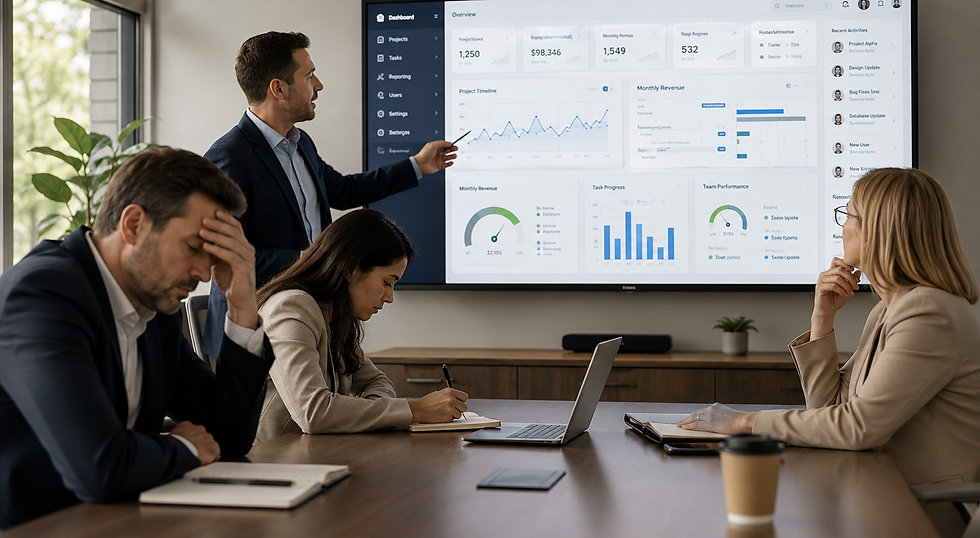
What Is a "Harbor Tour" Demo?
In a Harbor Tour demo, the product demonstration is executed in a conventional manner, where the presenter goes through the entire software interface step by step. This starts with login, dashboard exploration, and then goes into a multitude of features.
This type of demo is usually meant to be exhaustive. The sales team aims to leave no stone unturned, while the product teams always emphasize thorough coverage of features. At first glance, it sounds reasonable.
But the issue here is that structure without context is not enough. All features are demonstrated sequentially, without consideration for the buyer's needs or interests. Thus, it becomes a strictly product-centric approach rather than a buyer-centric one.
Consequently, such a demonstration can come across as being informative but not compelling. Buyers know about the product features, but still do not get why the product would matter to them.
Why Does Generic Software Demo Fail to Impress Modern Buyers?
Research supports this shift in buyer expectations. According to Walnut and Gartner-backed findings, 73% of B2B buyers actively avoid sellers that provide irrelevant or generic experiences, reinforcing the need for personalized and business-focused software demos.
Executives don't evaluate interfaces; they evaluate results. Their main concerns are revenue generation, operational efficiency, risk management, and time to value. If a demonstration is too feature-heavy and doesn't make any connections between its capabilities and these benefits, it leaves the responsibility for making sense of it all on the client side.
That requires extra effort and takes away valuable brainpower. Instead of following a structured narrative, executives need to piece everything together themselves. And in most cases, they won't remember much of it anyway.
The attention problem should also be considered. In a Harbor Tour-style demonstration, too many features are covered in too little time. Without a narrative thread, the content turns into noise. The audience tunes out regardless of whether they pay attention to the presentation itself.
Another factor that comes into play is relevance. When a demo is too generic, the audience immediately understands this. It suggests that the vendor hasn't done enough research about the customer's industry or organization.
Revenue Impacts of Overly Complex Demo Features
There are many negative impacts resulting from Harbor Tours, but perhaps one of the clearest is increased time spent closing. Too much information without prioritization creates confusion instead of clarity. Buyers require additional meetings to clarify points and gain alignment.
Engagement from key executives is also negatively impacted by complex demos. They will tune out of conversations that veer too far towards technology or lack focus. When key business results aren't readily apparent to them, executives are unlikely to maintain engagement or contribute value to the discussion.
This also means a loss of differentiation. Once vendors start to converge with similar demos and feature highlights, the product is essentially an afterthought. At this stage, the buyer falls back on price, reputation, and risk.
Conversion rates will suffer as well. An ineffective demo does not immediately cost the deal, but it causes doubt to creep in. This can be fatal in enterprise sales.
The Psychology Behind Highly Convertible Demos
Highly convertible demos do not work by covering features. They work by presenting an achievable result. Prospects want to understand how they will operate in a future state where everything is more efficient, streamlined, or fast.
Building trust during software demos is especially important in remote selling environments, where buyers often evaluate vendors before ever meeting them face-to-face. This is why relationship-building and credibility play such a critical role in enterprise sales conversations.
Such a future state needs to be clear. The demo needs to present real-world issues that prospects deal with in their businesses and how they can be overcome. Once there is clarity on that, decisions get made faster.
Relevance attracts attention. Attention gets drawn when prospects see themselves in the demonstration. That means using their language, industry terminology, processes, and problems. Otherwise, no one will pay attention.
The last thing to consider is memorability. No one remembers software interfaces; they remember stories. Features become easy to remember when placed in the context of a business scenario.
The Transition from a Demonstration to the Strategic Storyline
Pre-sales people today do not fall prey to the so-called Harbor Tour mentality. Rather than displaying everything, the focus lies on demonstrating the relevant content. It is important to exercise selectivity here. Everything that does not relate to the buyer's strategic goals should be left out.
Another essential aspect of a good demonstration lies in starting with the problem itself rather than with the product. The basis for it must be formed from insights gained during discovery sessions. This approach ensures relevance from the outset.
Instead of clicking through all the menu options, highly performing salespeople design a demo session based on real-life use cases. By demonstrating the product in such scenarios, the demo takes the shape of a strategic discussion rather than being a purely technical one.
Each function demonstrated has its value. It must be articulated clearly, and if it is not evident, it must either be reframed or left out.
How Top-notch Pre-Sales Teams Can Avoid the Harbor Tour Pitfall
Top-notch pre-sales teams start by doing discovery. They make sure they have the proper insight into KPIs, friction points, and other factors that influence stakeholders' interests. Otherwise, there will be no personalization possible.
In addition to this, top-notch pre-sales teams make sure the demonstration is tailored to the prospect. This means they use data relevant to the prospect's industry, the roles of different individuals involved, and business processes specific to their organization.
Another way they prevent this problem is by making sure they do not rush while demonstrating each of the software's components. Instead, the demonstration is organized in such a way that each step requires some thought on the prospect's part.
Lastly, communication between Account Executives and Sales Engineers is coordinated perfectly.
Signs You Have a Problem with Your Demo Strategy
The signs of Harbor Tour are easy to recognize. Demos that last for more than an hour and fail to engage, where prospects stop asking questions, and executives get bored, point to problems with the underlying architecture.
One such sign occurs when demos focus too much on product features rather than a narrative approach to achieving business results. The problem arises when success is judged based on the number of features shown during the demo.
These signs do not indicate small problems. They signify structural flaws in the demo strategy that negatively affect sales performance.
Creating a Modern Demo Strategy That Closes Deals
There are three fundamental pillars of a modern demo strategy. The first pillar is outcome clarity, where each step of the demo process has a measurable result. Personalization is another important aspect of a modern demo, as the experience should be tailored according to individual buyers' needs. The third and final one is simplicity.
Applying these principles to every demo leads to a significant change in its nature from a product tour to a tool for making decisions.
Conclusion
The Harbor Tour demo is no longer relevant in the current B2B sales process. Buyers don't appreciate comprehensive demos anymore. What they need now is clear and relevant content that resonates with their business objectives.
Generic software demonstrations are no good because they try to demonstrate everything rather than demonstrate what really matters. This approach only confuses and frustrates the decision-making process and lowers closing ratios.
Demos that tell compelling stories about what your software can achieve will be the ones to lead you to success. Once your organization adopts such an approach, expect faster decisions, higher executive involvement, and increased conversions.
In the current sales landscape, what matters is not the amount but the relevancy of information presented in demonstrations.


The same principle applies to financial software: a useful tool should solve a specific workflow rather than simply provide a generic overview. For Canadian investors, an ACB tracker can be valuable when it focuses on practical record-keeping, such as tracking purchases, sales, distributions, transfers, and adjustments that affect the adjusted cost base.
Generic software demos can feel exhausting when the presenter clicks through every feature without connecting anything to the buyer’s actual needs. I once joined a demo for an accounting tool and only wanted to see invoicing, reporting, and customer support options. A practical example would have been much more useful than a long tour of menus. Before the call, I browsed https://quickbooks-intuit.pissedconsumer.com/review.html to understand what real users mentioned most often. The best demos start with a common problem, show a clear solution, and leave time for questions. Buyers remember relevant results far more easily than a crowded screen.
I like how Cool Games gives you something interactive to do during slow evenings. It feels more engaging than just browsing random sites.