The New Talent Gap: From Content Creator to Prompt Engineer, Reskilling for AI
- ClickInsights

- Dec 21, 2025
- 5 min read
Introduction: The Talent Gap No One Saw Coming
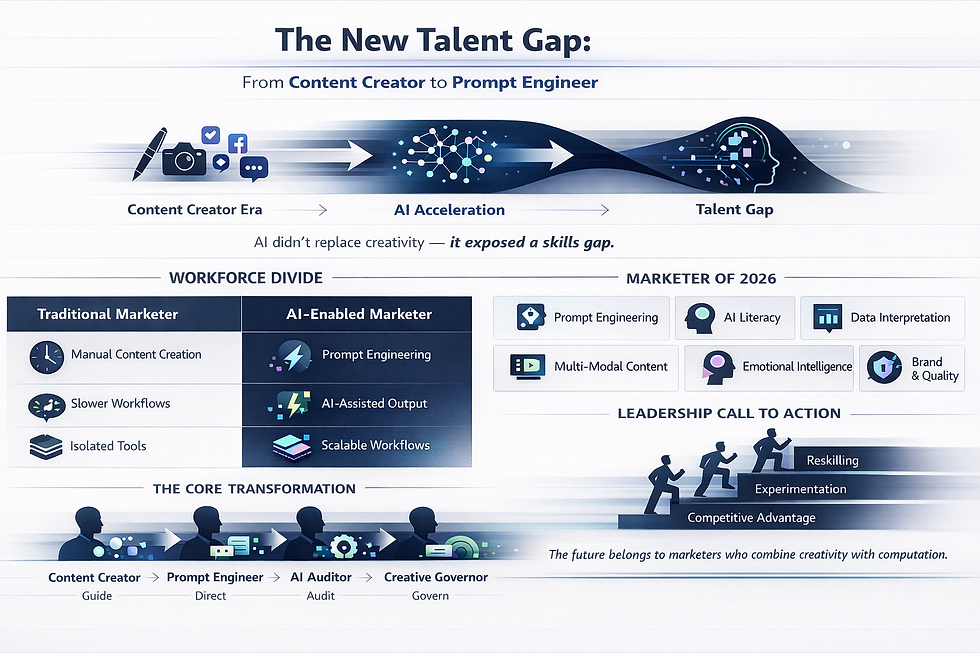
Marketing entered the 2020s celebrating content creators as the engine of digital growth. Social media teams expanded, video creators flourished, and writers became the strategic core of countless campaigns. Then AI matured faster than anyone expected. Suddenly, machines could draft scripts, generate visuals, write posts, and even create full campaigns in a fraction of the time it takes a human. The result was not the death of creativity but rather the start of a new era where creativity will need to be merged with technical understanding. The true disruption is not automation; it's the talent gap it exposes.
Today's marketer has to know how to guide, govern, and quality-check the output of AI. They have to understand human psychology and machine logic. They have to be strategists, directors, auditors, and orchestrators. And this transition from content creator to prompt engineer is not an option. It illustrates who will grow, who will stagnate, and who will fall behind in 2026 and onward. Marketing is no longer about creating content. It is communicating with intelligent systems now executing large swaths of the creative process. And it's the teams that will drive the next decade of brand growth.
The Great AI Realignment and the New Workforce Divide
AI has accelerated from a supporting tool to a core execution engine. It no longer just assists with tasks; it performs them. This new fundamental shift has created a new workforce divide. On one side are marketers who continue to operate traditionally, focusing their attention on manually producing content. And on the other end are those marketers who understand how AI behaves, how to guide it, and how to integrate it into workflows strategically.
This chasm widens every month. While some teams already perform at a rate of 5 to 10 times their previous output with AI-enhanced efficiency, others are stuck in processes that simply can't compete with the speed of machine execution. Creativity still matters, but how it's applied has changed. Today's marketer must combine strategic thinking with technical fluency, from model behavior and data inputs to audience signals and quality governance. It's fast becoming the new minimum.
Why Traditional Content Skills Are No Longer Enough
AI is now creating content at a baseline level that is often indistinguishable from human work. It makes videos, graphics, blogs, keyword-optimized articles, customer messages, and personalization variants at an unprecedented scale. But high volume does not equate to high value, and the real determinant of impact is found in the human direction behind the machine.
Traditional content skills aren't enough anymore because marketers are responsible not only for creation but also for making sure AI-generated outputs are accurate, compliant, emotionally resonant, and on-brand. That means understanding how to structure inputs, how to enforce brand rules, how to guide tone, and how to spot inaccuracies or risks. Without those competencies, brands open themselves up to generic, inconsistent, or even harmful content. The modern marketer needs to be both creative and technically aware.
Prompt Engineering: The New Foundation Skill for Modern Marketers
Prompt engineering is rapidly becoming one of the key skills for marketing teams. It is not just a question of typing in commands. It is about understanding how AI interprets instruction, context, tone, constraints, and outcome. Good prompt engineering demands clarity, structure, and intention. It embeds brand voice, human psychology, customer insight, and creative direction.
The best prompt engineers treat prompts like briefs. They give the AI a complete strategic frame: target audience, desired emotion, message hierarchy, factual boundaries, and quality criteria. They iterate, refine, and quality-check until the output reaches the expected standard. Prompt engineering is part art and part science. And teams that master it produce higher-quality content, at greater speed, and with significantly fewer revisions. It is the new foundation skill that separates modern marketers from traditional ones.
Beyond Prompts: The Rise of AI Auditors and Creative Governors
As AI takes over execution, human roles naturally shift to oversight. Teams now require AI auditors who review outputs for accuracy, alignment with the brand voice, ethical considerations, and consistency in facts. Such professionals ensure that the speed at which AI operates never compromises quality or compliance, helping to flag hallucinations, bias, and factual incorrectness before they reach the customer.
At the same time, the creative governor role is taking shape: the individual responsible for setting the frameworks, guardrails, and creative standards that AI systems need to work within. They define templates, tone guidelines, style patterns, and decision rules that help create consistency across all AI-generated content. These roles require strategic thinking, emotional intelligence, and deep knowledge of brand identity. They are fast-becoming 'must-haves' for the modern marketing team.
The Skills Every Marketer Must Master in an AI-Driven Environment
The marketer in 2026 is both multiskilled and multi-dimensional. They understand creative direction but also how data influences output. They can write compelling stories but also structure machine-readable instructions. They understand how to build emotional resonance, but also know how to manage technical systems. Core skills now include:
Data interpretation and knowing which inputs create the best AI outputs.
Multi-modal communication across text, video, image, audio, and chat experiences.
Creative problem solving that treats AI as a collaborator, not a competitor.
Emotional Intelligence: This dictates humanity while interacting with automation.
Cross-functional collaboration for bridging creative, technical, and analytical teams.
These capabilities make marketers indispensable in a world where AI becomes stronger.
How Leaders Can Close the Talent Gap Before It Becomes a Crisis
Leaders must take prompt steps to ensure the talent gap does not undermine performance. Reskilling must be conscious, structured, and continuous. Teams require actual training in prompt engineering, AI literacy, creative governance, and model behavior. Refresh job descriptions and career paths to include AI-enhanced responsibilities.
Most importantly, leaders must foster an experimentation culture. Curiosity, play, and learning-by-doing are the quickest roads to adoption. The teams that practice most with AI will outcompete those who deploy it occasionally or with caution. With early investments, leaders set their organizations up for long-term competitive advantage.
Conclusion: The Marketer of 2026 Is Both Creative and Computational
This shift from content creator to prompt engineer is one of the most fundamental changes in contemporary marketing. It is an evolution, not a threat-one that opens up new levels of creativity, efficiency, and strategic influence. The most valuable marketers will be those who combine human insight with machine fluency. Storytelling, empathy, and emotional intelligence are still essential. Still, they are now joined by technical direction, AI auditing, and system governance. AI accelerates the execution, but humans still define meaning, intent, and connection. The marketers who embrace this hybrid skillset will lead their teams, shape brand narratives, and drive measurable impact in a world where creativity meets computation. The people who thrive tomorrow will be the ones who choose to collaborate with AI rather than resist it.



Comments