The Power of Empathy: How to Truly Understand Your Customer's Hidden Pain Points

These days, every business is flooded with data. Clicks, conversion rates, and behavioral trends can be measured on a variety of channels. However, even with this plethora of data at hand, many companies fail to resonate with their customers. The results? Unsuccessful campaigns, off-target products, and unengaged customers. Why? Because data gives us the facts about the customer, but not their reasons.
That's when customer empathy comes in handy.
Finding hidden pain points of your customers cannot be done solely through data. You need to put yourself in your customer's shoes, understand what they are going through and get insight into their emotional experiences and pain points. Find out how to leverage customer empathy for uncovering hidden customer pain points in this blog.
Understanding the Concept of Customer Empathy
Customer empathy refers to an organization's capacity to know and comprehend the emotional states, intentions, and struggles of its customers. More importantly, it involves knowing beyond just the facts and focusing on what makes humans tick.
The concept of empathy in business can take three different forms:
Cognitive empathy: Knowledge of what your customers think and how they come up with decisions
Emotional empathy: Knowing what your customers feel along their journey
Behavioral empathy: Doing something based on the above understanding
By practicing all three types of empathy in businesses, companies get one step closer to becoming customer-centered in their operations.
Why Are Hidden Customer Pain Points Hard to Identify?
Many companies think they know their customers thanks to having access to dashboards and reports. Yet these resources often offer an incomplete picture.
To begin with, there's a problem of metrics versus insight. A metric can tell you why a certain user abandoned your website at a particular point in the sales process, but it will not tell you why exactly this happened. The reason might be a misunderstanding or a problem that can be solved easily if you knew about it in advance. When people complete surveys, they tend to either provide inaccurate information or answer according to their biases and assumptions.
Another common barrier for companies in fully comprehending their customers is related to:
The company's preconceived notions
Insufficient use of qualitative data
Limited contact with customers
Not identifying hidden pain points can cause many problems, such as poor communication, bad customer experience, etc.
What Are Hidden Customer Pain Points?
Hidden customer pain points are issues, frustrations, or unsatisfied needs of customers that might go unspoken. Most of the time, customers are not aware of these pain points at all, or they have trouble articulating their issues clearly.
The three types of hidden customer pain points include:
Emotional pain points include feelings like frustration, anxiety, and lack of trust.
Functional pain points: Including inefficiency or unfulfilled needs
Social pain points: Related to perceptions, status, or social pressure
So when a customer says he wants a faster product, his pain point might really be that he's frustrated by lost time or worries about being left behind.
How Empathy Helps Understand Your Customers' Needs
With empathy, organizations learn to read customer behaviors differently than without it. Not only do you become aware of customer actions, but empathy helps you understand what they mean.
Once you start using customer empathy, you will begin to detect certain signs that would be impossible to see just by analyzing data. The pause during a conversation can tell you about uncertainty. Disengagement can imply that something does not make sense to the client. Such subtle clues can help uncover underlying pain points.
In addition, active listening skills become much more effective when empathy is present. Not only do you listen to what people say, but you pay attention to tone of voice and context to learn their needs and concerns.
Building trust with clients becomes essential, too. People tend to be more open and honest when they feel that someone is paying attention to them and really trying to help.
Practical Strategies for Generating Customer Empathy
Generating customer empathy involves a combination of effort and the correct strategies. It is not a one-off project but an ongoing journey of improvement and discovery.
The first strategy involves engaging customers directly. Talking with them can offer a level of insight that cannot be achieved through any form of report or analytics. The power of open-ended questions can uncover details that otherwise go unnoticed.
Secondly, watching customers interact with your product or service helps reveal what they enjoy and what frustrates them. These observations will point out areas of concern that may not have been reported by the customers.
Thirdly, creating customer journeys can provide insight into the experience that customers have with your products or services. These journeys involve mapping out all touch points, high points, and low points in their experience.
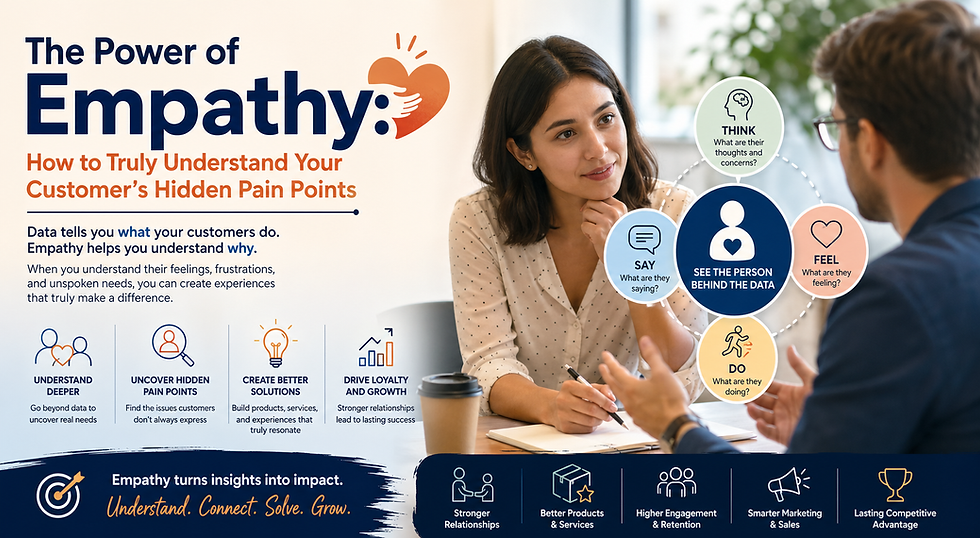
Fourthly, empathy maps can also help teams organize the data collected. They focus on the saying, thinking, feeling, and doing of the customers.
Lastly, setting up a feedback loop ensures that you are continually learning about your customers' needs. This way, you can adapt and grow alongside them.
Advantages of Knowing the Underlying Pain Points
Once companies allocate resources to learning more about their customers, all parts of the business will benefit.
Better customer relationships based on trust
Effective products and services
Greater engagement and retention
Superior marketing and sales operations
Distinctiveness within the competition
Empathy enables companies to transition from reactive fixes to value generation.
Common Errors to Avoid
Although empathy is a potent tool, it needs to be used appropriately. Several errors commonly made by businesses prevent their full implementation.
They are:
Believing they know their clients well enough
Focusing solely on numbers without consideration
Using guiding or close-ended questions
Neglecting emotions while making decisions
Using empathy once and not continuously
Avoiding these errors is crucial when developing a customer-centric approach.
Conclusion
Knowing your customers has become a necessity in an environment where there is stiff competition for attention; companies that do not make connections run the risk of being left behind.
The only way to discover the underlying issues facing your customers is through empathizing with them. This means taking time to talk to them, watching their actions, and listening to both what they say and what they do not say.
Take baby steps. Start by making genuine connections with your clients, observing them, and paying attention to what they are saying. Over time, you will notice how this changes your approach when designing products or developing campaigns.
Ultimately, the more you know about your customers, the better you can cater to them.
Call-to-Action
For anyone that wants any further guidance, ClickAcademy Asia is exactly what you need. Join our class in Singapore and enjoy up to 70% government funding. Our courses are also Skills Future Credit Claimable and UTAP, PSEA and SFEC approved. Find out more information and sign up here. (https://www.clickacademyasia.com/course/design-thinking-for-sales-and-marketing).


Comments