The Psychology of Commitment and Consistency: Guiding Your Customer Toward a Decision

Introduction: Why Commitment and Consistency are Important for Sales
Have you ever noticed that if someone agrees to a small favor, they are more apt to obey a larger favor at a later date? That, my friends, is the fundamental principle of commitment and consistency. Everyone tries to align things as best as possible with previous promises and personal images.
Know more about commitment and consistency.
Commitment and consistency are concepts that salespeople and entrepreneurs should grasp and apply to nudge customers towards confident buying decisions. By consistently creating and layering small commitments, you strengthen trust and credibility with your audience, which ultimately leads to higher conversions. You will learn more about commitment and consistency below.
Comprehending Commitment and Consistency within Human Behaviour
Commitment and consistency stem from people wanting to behave in ways consistent with what they have done before. Psychologists call this "cognitive consistency." When people make a decision, they experience an internal drive to act consistently with it. This drive helps people maintain a sense of integrity and self.
From an evolutionary viewpoint, consistency leads to a more cohesive society. A consistent person will be seen as trustworthy and reliable. Consequential cooperation and survival among groups will be ensured. A small positive action will be triggered while making decisions. It may include registering for a newsletter and a demo. Subsequent actions will consist of buying and enhancing services. It will be done because of the consistency created by previous actions.
Commitment and Consistency - Sales Psychology
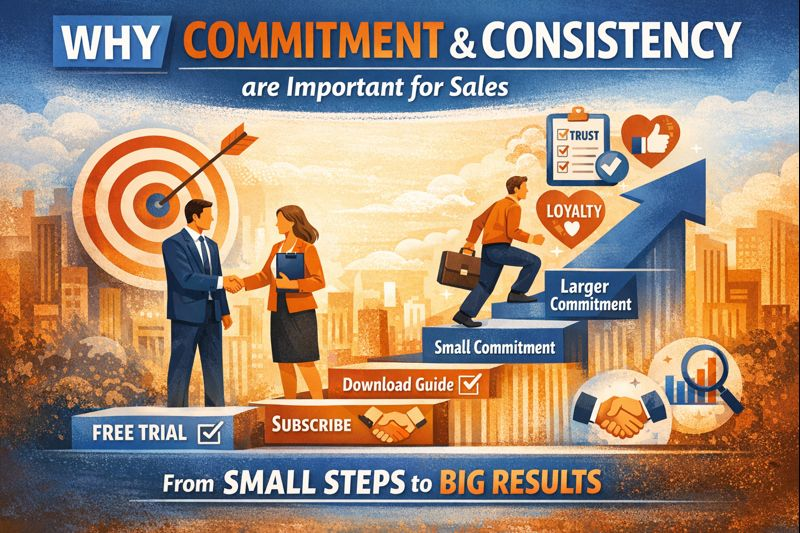
In sales, commitment and consistency can effectively change customer behavior. A commitment-and-consistency technique would involve establishing small commitment points. These include actions a business may offer, such as a trial, a download, or a consultation. When a customer commits to these small actions, they are more likely to make a larger commitment.
Consistency will also improve customer interactions. By taking note of actions that the prospect previously undertook, perhaps they took a survey or looked at product information, you acknowledge these efforts and encourage them without even realizing it. It's because customers want subsequent actions to be consistent with those they previously took.
Examples include cloud software services that offer a two-week free trial. Customers who start using a product may subscribe to a paid service because they have already made a commitment and will act consistently with it. Fitness applications usually offer daily challenges as a momentum technique.
Methods for Applying Commitment and Consistency in Sales Closes
Foot-in-the-Door Technique: It begins with making a small demand that hardly requires an affirmative response from the customer. It lays the groundwork for more significant requests. A business would start with downloading a complimentary guide before suggesting an entire package.
Written or Verbal Agreements: When customers agree in a written or verbal agreement, they are more likely to comply. An oral or written commitment on a form will improve compliance.
Public Commitment: When people publicly declare intentions, either within a community or on an online platform such as a discussion group on a social media site, they are more likely to follow through. A coaching program could leverage posting goals on an online platform as a commitment device.
Pointing at Previous Choices: Referring customers back to previous positive actions, viewing a webinar, requesting a product demonstration, or downloading materials, encourages them toward completing the next step within the buying process. It makes it easier for customers to maintain consistency between actions.
Avoiding pitfalls and ensuring ethical Use
Commitment and consistency are very useful, but it is necessary to be ethical about them. Make sure that every action brings value to your customer. Do not use psychological tools to put pressure on your leads. It should be about making decisions for your customer.
It is necessary to be respectful and understanding about customer autonomy. Aggressive and unrealistic commitment techniques might backfire, leading to customer frustration and mistrust. It becomes essential to ensure the commitment is feasible and attainable. Ethical commitment and consistency can help build enduring relationships, but manipulation can undermine customer loyalty.
Measuring and Improving Success Strategies
To assess the efficacy of commitment-based methods, it is necessary to monitor key performance variables. Conversion rates need to be measured on the impact of micro-commitments on full purchases. It will help determine whether leads are engaged, attending webinars, downloading materials, and activating trials.
It would be useful to monitor customer satisfaction as well, so that trust-building methods are encouraged and not forced. Feedback should be gathered from customers via surveys and reviews. Outcomes should be processed, and techniques tweaked constantly, with commitment size and timing adjusted based on observation.
Conclusion
Commitment and consistency are fundamental components of successful sales and marketing efforts. Both techniques allow for maximum impact. By leveraging commitment and consistency, an easier and more natural process for influencing customers and making decisions becomes available. By making these small, ethical commitments and following through, salespeople can build trust and make more conversions. Examples include using a free trial period, making micro-commitments, and setting goals. Effective and ethical use of commitment and consistency will result in customers being aided, not persuaded. Commitment and consistency will allow you to build enduring relationships and increase customer loyalty. To put these concepts into practice, start by identifying specific actions that add value to your customer and your business. Results will be measurable, and there will be no room for error as you lead your customers on a path of commitment and consistency.
Call-to-Action
For anyone that wants any further guidance, ClickAcademy Asia is exactly what you need. Join our class in Singapore and enjoy up to 70% government funding. Our courses are also Skills Future Credit Claimable and UTAP, PSEA and SFEC approved. Find out more information and sign up here. (https://www.clickacademyasia.com/psychology-of-selling)


@melon sandbox: Vehicle upgrades on the interface create extra attraction for players