The “Sudden Objection” Test: A Game-Changing Sales Interview Tactic
- ClickInsights

- Jun 12
- 5 min read
Introduction
Recruitment of sales talent is undoubtedly one of the most impactful decisions any business makes. Nevertheless, even in the modern world, many sales interview techniques are so predictable and formulaic that candidates can prepare in advance, memorize prepared responses, and come up with impressive stories about their achievements. But this will not necessarily reveal how candidates react under stress when a client interrupts, opposes, or questions a proposal or its price.
In reality, sales interviews should account for the unpredictability of sales conversations. Sales representatives do not know what buyers' reactions will be at every stage, or whether their arguments will be challenged or rejected. For high-volume transactional sales, it is much more important to remain calm and effective in a conflict situation than to follow an already memorized sales script.
That is why the following role-play exercise, called the “Sudden Objection,” is such a powerful tool in sales recruiting.

Why Traditional Sales Interviews Often Miss Top Talent
In a traditional sales interview, the interview is usually very structured. There are questions about a candidate's background, accomplishments, strengths, and sales approach. This does not mean that such information cannot be valuable for understanding a candidate; rather, it means that it is unlikely to uncover their potential performance under pressure.
Candidates with prior experience are familiar with how to respond in such situations. The interview then becomes, more or less, a useless exercise, since most people can prepare and tell appropriate stories about their past performance.
The problem is especially relevant in transactional sales positions, which require quick decisions and a strong emotional balance. One may perform brilliantly when explaining how they handle objections, but prove incompetent when facing one during the conversation.
What Is the "Sudden Objection" Test?
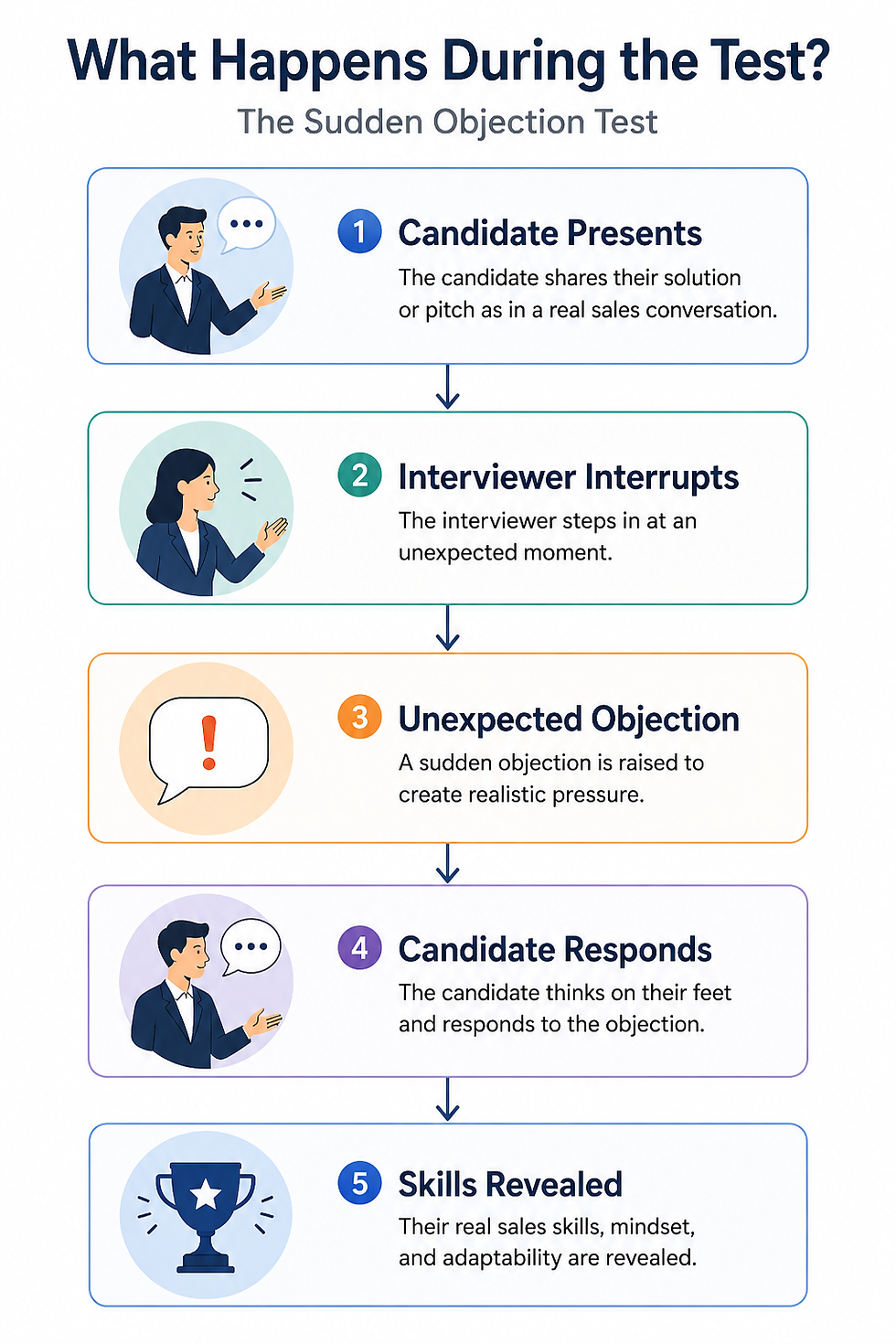
The Sudden Objection Test is an interview simulation game for sales jobs, in which the manager makes an unscheduled objection during an interview to observe the candidate's response.
It is a situation in which the candidate is suddenly faced with resistance, and he must see how well he can overcome it and persuade a customer or prospect to make a purchase.
For instance, the interviewer may make such an objection at some point in the conversation:
“Everything you’ve said makes sense, but I do have a competitor who is 20 percent cheaper.”
This is exactly when the game starts. At once, the candidate feels as if he were selling and was faced with resistance from the prospective buyer.
Why Live Objections Reveal More Than Interview Answers
There's a big difference between talking about sales skills and actually demonstrating them. While many applicants can provide insightful answers about how they would handle objections, not everyone can demonstrate their skills under real-life pressure.
According to Salesforce, one of the biggest obstacles to closing new business is not the objection itself but how the salesperson manages it. This is why live objection simulations can be far more revealing than asking candidates how they would theoretically handle resistance in a sales conversation.
The Sudden Objection Technique reveals applicants' true colors when faced with disruption. While some stay calm and focused, others start defending their position or trying to justify their decisions.
At the same time, it highlights flexibility good applicants can steer the dialogue in a new direction. In contrast, less capable ones struggle to overcome their first impression.
For employers, this method provides a far more reliable forecast of future performance than any other interview technique.
The Classic Scenario: “Your Competitor Is 20% Cheaper”
One of the most useful objection scenarios to use during an interview role-play for sales positions is pricing pressure. It is straightforward, realistic, and very insightful.
When presented with the statement, “Your competitor is 20% cheaper,” the candidate must respond immediately.
This is a very good exercise, as it allows you to observe whether the candidate has learned about value positioning, can control themselves under pressure, and tends to discount or use value-based selling techniques.
It also lets you assess whether the candidate listens attentively or responds impulsively. These factors are extremely important in high-volume sales.
What Strong Candidates Do in the Moment
Great candidates usually exhibit similar behavior while responding to a quick objection.
They keep their cool and do not get emotional about the situation. They accept the objection rather than dismiss or deny it. For instance, their response might be, “I fully understand your concerns regarding pricing.”
They ask questions instead of immediately defending their position. It will help them identify the root cause of the objection and determine whether price is a decisive factor. Strong salespeople understand that not every objection reflects the buyer's real concern, which is why they focus on uncovering whether they are facing a genuine issue or a hidden objection before attempting to respond.
Finally, they turn the focus from the price to the value of what they are selling. They discuss outcomes, priorities, and impact without making any immediate promises about discounting.
Such candidate behavior indicates excellent objection management skills, strong emotional control, and a customer-centric attitude, all key qualities for transactional roles.
Warning Signs That a Candidate May Struggle
The Sudden Objection Test is also very effective in identifying risk indicators.
Defensiveness is one of the primary warning signs. Candidates who tend to argue immediately or try to "beat" others in discussion usually struggle in sales situations, where empathy is crucial.
A price reduction is another warning sign for candidates. If a candidate instinctively tries to lower prices, it may signal weak value-selling skills.
Candidates also tend to overlook the interviewer's objection and proceed with their presentation regardless. Such behavior may show that the candidate is not a good listener or is out of touch with reality.
Some candidates tend to become visibly insecure or disoriented when faced with a sudden objection. This becomes a challenge, particularly when the sales role requires managing objections from multiple clients.
What the Sudden Objection Test Actually Measures
This sales interview role-play is highly effective because it allows recruiters to assess multiple core competencies simultaneously.
Emotional stability can be measured based on reactions to pressure. Transactional flexibility is evaluated based on adaptability to changing conditions.
Moreover, active listening, empathy, and value-based selling are also evaluated. The major advantage of this test is that it combines all these skills into one single task.
This is why it is one of the most efficient tools for assessing future sales effectiveness.
How to Use the Test Effectively in Hiring
To use the Sudden Objection Test effectively, one needs to choose the right time and follow the procedure consistently. The test should not be used right at the start of an interview, when the applicant is still getting accustomed to the environment.
The objection needs to be credible and consistent, meaning it must reflect the clients' problems and apply to all applicants.
Behavioral aspects need to be assessed rather than the correct answer to an objection.
Recording answers straight away after the interview increases objectivity.
Combining It With Other Hiring Methods
The Sudden Objection Method is best used in conjunction with other evaluation techniques. It is not meant to replace resume reviews and behavioral interviews, but rather to supplement them.
The resume helps establish background information, while the behavioral interview uncovers previous behavioral tendencies. Role-playing offers a glimpse of actual behavior.
In conjunction with these, the hiring manager will be able to get an accurate sense of how well the candidate excels in transactions.
Such a multi-tiered approach can prove extremely useful in recruitment.
Conclusion
Interviews for most sales positions focus on gauging how well the prospect can talk about selling rather than testing how well they sell. The sales interview simulation, the Sudden Objection Test, addresses the issue by introducing elements of stress and requiring participants to see things through actions.
The most qualified prospects tend to stay cool under pressure, address concerns raised, listen intently, and focus on value rather than reacting negatively or resorting to discounting. They are the ones who perform best when working as salespeople.
For a recruiter, a single sudden objection may be more telling of the applicant's qualities than a whole interview packed with memorized answers.


Comments