Time-Blocking for Full-Stack Reps: Surviving the Outbound/Closing Split

Too Many Priorities, Too Little Time
Being responsible for managing the whole sales process from start to finish is one of the toughest tasks in contemporary business-to-business sales. Full-stack reps have to prospect, make discovery calls, give demonstrations, follow up, negotiate, and close deals. There are just too many things to do and never enough time to do them all.
Without any organization, some things will definitely get pushed aside. Prospect calls will be put off when there are last-minute deals to finalize. Admin work will stack up. Following up with clients will be inconsistent. Ultimately, the pipeline will suffer, and so will performance.
This is precisely why good time management is so vital for Full Cycle Mavericks. f you're new to the concept of the Full-Stack Rep and how this role evolved from founder-led selling, read our guide, "Founder-Led Sales to Full-Stack Rep: The Evolution of the Maverick," for the complete journey.
The best in their game know better than to believe that being productive means putting in extra time. Instead, it's about developing ways of doing things that enable them to stay productive.
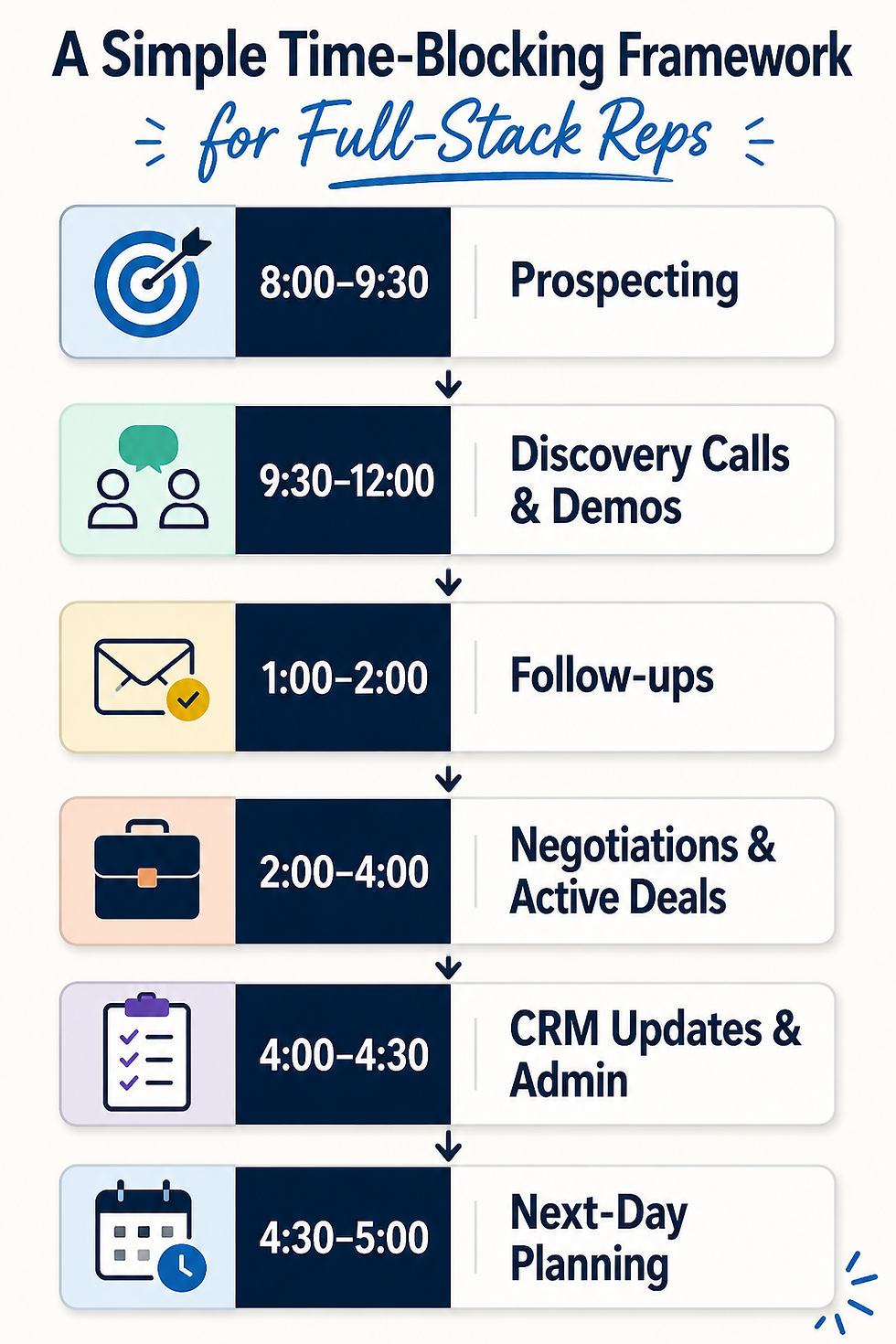
Structure Creates Momentum
Sales pros assume that being a multi-tasker is what makes them productive. The truth is that multitasking can often impair their focus and lead to errors.
Handling emails during cold calling, working on CRM data entry while having meetings with customers, and switching from task to task causes mental weariness and sluggishness. What is supposed to be progress actually becomes a distraction from achieving real results. This is where time-blocking helps.
By setting aside dedicated time blocks for each activity, Full-Cycle Mavericks increase their focus and keep momentum alive. Time blocks bring discipline, minimize distractions, and make sure that important tasks always have priority.
Revenue generation depends on disciplined processes and not motivation and urgency.
Top performers thrive on systems.
Why Full-Stack Reps Struggle With Time
The primary issue that full-stack reps run into when it comes to time management is balancing prospecting and closing.
While top-of-the-funnel tasks are important to ensure future revenue, bottom-of-the-funnel ones tend to appear more pressing. Negotiations, demos, and client queries are bound to divert attention from outreach activities.
There's also administrative work to consider. Tasks such as keeping CRM updated, having internal meetings, preparing proposals, and reporting drain a lot of productive time.
It's hard enough already without interruptions, which come in various forms ranging from emails and Slack messages to unexpected phone calls and meeting requests.
This challenge is backed by industry research. According to a research, sales representatives spend only about 36% of their average workweek actively selling, while the remaining 64% is consumed by non-selling activities such as administrative work, internal meetings, service tasks, and other operational responsibilities. This makes disciplined time management essential for protecting revenue-generating activities.
Without proper planning, reps become overly reactive in nature. Their day-to-day routine is centered around responding to the most pressing tasks, regardless of what needs to get done to move the business forward.
Creating Effective Time Blocks
The Full Cycle Mavericks rely on the time-blocking technique in order to organize their work life amidst multiple demands.
Prospecting is among the key blocks for them. They have a certain time allocated exclusively to prospecting activities such as cold calling, research, and personalizing emails to the audience.
Another important block for the group includes customer interactions. Activities such as discovery calls, demonstrations, and negotiations take up significant time; therefore, the reps must be present to give a positive experience to the prospects.
Lastly, follow-ups and updating CRM are critical for their success. Rather than attempting to fit those activities into other parts of their schedule, successful reps spend certain amounts of time updating records to keep the data accurate.
Such an approach allows them to minimize distraction and maximize organization.
Protecting High-Value Activities
Not all activities have an equal impact on revenue.
One of the key factors that contributes to Full Cycle Mavericks being better off compared to others is prioritizing high-value activities. Activities such as prospecting, engaging with clients, and managing deals consume most of their time as these activities impact revenue directly.
Distracting low-value activities are avoided as much as possible. Too many meetings, too much administrative activity, and numerous notifications are managed rather than dominating the day's schedule. Consistency is equally crucial for them.
While most sales reps tend to be proactive on prospecting when the pipeline gets weak, other sales reps neglect the follow-up when it gets busy. This is an area where Full Cycle Mavericks differ from others in terms of maintaining consistency.
Avoiding Burnout and Chaos
It is easy for Full-Cycle salespeople to fall into a chaotic work rhythm without having any plan in place.
Shifting from one task to another constantly creates a lot of stress and drains energy out of the individual performing the task.
Routine eliminates some of that chaos for the most part. Having a clear schedule of their activities, such as when they will go prospect, meet potential customers, and carry out their admin tasks, takes away decision fatigue for Full-Cycle Mavericks.
They have a better idea of what is coming up during their day, which means there is no need for them to wonder about what they should be doing right now.
Time-blocking also improves performance and productivity, among other things.
Why Time Management Creates a Competitive Advantage
A lot of people do not recognize how important effective time management is when it comes to generating sales.
The truth is, however, that proper priority management can be the difference between exceptional salespeople and average performers. Two salespeople might have identical skill sets and knowledge, but the better-organized one would invariably perform more consistently.
Time blocking gives you an edge because it enables you to sell with discipline.
While other salespeople respond to what happens to them, Full Cycle Mavericks proactively manage their own schedules. They ensure that prospecting does not cease, clients stay happy, and administrative tasks do not take up too much of their time.
Conclusion: Time Management Is a Competitive Advantage
A full-cycle sales job consists of juggling hundreds of different balls. From prospecting and client meetings to deal closures and administrative tasks, there are countless responsibilities to manage, making a structured approach essential.
For the Full-Cycle Mavericks, it is important to realize that being productive does not necessarily mean completing all tasks but focusing on the right ones.
With time-blocking, they are able to maintain focus, safeguard their highest-leverage activities, and prevent themselves from getting pulled apart by other less relevant engagements.
Ultimately, sales success does not boil down to ability alone. It also depends on discipline.
For Full-Stack Reps, effective time management is one such competitive advantage they can build.



Brainrot Games may look simple at first, but they become surprisingly addictive once you understand the gameplay. The combination of fast action, trolling, and meme humor creates an experience that feels different every time you join a new match online.