Uncovering the “Why”: Moving from Surface Pain to Business Impact

Introduction: Why Knowing the Problem is not enough
In enterprise sales, finding a problem is often thought to be enough.
A prospect describes their difficulties. Issues are discussed. Complaints are aired. At face value, it seems to be a productive discussion on problems that have arisen.
However, most lost deals don't fall through due to a lack of clarity on problems.
What most lost deals have in common is a lack of clarity on the impact.
Problem statements without a business impact make little sense. Problems might be real, but there's no sense of urgency around addressing them if their impact isn't clearly understood.
Here's where the importance of defining the impact of problems in enterprise sales discovery comes in.
The best Account Executives go beyond just understanding what the problem is.
The great ones know why the problem matters and how it impacts their business in quantifiable terms.
Because in enterprises, decisions aren't made purely on problems.
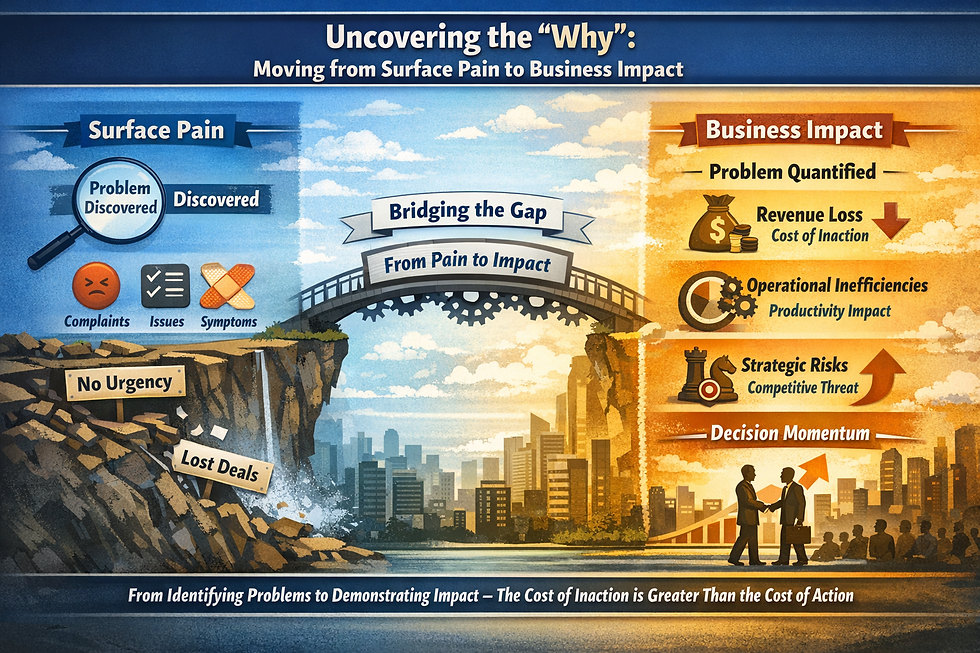
The Critical Difference Between Pain and Impact
One of the biggest problems in enterprise sales is the difference between pain and impact.
Too often, the deal arrives at a stage where there is recognition of a problem, but no sense of urgency about addressing it.
It's here where the deal breaks down.
The problem is real enough, but not serious enough. It is one of many competing issues, easily overridden by other priorities.
This happens because the problem has yet to be framed in business terms.
Until you understand how the problem impacts the organization, it will never receive the attention it deserves.
Enterprise sales discovery bridges this gap.
How to Turn Your Customer's Pain into Revenue for Business Impact
Transitioning from customer pains into impact requires some method.
Start by considering the ways in which your problem influences multiple facets of the business.
The first one is the monetary loss.
Each problem comes at a price tag. Whether this loss is a direct loss of revenue or the rising costs, every problem carries some sort of monetary burden.
For example, an inefficient procedure may mean slower cash flow or increased operational expenses.
Once these figures are calculated, the problem acquires meaning.
The second one is the operational inefficiencies.
Some of your pains might affect your customer's team and its operations. In this case, it means the problem has a direct effect on the daily performance and productivity of the company.
The third one is the strategic risks.
In this case, the influence is harder to notice, but still important. It may be represented by a higher degree of difficulty to compete or scale your business.
For instance, you might experience a loss in market share due to the problem.
Why Business Impact Is Behind Executive Decisions
In enterprise environments, decisions are hardly ever made solely based on problems.
Executives work with limitations. They need to handle their budgets, resources, and opportunities according to their projected results.
That's why every decision has to be justified.
A problem without a quantifiable impact will be hard to make a priority of.
The organization may recognize it, but that won't necessarily mean they are going to act upon it.
On the contrary, a problem with an evident business impact must be solved.
If one understands the cost, inefficiencies, and risks involved in letting the issue go unsolved, then there's more reason to implement changes.
That's the importance of business impact in enterprise sales discovery.
It helps identify the problem from the same perspective as the executives approach it.
Building a Business Case With Discovery
Deal Architects look at discovery as a process of building the business case.
They do not create the value proposition. Instead, they discover it with the customer.
It starts with co-creation.
As opposed to explaining what the value is to the buyer, Deal Architects help them discover it themselves by asking the right questions.
This promotes ownership.
Since stakeholders play a part in defining the value, they become more likely to buy into the solution.
Another stage involves alignment.
Enterprise sales deals involve more than one stakeholder. The problem could mean something else to each stakeholder. That's why Deal Architects align all stakeholders about the impact.
This makes the deal smoother further down the road.
The last stage includes making the problem undeniable.
With the enterprise sales discovery process, they link it to tangible outcomes, such as cost, risk, and urgency. The impact then becomes undeniable.
The discussion then shifts its focus.
From Problem Awareness to Decision Momentum
Where there is clarity on the impact, momentum comes automatically.
There is now an understanding of the problem, not just as something to be solved, but as something that is important. The price of inaction looms larger than the price of action.
This is essential.
What it does is turn the sales process into one of alignment rather than persuasion. You are no longer trying to convince the buyer; you are educating them on the truth of their situation.
That is the beauty of business impact in enterprise sales discovery.
Conclusion: Deals Progress When the Cost of Not Acting is Known
Problem identification is merely the first step in enterprise sales.
Action is achieved when the problem can be correlated to business outcomes.
Surface problems might spark interest, but the effect makes the decision.
It is here that great Account Executives shine. They don't just point out the problem; they identify the reason why it is significant. They link problems to lost revenue, inefficient processes, and potential risks.
By employing enterprise sales discovery, they formulate a powerful narrative around the problem.
What really sets them apart, however, is their ability to demonstrate that not acting is even more costly than taking action.
For in reality, when the cost of inaction is known, there is no other choice but to take action.
This is how deals progress.
This is how alignment occurs.
And this is what truly makes the difference between good sales professionals and Deal Architects.


Comments