What is Dark Social and Why is it Ruining Your B2B Analytics?

Introduction: The Biggest Blind Spot in Modern B2B Marketing
Your marketing metrics dashboard shows a positive story. You see growth in organic traffic, direct visits increase, and recent marketing initiatives produce good engagement numbers. And yet, when you close another deal, you often wonder how the customer came across your brand in the first place.
This kind of dilemma represents one of the biggest issues in today's B2B marketing. Customers no longer proceed from viewing the ad, reading the white paper, downloading something, and requesting a demo. They explore different vendors using private communication, industry communities, podcasts, LinkedIn groups, and peer recommendations. All of those things usually remain outside the scope of conventional analytical tools.
All of that represents what is referred to as Dark Social. Although it has an important influence on the decision-making process of customers, it does not receive any attention in the context of marketing reporting.
In the current article, we will define what Dark Social is, what makes Dark Social a huge blind spot in B2B analytics, and why it is crucial to comprehend Dark Social to improve marketing attribution and achieve sustainable revenue growth.
What is Dark Social?
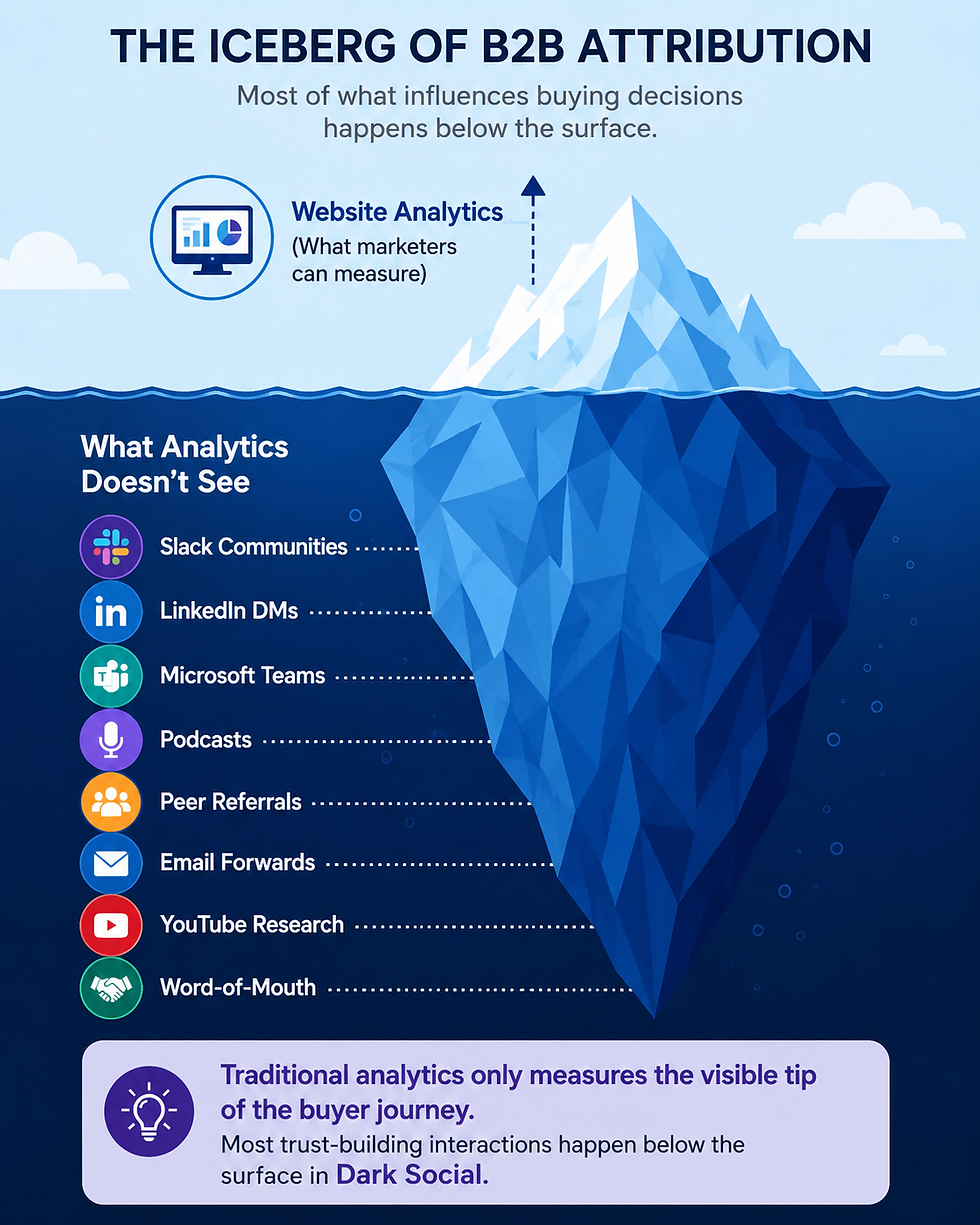
Dark Social is a term used to refer to the online interactions and content sharing that cannot be tracked using conventional analytics tools. Despite its misleading name, Dark Social does not imply any suspicious or unlawful online behavior. Rather, it means a closed digital environment where people exchange their information anonymously.
For the world of B2B, Dark Social plays an extremely important role within the purchasing funnel. In the process of selecting vendors, decision-makers use not only Google searches but also recommendations from other experts, questions asked in closed groups, industry specialists' opinions, and educational content before visiting vendors' websites.
Examples of Dark Social include:
Slack and Discord groups
LinkedIn direct messaging
WhatsApp and Microsoft Teams
Podcasts
YouTube videos
Email forwarding
Industry forums
Peer-to-peer referrals
While these are important drivers of purchase decisions, most attribution tools ignore their effect on the decision-making process.
Why Traditional B2B Analytics Cannot See Dark Social
Most marketing analytics platforms use techniques to measure events that can be tracked using cookies, UTM tags, referral URLs, and tracking pixels.
The traditional system has been working effectively since the buyer journey has been linear. The buyer saw an ad, downloaded some information, received some emails, and finally asked for a demo of the product.
Nowadays, the B2B customer journey is much more complicated.
Consider a scenario where a marketing director interviewed your CEO in a podcast. The marketing director listened to the interview on their way to work and then sent the link to the interview to other colleagues in a private Slack channel. Another colleague watched videos from your YouTube channel. At the same time, another colleague discussed your company in a LinkedIn message. Some weeks later, one colleague searched the name of your company on Google and booked a demo.
It can be marked as "Organic Search" or "Direct Traffic" within your analytics tool. But in fact, that purchase decision is based on a variety of Dark Social connections which are unknown to your reporting system.
The Hidden Places Where B2B Buying Decisions Happen
Private Communities
Private communities have become a haven for professionals looking for impartial advice. Slack workspaces, Discord communities, and private forums make it possible to talk about vendors without any marketing involvement from the outside.
Such discussions are more credible than any other kind of branded content since they come from experts.
Direct Messages
More and more, professionals in the business world utilize LinkedIn messages, WhatsApp, Microsoft Teams, and emails for exchanging recommendations.
Something as simple as "We've had a great experience with this platform" can have a much bigger impact on the purchase decision compared to a paid ad. Recommendations like that occur all the time, but they generate no data at all.
Content Without Clicks
It's not true that any successful piece of content generates direct traffic to a company website. Often, the buyer will gather useful information via LinkedIn, YouTube, and even podcast platforms without ever clicking through to the company website.
This is because a LinkedIn article or an interesting podcast interview can establish credibility well in advance.
Word-of-Mouth
Word-of-mouth is still one of the most potent motivators for B2B purchasing decisions. Recommendations made at conferences, virtual meetings, networking opportunities, or one-on-one discussions have an impact on the vendor choice much greater than marketing campaigns.
However, all these activities are not included in the attribution reports, although they have a considerable effect on revenue generation.
Why Dark Social is Ruining Your B2B Analytics
Dark Social is not the problem; the problem arises from using only the traditional models of attribution in evaluating the performance of your marketing efforts.
If you concentrate only on measurable clicks and conversions, you run the risk of missing activities that actually motivate the buyer. Branding activities, thought leadership activities, podcasts, and community building will appear inefficient because they cannot be traced via software.
It presents the following problems:
More marketing budgets go towards easily trackable marketing campaigns than high-impact brand campaigns.
Valuable content gets replaced with gated assets to drive form fills.
Senior leaders don't have insight into the true motivators of the purchases.
Incomplete metrics become the benchmark of marketing performance.
The organization tends to optimize for what its dashboards track rather than for what their customers value.
The "Direct Traffic" Illusion
When the marketers celebrate growth of their direct traffic, they think that people type the address of their website manually to visit it. It may happen, but in most cases, direct traffic stands for a different concept.
The person learns about you from a podcast, hears a recommendation of your product in a closed Slack channel, or discusses your product in a WhatsApp conversation, and only then searches for you or visits your website directly.
Since any tools can't track the previous interactions, such visits get counted as direct traffic or organic traffic.
It creates an illusion that the buyer found your company on his own, while in reality, he was affected by a whole network of invisible conversations which standard attribution can't pick up.
The Cost of Ignoring Dark Social
Ignoring the concept of Dark Social may result in business ramifications.
Marketing departments will limit spending on thought leadership programs, podcasts, community efforts, and educational materials because such tasks seem hard to measure. On the contrary, they keep spending on campaigns producing great results in terms of numbers yet delivering nothing in sales.
This gap may lead to tensions between Marketing and Sales as well. It is typical for salespeople to listen to buyers mentioning podcasts, industry talks, and references from other companies while marketing people attribute results to search engines or direct visits.
Companies that overlook Dark Social run the risk of making poor business decisions based on partial information.
A Better Way Forward
The upside is that Dark Social needn't be dark forever.
B2B companies that have their eyes on the future are beginning to use hybrid attribution techniques that combine technology-based tracking with insights about buyers gained through qualitative means. Instead of simply using analytic tools to gather insights, these organizations turn to their prospects to ask how they found out about the organization.
Not only do these tactics give a much clearer picture of what the path to purchase looks like, but they also enable companies to spend money wisely on the channels that matter.
Future blogs in this series will cover specific strategies such as self-reported attribution, hybrid attribution models, and sales discovery techniques.
Conclusion
The knowledge of what Dark Social is has become imperative for any B2B marketer. The modern customer journey goes way beyond clicks, cookies, and pixels. Customers build trust through conversations, professional communities, podcasts, videos, and referrals before showing up in your analytics report.
Dark Social is not making B2B analytics irrelevant due to unpredictable customer behavior. It uncovers the flaws of the current attribution models, which have been developed for a different digital world.
Companies that understand these changes can better allocate their marketing budget, enhance their Marketing and Sales collaboration, and know more about what brings revenues. When B2B buyers continue changing, the companies that will prosper will be those who measure not only what is easy to track but what really impacts their buyers.


The next replay might be the one where everything finally falls into place in Friday Night Funkin FNF. Give it another shot and enjoy the satisfaction of a clean performance.