Podcasts, DMs, and WhatsApp: The Untrackable Future of B2B Sales

Introduction: The Future of B2B Sales is Already Here
The way companies drive B2B sales has evolved significantly in recent years. Today's buyers do not rely on websites, sales meetings, and downloaded content to consider prospective providers of services. They study for weeks or even months through podcasts, exchanging recommendations via direct messages in LinkedIn, and discussing solutions in private WhatsApp groups prior to reaching out to a business.
It is challenging for marketers and sales teams because many of the interactions that impact purchase decision-making take place far from traditional analysis tools. A podcast interview can prompt a buyer to look into your company. Your solution can be recommended by someone you trust in a direct message. There may be a discussion of your product in a WhatsApp group that no one visits yet. And all of these interactions will not show up in a marketing dashboard.
This is the future evolution of Dark Social. If you want to be successful in B2B sales, you should be ready for it.

The B2B Sales Journey No Longer Begins with a Website
The old-school B2B buying process was pretty much consistent. Prospects went online, found a vendor website, read a white paper, watched a demo, and talked to a sales rep. Marketing had visibility into most of the customer journey through campaign links, referral sources, and website analytics.
Modern buyers take a completely different route.
Enterprise buyers research vendors way before engaging with them. They get input from industry experts, follow them on LinkedIn, seek opinions of their peers, and join discussions in private communities. By the time they land on a vendor's website, they might know all about the industry and be familiar with top players, having selected their short-list.
It has completely changed the paradigm of marketing. It does not just need to drive traffic to the website anymore; it has to establish credibility in places where prospects look for it. And many of those places are hidden from traditional attribution tools.
Why Podcasts Have Become Strong Sales Influencers
Podcasts have become one of the most trusted sources for professional learning for executives and business leaders. Unlike a short ad or a marketing email, the podcast enables experts to dive into industry problems, talk about experiences, and share their thoughts on industry trends.
This medium enables building up credibility over time. A founder talking about customer problems or a subject matter expert sharing their opinion on market trends can do that much earlier than a selling moment happens. Podcasting is not about directly selling a product. Instead, it focuses on educating audiences and establishing the brand as a trusted industry authority.
The influence of podcasts is usually gradual. A person listening to several episodes throughout several months can be passive for that period of time. However, once a business problem appears, the person will remember the company, find their website, and ask for a demo.
From the analytical point of view, this traffic will be considered as direct traffic or organic search. The podcast that has made that awareness will be unaccounted.
That is why podcasting has become one of the most influential and least measurable sources of modern B2B sales.
LinkedIn DMs: The Place for Private Professional Recommendations
Marketers tend to care about public metrics such as impressions, likes, and comments. But in fact, many of the most important discussions take place after a post gets out of the public eye.
LinkedIn direct messages have now become an essential tool for professional recommendations. Managers exchange useful articles, recommend vendors, introduce consulting partners, and continue their discussions after the public posts.
A marketing manager can forward an interesting article to their peer while adding a brief recommendation of a certain company. A technology manager can recommend a vendor after hearing someone discuss their problem. These conversations feel personal because they are built on professional relationships rather than advertising campaigns.
While recommendations have great value in the decision-making process, attribution tools cannot track those discussions within LinkedIn messaging.
For many companies, the true value of LinkedIn goes far beyond public metrics.
WhatsApp and Private Messaging Influence Enterprise Buying
WhatsApp has become much more than just a personal messaging tool. In many countries, business people use it to communicate with colleagues, customers, and members of the industry.
Enterprise buying teams use WhatsApp to discuss product recommendations, compare vendors, send screenshots, and talk about pricing. Since these communications take place in closed groups, they cannot be analyzed through marketing analytics tools.
Think of a procurement manager who sends out product comparisons to a number of people. One of their colleagues passes them a product recommendation from an industry contact. Meanwhile, a senior executive shares a podcast interview with the company founder. During the next few days, the buying committee will discuss all options and decide which vendors to investigate further.
Finally, one person will visit the vendor's website to book a demo presentation.
Analytical software will record the website visit but will miss everything that was communicated to this person beforehand.
Why These Channels Are Difficult to Measure
Attribution methods are reliant on measurable digital signals like referral links, cookies, tracking pixels, and campaigns. However, this works well only when customers interact with open websites and click on ads.
Private communication channels are a different case altogether.
Podcasts are commonly consumed via listening applications with no data to refer back to. LinkedIn direct messages, WhatsApp chats, forwarded emails, and internal messaging platforms all operate in private environments, leaving marketers with no visibility into these interactions. When a customer is provided a shared link, the referral data can be stripped out even before they visit the website.
Therefore, customers who have been persuaded over many weeks of conversations show up in the reports as direct traffic or branded searchers.
As a result, marketers are left without a complete picture of their marketing performance. Attribution software can measure the last click but not the experiences leading up to the visit.
In today's Dark Social environment, marketers need to realize that software measures results better than influence.
What This Means for Modern B2B Marketing and Sales
Increased importance of the role of private communication channels means that business owners need to change their strategies in terms of marketing and sales processes.
In addition to driving clicks, organizations should focus on providing useful content that would be desirable to share with other colleagues. Podcasts, interviews, industry discussions, and useful LinkedIn content will remain relevant through private conversations long after their launch date.
Building the personal brands of founders, executives, consultants, and industry experts is equally important. There are much higher chances that someone would recommend useful information provided by a respected person rather than through a traditional marketing campaign.
Collaboration between Marketing and Sales is essential for identifying the process of discovery by which people learn about the company. Through calls, customer interviews, and questions regarding attribution, it becomes possible to get valuable information about the process of discovery.
Preparing for the Untrackable Future of B2B Sales
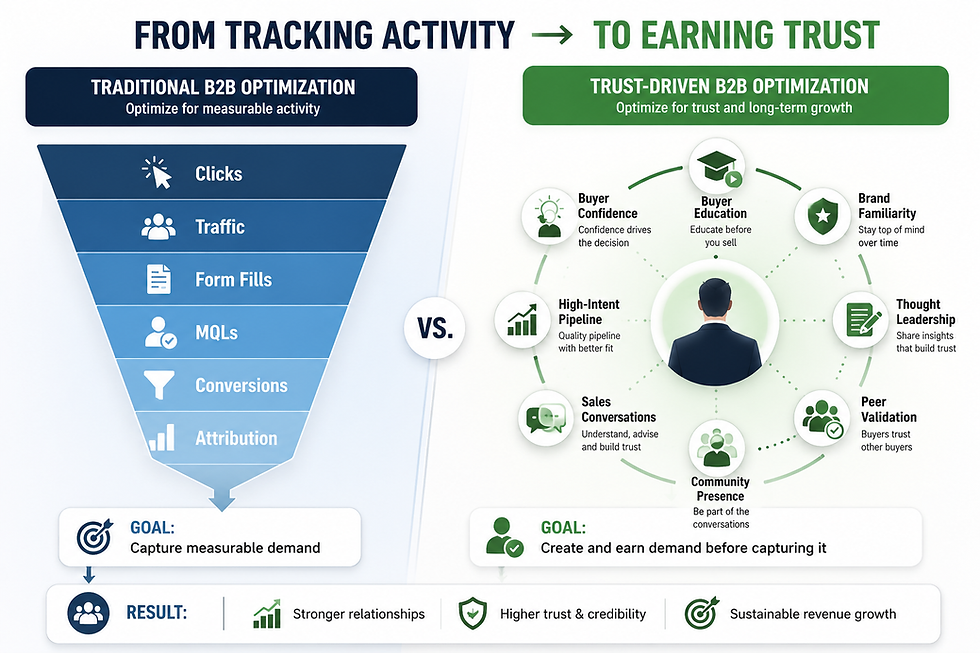
Perfect attribution is an ever-diminishing possibility in a changing buyer landscape. Rather than attempting to track every interaction, companies should focus on influencing buyers through multiple trusted channels.
This includes combining website analytics with customer feedback, CRM data, self-attribution, and the sales conversation in order to figure out the process by which decisions are made. It also includes recognizing that certain marketing activities are not possible to measure accurately.
Firms that work consistently on educating customers, community engagement, executive leadership, and customer advocacy are likely to generate more demand than those firms that rely only on their measurable campaigns.
The key to success in B2B sales today is less about tracking clicks and more about establishing trust prior to the start of the sales process.
Conclusion: The Conversations That Close Deals Often Leave No Digital Trail
B2B sales of the future will be defined by conversations that take place outside of company websites. Podcasts, direct messages from LinkedIn, WhatsApp, and many other private conversation channels are trusted sources for business customers looking for advice and recommendations.
These conversations do not produce any attribution data; however, they often play a crucial role in deciding which vendors business customers investigate, trust, and select in the end. The companies that rely solely on classic analytics may miss some of the most valuable sources of demand.
As Dark Social becomes an integral part of the buyer journey, the most successful organizations will shift their efforts from the constant tracking of all interactions to generating engaging conversations. Companies will invest in the development of expertise, educational content, and relationships that will naturally spread through private networks.
The future market leaders will not necessarily be the most visible companies online. They will be the ones that business customers learn about well before visiting any website.


Podcasts, private messages, and WhatsApp referrals often influence B2B deals long before a trackable website visit appears. Since perfect attribution isn’t realistic, I’d focus on creating material people genuinely want to pass along. Vladenza can turn a founder’s experience into credible linkedin marketing through practical opinions, case-based stories, useful lessons, and consistent interaction with the right professional audience. Those posts give podcast listeners and private contacts something concrete to share or revisit later. I’d track profile views, branded searches, qualified conversations, and self-reported attribution rather than judging the entire channel by last-click conversions.