The Evolution of RevOps in a Community-Driven B2B Landscape
- ClickInsights

- 20 hours ago
- 5 min read
Introduction: RevOps Must Evolve With the Modern Buyer Journey
Revenue Operations has become one of the most crucial functions in modern B2B businesses. Previously, RevOps was primarily concerned with system management, data quality, forecasting, and performance reporting. While all of these activities remain relevant, the modern buyer journey calls for an expanded remit.
Modern B2B buyers very seldom transition directly from a marketing campaign into a sales conversation. Buyers research independently via LinkedIn thought leadership, podcast listening, private communities, knowledge from employees, and peer reviews well before they even become measurable in a CRM. Most of this research is conducted via Dark Social, leaving major gaps in the reporting picture.
The evolution of RevOps stems from these changes in the buyer journey. Revenue Operations needs to stop being just about systems and instead become the function that integrates Marketing, Sales, and buyer insight into one holistic view of the customer journey.

Why Traditional RevOps Reporting is No Longer Enough
RevOps reporting has been traditionally focused on measurable data. Web traffic, campaign reporting, CRM data, pipeline analysis, and conversion metrics give us insight into how our company is performing. But these reports allow for analysis of marketing efficiency, tracking of sales activities, and future revenue predictions.
But the truth is, such reporting captures only those interactions taking place in measurable digital space. It does not track what podcasts got the buyer engaged with the company, what LinkedIn post created trust, and what recommendation of a known industry expert made the buyer do more research.
With buyer behavior becoming more community-based, these intangible factors become increasingly important in making purchase decisions. RevOps teams relying solely on software attribution risk getting an incomplete picture of marketing performance and customer acquisition.
For better decision-making, Revenue Operations needs to go beyond traditional reporting and start considering these intangibles.
Community-Driven Buying Requires a New Revenue Perspective
How B2B purchasers assess their vendor options has been dramatically altered. Buyers no longer get their information by sales pitches or visiting corporate websites, but rather draw insights from a wide array of trusted sources before engaging with a business.
These include following industry thought leaders on LinkedIn, joining professional groups, listening to podcasts, watching training videos, and getting peer referrals. This helps buyers build their confidence and make decisions well before there are any signals of purchase intent.
As many of these activities happen outside of traditional analytics tools, the attribution solution does not give a full picture of demand generation. Marketing might know about the website visit, while sales might be aware of the referral, but none of that shows up in any of the dashboards.
RevOps needs to have a more comprehensive view on the matter. Knowing how to drive revenue today involves not only interactions but also community-driven experiences.
The Evolution of RevOps Through the Hybrid Attribution Framework
Among the significant advances in the RevOps evolution is the use of a Hybrid Attribution Framework. Instead of focusing on only one source of data, this strategy uses different points of view to build a comprehensive overview of the buyers' actions.
Marketing provides the data about campaigns, website performance, and engagement. Sales provide qualitative data from discovery conversations and self-attributed information. CRM keeps customers' data, while buyer feedback gives an extra layer of information that cannot be provided by software.
In this case, Revenue Operations will have to integrate all of these sources into one reporting framework. Instead of arguing about whose data is right, RevOps will take both qualitative and quantitative data and use it to describe not just what buyers do but also why.
It gives additional business intelligence and enables leaders to assess the value of their marketing efforts more accurately.
RevOps as the Bridge Between Marketing and Sales
One of the biggest areas where RevOps can be used to its advantage is bridging the gap between Marketing and Sales. The two teams offer important insights into the buyer journey, but they use different measures and reporting systems.
Marketing knows campaign performance and demand generation. Sales knows the motivations of buyers, competitive evaluation, and conversations impacting purchase decisions. RevOps brings these worlds together through reporting systems that merge performance with the qualitative buyer journey insights.
However, RevOps' job does not stop here. It helps create processes for proper attribution, discovery insight organization, and shared reporting, and it gives leadership a holistic view of customers.
When Marketing, Sales, and RevOps have access to the same data, organizations avoid siloing and gain a better picture for making decisions strategically. Collaboration becomes easier since everyone has the same idea of how demand creation turns into revenue.
Redefining Revenue Measurement Beyond Traditional Metrics
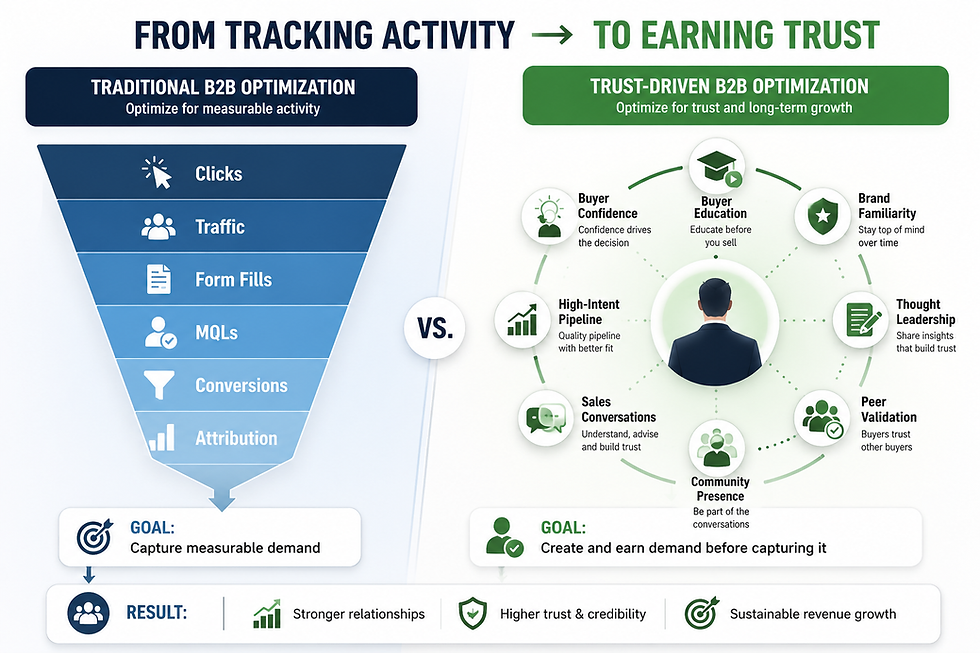
Moreover, the change in buyer behavior will make companies reconsider what success means to them and what metrics should be used for measuring it. Although the conventional marketing metrics like Marketing Qualified Leads, website visits, or campaign engagement can still work for some operational purposes, they do not necessarily demonstrate any business value.
RevOps is supposed to help the leadership focus on the metrics that correlate better with revenue growth. For example, high-intent pipeline, opportunity quality, revenue contribution, customer acquisition quality, win rates, and self-attribution trends are more effective metrics that indicate how well a company performs.
Such metrics will motivate Marketing to produce quality leads, and Sales to concentrate on high-value leads while providing more business visibility to leadership.
Building a Revenue Intelligence Function for the Future
The future of Revenue Operations lies beyond just reporting on past performance. RevOps is gradually evolving into a revenue intelligence function where an organization gets to know about the buying behavior of its customers and future trends.
It involves getting qualitative insights from buyers, recurring attribution patterns, ensuring quality data, and constantly optimizing the Hybrid Attribution Framework. Rather than just presenting dashboards to the company's leaders, RevOps gets to explain what drives their customer behavior and how their marketing and sales strategies need to be aligned.
With community-driven buying becoming more common, this intelligence offers a competitive edge to organizations because it enables them to know what drives trust, influence, and sustainable revenue generation.
RevOps teams who adopt this expanded scope of functions will be able to offer much more to their companies' leaders.
Conclusion: The Future of RevOps Is Understanding the Complete Buyer Journey
RevOps development is not only about embracing new tools. This trend is about adjusting to a buyer journey that has become more complicated, more community-based, and harder to measure with the help of software alone.
Though traditional reporting is still needed, it should be supplemented with qualitative information about the buyer gained from self-attributions, sales discovery interviews, and customers' feedback. This combination gives RevOps a broader vision of how buyers become aware of vendors, compare them, and select one.
Moreover, such RevOps activity encourages closer collaboration between Marketing, Sales, and management, resulting in proper investments, successful demand generation, and robust revenue strategy.
In the time of Dark Social, the best RevOps will not be measured by the number of dashboards they have created. The best RevOps will be known for helping the whole company comprehend the whole buyer journey and leverage this knowledge to achieve sustainable growth.


Comments