Why Incentivizing "Trackable Clicks" is Destroying Your Content Quality
- ClickInsights

- 2 days ago
- 6 min read
Introduction: When Marketing Starts Serving Dashboards Instead of Buyers
Imagine two pieces of content produced by one company. One of them is an original report, which includes valuable insights obtained through customers' interviews and personal experience. The other one is a short article that is created based on trending keywords and a strong title to get more clicks. After a month, the second article brings more traffic to the company website and shows higher performance in marketing dashboards compared to the industry report.
Which piece of content will be deemed successful?
In most companies, the answer is going to be the one that delivered more measurable results. That is how the new reality of B2B content marketing has emerged. Instead of discussing whether the content educates the buyer or builds trust, the marketing teams are now concerned about how many clicks, downloads, and form submissions a certain piece of content can bring. Even though the metrics are important for B2B companies, prioritizing them all the time may lower the quality of content.

The Transformation of KPIs on the Purpose of Content
Content marketing used to rely on the basic notion of educating the potential buyer before making him interested in buying the product or service. This type of marketing implied providing a buyer with extensive guides, research papers, case studies, etc. The key factor of success was building credibility and trust through content.
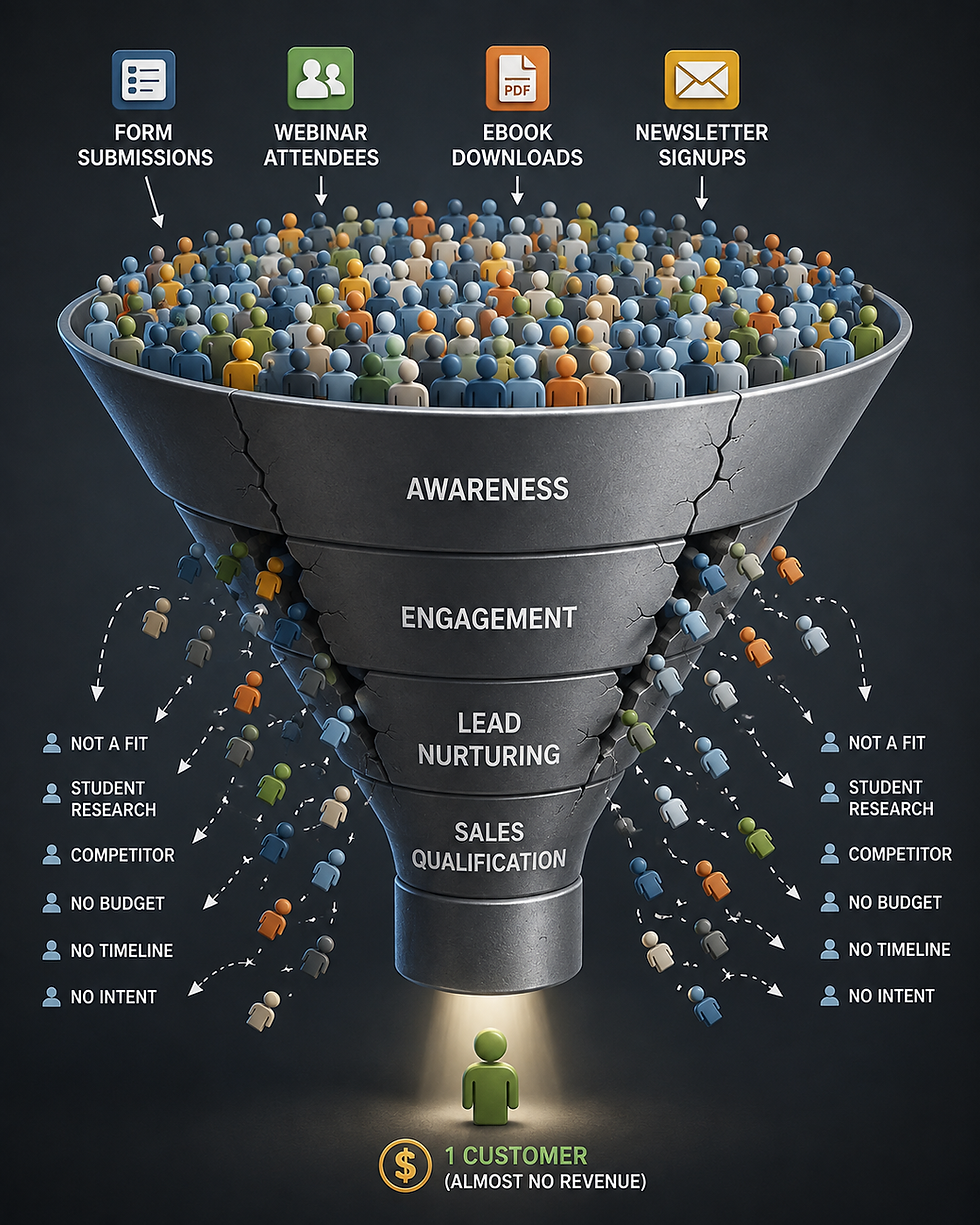
When marketing became more dependent on data, the focus began to change. Senior managers asked for some metrics that would prove that money spent on content marketing is worth it. It led to counting metrics like the number of visitors to the website, click-through rate, form fills, downloads of the content, and cost-per-lead.
It is important to note that such metrics became the primary criterion of success. Marketers were evaluating the content by the amount of activities it was generating rather than by its value. Naturally, marketers adapted to such new criteria.
Thus, content used to be helpful for buyers to make good decisions but later on turned into activities-generating content.
Why Trackable Clicks Don't Always Reflect Buyer Influence
A click proves to a marketer that someone engaged with the content but says nothing about whether it had any influence over a buying decision or whether it changed the buyer's perception.
Enterprise buyers often consume valuable content without clicking a link or leaving any measurable trace. It could be an episode of a podcast educating about a better approach to handling a business situation, a LinkedIn post from the founder of the company explaining an industry trend, or an interview with the company's executives gaining trust among decision-makers.
All of these are usually influential in buying decisions but don't ever appear in an attribution report.
This applies to the content shared using Dark Social. An article recommended in a Slack community, a screenshot posted via WhatsApp, or a research paper mentioned in a LinkedIn DM can all contribute to purchase decisions without leaving any referral traffic data.
It is important to remember that in focusing on clicks, marketers can miss the essence of their job – which is to educate, influence, and gain the buyer's trust.
Influence cannot always be measured in terms of instant engagement.
The Hidden Cost of Optimizing for Clicks
Once an organization starts putting more emphasis on clicks, certain changes will be seen in content strategy.
Marketers will focus more on catchy headlines, relevant keywords, and SEO content since such content has a greater chance of bringing traffic. It will become more and more usual to create gated content because downloads can be measured more easily compared to discussions. Writers will create content faster and without thinking about original ideas too much.
The consequence of such an approach will be more content created but less high-quality content produced.
Potential buyers will start seeing numerous repetitive articles containing information that can be found in other places. The majority of blog posts will include industry tips but no actual expertise and experience. Content becomes more about optimizing content for an algorithm and for reporting metrics rather than solving any problem.
The content types that actually make an impression on enterprise buyers—research, customer success stories, interviews with experts, and industry analysis—will not get enough attention due to being hard to measure.
Why Modern Buyers Prioritize Expertise Over Promotion
Modern business buyers have access to a plethora of information. They can browse through numerous articles, watch videos, compare software providers, download whitepapers and case studies in just minutes. Information as a competitive differentiator is a thing of the past.
Nowadays, what modern buyers need is expertise.
Buyers appreciate insights from people who have already faced and resolved similar challenges before them. Experienced consultants, practitioners in the industry, founders, customers and other subject matter experts get more recognition than any promotional material.
This trend is in tune with the evolution of content on the whole. Search engines and AI-based discovery platforms tend to reward content that shows true expertise, authority and credibility. In the same way, buyers also recommend content that provides valuable lessons to learn, not just promoting a company.
The best content deals with challenging questions, provides a new point of view or shares hard-earned experience. It receives attention because of the value, not because of its compelling headlines and calls to action.
For modern B2B companies, expertise has become a better strategy for growth than promotion.
How Dark Social Changes the Definition of Great Content
Dark Social is affecting not only the way customers find organizations, but also the way they assess and distribute content.
Traditionally, marketers measured success based on website visits, social shares, and content downloads. These days, much of the content that drives the greatest results is distributed via closed channels of communication that any analytical platform cannot detect.
It can be a podcast episode mentioned during a leadership discussion. It can be a LinkedIn article republished in a closed Slack channel. It can be a helpful chart from a research publication distributed through WhatsApp chat where people discuss their software choices. It can be a newsletter distributed among several coworkers who are assessing vendors.
None of these activities can be measured in marketing metrics, but these activities can drive purchasing decisions.
It impacts the definition of great content. Great content is not just content created for attracting clicks. It is content that becomes a part of professional discussions.
Organizations need to concentrate on creating shareable expertise – the content that professionals want to share with their colleagues because it will help them solve important business issues.
How To Build Content Strategy On The Basis Of Buyer Value
In order to increase content effectiveness, it is necessary to reconsider the goal of content marketing. In other words, instead of counting clicks that certain content may have, it is better to think about how useful it is for buyers when making a decision.
The most effective content strategies are those that solve business issues via innovative thinking, helpful suggestions, buyer insights and expertise in a particular industry. Content should be unique and original and not just another source of information available to everyone.
Valuable content also implies zero-click content that allows buyers to receive valuable insights from LinkedIn, YouTube, emails, webinars and podcasts without visiting landing pages. In this way, content creators build trust even before measuring any conversion.
Finally, the marketing department should reconsider the criteria for measuring content success. In some cases, sales conversations, buyer feedback, self-attribution, pipeline influence, and buyer mentions can show better results than clicks.
When organizations consider buyer value rather than numbers, they produce useful content.
Rethinking Success in Content Marketing
Content marketing today needs a wider definition of success. Website traffic and engagement data are valuable, but they must no longer solely drive decision-making on strategy.
Marketing professionals must also be mindful of qualitative measures of increasing trust in the market. Are prospects referencing your articles in discovery calls? Do your customers refer your research to their colleagues? Are your executives becoming respected thought leaders in the industry? Do your buyers refer your insights prior to reaching out to Sales?
These can be signs of greater influence than just data from your dashboard.
When measuring success in content marketing, you need to have both quantitative data and qualitative insight from your buyers. Together, they give you a much more realistic picture of how your content performs.
The real goal of content marketing isn't to get traction. The true goal is to shape perceptions, earn credibility, and influence buying decisions.
Companies that understand this difference will create better content and gain a competitive edge.
Conclusion: Stop Rewarding Clicks and Start Rewarding Trust
The need to show tangible results has made many companies favor content optimized for clicks above content created for clients. Although site visits, downloads, and other engagement statistics still matter a lot, there is more to it. The numbers may indicate user interaction, but they do not necessarily mean user influence.
Expert, unique, and valuable content has all three characteristics. It solves hard problems, shares useful experience, and builds trust by educating people rather than promoting the business. As enterprise buyers are turning more and more to peer recommendations, dark social media channels, and podcasts, the content that makes an actual difference in business is the one that sparks conversations instead of making conversions.
It is time for marketing professionals to keep tracking engagement metrics, but at the same time start asking themselves additional questions. Does the content educate buyers? Does it increase the company's reputation? Is it worth recommending to other people?
In today's buyer journey, B2B content marketing belongs to companies that move from rewarding clicks to rewarding trust.


xfinity gateway login — This interview offers practical and inspiring advice for graduate students interested in organizing local workshops. Alex Moon’s experience shows how collaboration, planning, and initiative can turn an academic idea into a successful community learning event.