Breaking Bread: Why the Best Business Happens Outside the Boardroom
- ClickInsights

- 3 days ago
- 7 min read
It all sounds perfect: a formal sales meeting in a business setting where the seller presents the product, its capabilities, and its return on investment, answers any questions, and goes into implementation strategy. They leave with all the information they need. The business still isn't decided.
And then they continue their talk over lunch or dinner. No more PowerPoint presentation. All the slides have been closed. Discussion gets more casual and personal as the buyer starts talking about their problems with implementation, prior bad experience with vendors, or an executive whose support they're still trying to get.
That's when the seller starts seeing things differently.
And that is the business value of relationship-based business in APAC. Informal conversations don't replace formal procurement, financial considerations, or product review process. But they might make those processes work better.
In difficult B2B deals, the boardroom might create the business case, but relationships make the sale happen.

Why Formal Meetings Have Limits
Business meetings are formal affairs. They have agendas, follow presentations, and people attending these meetings come with certain questions. All of these aspects are needed when an organization needs to assess pricing issues, technical ability, implementation needs, security, and possible business results.
However, formal business meetings often constrain people from speaking freely.
It can happen that the stakeholder has problems with the vendor, but he does not want to mention them in front of his colleagues. The executive may have worries related to the implementation, but he wants to express them in private. The department head can be concerned with the impact of the project on his department, but he does not want this concern to be formally mentioned.
All these aspects are hard to incorporate into the formal presentation.
The informal discussion of the problem can create the atmosphere where the buyer can become more open regarding the actual state of affairs.
That is why building relationships can be commercially beneficial for the seller.
Shared Meals as a Vehicle for Building Trust
It is not enough that people sit around one table and eat. The real value is in the ability to have interactions in an atmosphere that is less commercial.
If, in the context of a business sales pitch, the seller is required to show their value, in the context of an informal conversation, people have more chances to listen, to ask questions, to exchange experience, and to get to know the human being behind the job description.
That makes all the difference in the business relationship-based context.
When enterprise buyers evaluate a product, they also assess the person responsible for it. Are they aware of the buyer's needs, do they communicate openly, do they solve arising problems and can be trus
Certainly, a single meal cannot make the buyer feel that way.
But informal communication can assist this process by making the two parties get better acquainted with each other.
The business goal here is not to close a deal over dinner but to build relationships.
What Buyers Reveal Outside the Boardroom
One of the main benefits of informal discussions is that they can reveal things that you will never get from an RFP or the formal presentation.
The buyer may tell you that the most important issue is not price, but risk. Someone else may let you know that a previous vendor did not offer enough support. You may find out that you need to convince a certain executive first.
All these pieces of information can make a significant difference when evaluating the opportunity.
The requirement might be to implement a new technology platform. However, in the informal conversation, you may learn that the only thing that really matters to them is not disrupting the current processes.
In the procurement document, you may read about cost savings. But the buyers will inform you that their main goal is to increase executive visibility.
The business case gives you all the official requirements. But informal conversations show you what stands behind these requirements.
This is directly connected to subjective buying. Enterprise decisions are data-driven, but there is more to them than that.
Relationship Capital and the Long Enterprise Sales Cycle
Enterprise sales often don't hinge on one meeting.
They may take months of research, evaluation, negotiation, internal coordination, and executive sign-off.
In that period, any worthwhile exchange helps build the relationship.
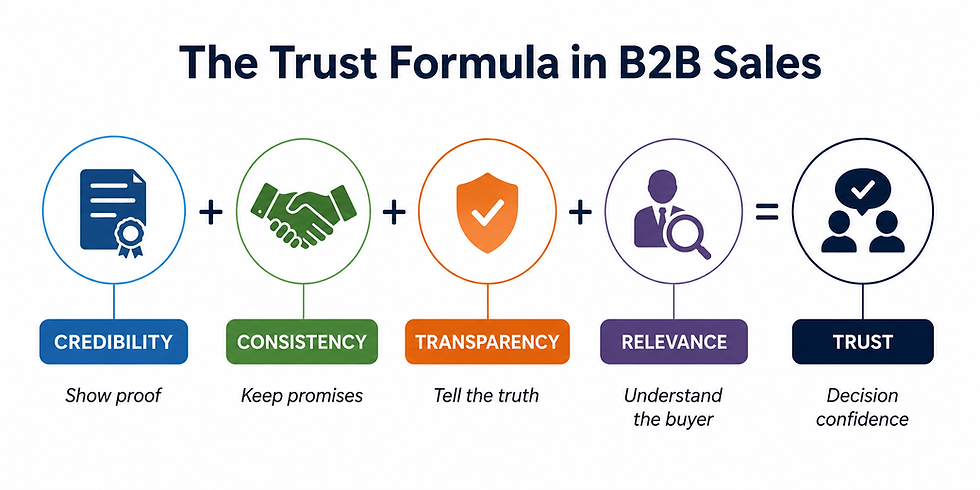
The accumulated reputation can be called relationship capital. It builds up through consistent reliability, understanding what matters to the customer, keeping promises, and being useful at all times.
A business lunch might well be just one of those exchanges.
It creates the chance to establish a deeper rapport, but it becomes much more valuable as part of a larger pattern of trustworthy behavior.
Gradually, more relationship capital can make hard discussions easier. Buyers become ready to share their worries. Sellers get insight into possible difficulties earlier. All parties become comfortable talking about organizational priorities not mentioned in the initial requirements.
None of this will guarantee a sale.
However, it can definitely improve the quality of the relationship in which the sale will be made.
This is why trust is a commercial resource rather than just a social one.
Breaking Bread and the Hidden Buying Committee
The named executive could have the final say; however, another stakeholder could wield considerable influence over the views of the executive. The technical expert may be influential due to their experience. The regional manager could know the operational challenges of which the senior management team is unaware. The internal advocate is accountable for ensuring other departments get on board with the initiative.
Such connections may not be apparent from the organizational hierarchy.
However, informal discussion could give the vendor a hint at such relationships.
The buyer might talk about the people needed for discussion, whose opinions should be taken into account, or which department has reservations about the project. Such hints would allow the vendor to understand the hidden networks of influence behind the buying committee.
The aim here is not to manipulate internal connections and circumvent the procurement process. The objective is to understand how the consensus is built in reality.
In B2B transactions, understanding who signed the deal may sometimes be insufficient. Knowing those who influenced the decision maker can be quite important too.
The APAC Context: Relationship Before Transaction
The question of building relationships must be analyzed in depth because APAC business cultures are unique and vary across Singapore, Indonesia, Malaysia, Thailand, Vietnam, the Philippines, and other regions in terms of business traditions, industries, organization, etc.
Not everyone who purchases goods or services in the region expects the deal to be made at the dinner table. Not every company puts a high premium on informal relationships. Extremely formal purchase procedures characterize many multinational businesses.
However, business relationship practices based on the principle of building relationships can be important in certain APAC environments due to professional contacts, reputation, hospitality, and credibility.
What is important for the seller is to avoid stereotyping the entire market.
Instead, the seller must focus on the client.
The dinner should meet the client's cultural and professional standards. It should be used as an opportunity to build business relationships rather than a strategy resulting in automatic business success.
The best approach will be based on cultural understanding and observations.
The Commercial ROI of Trust
What is the ROI of the shared meal?
It certainly isn't the price of the food versus the value of the contract.
Otherwise, relationship building would be yet another short-term ROI exercise.
The value proposition for the relationship lies in what the relationship building will help accomplish. The higher level of trust can result in more open communication, better understanding of the client's needs, earlier recognition of issues, easier access to the right people, and increased trust in the vendor.
For instance, when a client trusts the vendor, they are more likely to disclose why an opportunity has been moving slowly. This disclosure presents the vendor with an opportunity to resolve the problem before losing the deal.
Alternatively, when a buyer feels confident about the vendor, they are less constrained about speaking of long-term strategic goals of the company rather than just the transaction.
This is the ROI of relationship capital.
The shared meal itself isn't the outcome. The business conditions created by the relationship can be the outcome.
Why Trust Matters More as Deals Become More Complex
The more complex the transaction, the more parties are involved in the purchase. The involvement of many parties implies many opinions, risks, and chances to come into disagreement.
Transactional purchasing can be based on evaluating the product by price and specifications of its characteristics. Strategic enterprise partnerships require different treatment.
The purchaser is ready to invest a considerable amount of money and accept certain risks. They should feel confident that the vendor will be responsible after the deal is made.
Here comes the role of trust in all its glory.
Meetings can be used to demonstrate that the vendor has appropriate capabilities. Relationships allow creating trust in people who provide such capabilities.
Such an example supports the general conclusion about enterprise sales in this report. The technology allows automating information processing, meeting summaries, account research, and other administrative activities. But it does not allow reproducing the human interaction that allows organizations to create mutual trust.
Trust is still a human advantage in relationship-based enterprise sales.
Conclusion: The Boardroom Makes the Case, but Relationships Move the Business
The boardroom will not go away. Cases must still be made. Procurement requirements must still be met. Negotiations must still take place. ROI remains important.
But the boardroom does not provide the whole picture of how business relationships evolve.
Dining together creates an opportunity for a different dialogue. Buyers might open up about their worries, which weren't addressed during the presentation. Sellers could learn more about the motivations behind the procurement requirements. Relationships may strengthen because of simple human interaction. This is also why automation has limits when it comes to building genuine client relationships, as explored in why AI can't take your client for coffee.
This is the true power of dining together in business.
It is not about using dinner as a tool to make a sale. It is about understanding that trust is built by having multiple human experiences, not just Excel spreadsheets.
And for enterprise sellers operating in relationship-driven business markets in APAC, this makes all the difference.
The business case can be made in the boardroom, but at the table, the buyer decides if they trust the people making it.


Me parece muy útil conocer de antemano los requisitos relacionados con cobrar un premio. Una explicación clara puede evitar dudas posteriores y ayudar a que el proceso sea más ordenado. Este tipo de información práctica resulta especialmente valiosa porque permite al lector saber qué aspectos debería revisar antes de realizar cualquier trámite.
One of the most intriguing aspects of scary games is their atmosphere. A dark passage, a flickering light, a faraway sound, or an object that abruptly changes may all make even the most mundane situation feel anxious. Players are never sure what will scary games happen next, which pushes them to pay great attention to their surroundings.