How to Build Trust in a Relationship-Based Economy

In the case of B2B sales, having a good product is not always enough. A good solution, competitive prices, and high ROI can open doors, but cannot make a buyer purchase on their own.
At times, there are two vendors who have very similar offerings, and one is able to earn the customer's trust much quicker. It is about trust.
In today's relationship-based economy, customers evaluate not only what a company has to offer. They evaluate whether they can trust the people who will be working with the solution and who can be counted on in the time of need.
It is especially true in the case of complex enterprise sales. Making an expensive purchase in this scenario involves many people and requires a long-term relationship. Customers need to feel confident in the choice of the right solution and the right vendor.
Trust building becomes a commercial skill.
Why Trust Matters in Relationship-Based Business
Relationship-based business transactions are uncertain in nature. The buyer is spending their money, committing their own resources, adapting to change, and taking responsibility for their choice.
Even when a vendor proves their competence in technology and product, the buyer may have doubts about what will follow after signing the deal.
Will the vendor be able to live up to their promises? Will the implementation of the solution be timely? Will the account manager be responsive and communicative? Will the vendor be truthful in case of any problems?
Such questions cannot be answered easily using only spreadsheets.
Building trust alleviates the buyer's concerns and makes them feel more comfortable while disclosing their problems and exploring solutions.
This is the reason why trust is a kind of currency in the relationship-based economy.
Build Trust Through Credibility
Credibility is how you begin building trust.
The seller can't just say, "We are credible, trust us." They have to show proof.
Proof of credibility is shown through an understanding of the customer's industry, the customer's business model, the customer's challenges and priorities, experience, credible claims, customer references, and an understanding of what the proposed solution can and cannot do.
This is where most sellers err in the sales process. Sellers often make assumptions about the problem that needs solving and jump straight to the product demonstration.
The buyer might be getting an extensive run-down of product capabilities but still not believe that the seller understands their business.
The credible sellers approach sales in a different way. They ask smart questions, make connections between industry problems and business problems, and make no promises that they can't keep.
They prove their credibility, rather than assert it.
Consistency Turns Credibility Into Trust
An outstanding one-time sales meeting does not build a trusting relationship. Trust comes from repetition.
A seller builds trust by always doing what they promise to do. They send their info on Tuesday as promised. They admit that they don't have answers and ask someone else who does.
These may be minor actions, but they are very significant.
The contrary also applies. Missing appointments, inconsistent communications, overpromising, and unclear reasons for delays could easily undermine buyers' trust.
This is especially true for long enterprise sales cycles. An involved sales process could take weeks or months to complete, including discovery, technical evaluation, business case building, procurement, and decision-making by management. All these interactions contribute to the perception of the seller by the buyer.
Consistency builds trust each time credibility is proven.
Buyers become more confident about the reliability of the seller after signing a contract because of consistency.
Transparency Builds Confidence
Trust always faces a test in case of any problem.
A seller may find out that implementation is going to be delayed. There may be a limitation on the side of the product. Some additional technical specifications may arise. The cost may become higher due to some unexpected dependency.
The decision needs to be made.
The seller either minimizes the problem, hoping that it will vanish, or communicates openly, stating what should be done next.
In most cases, the latter becomes a better basis for a sustainable business relationship.
The buyers don't expect that every project will be perfect. They know that complicated implementations are accompanied by uncertainty. What they need is assurance that their supplier will tell the truth about any problems.
Sometimes, a seller saying, "This part will require some extra effort. Here is how we suggest you do it," can be more trusted than the seller who states that everything will be easy.
Honesty removes uncertainties.
Moreover, it shows an important thing – the seller is more concerned about making a proper decision for the buyer than closing the deal.
Understand the Buyer Before Asking for Trust
The easiest way to establish trust is by showing that you know the buyer's business.
Generalized sales messages do not foster trust. Buyers are constantly being told about efficiencies, innovations, cost savings, and transformations.
What catches their attention is relevancy.
A seller who knows the customer's priorities can have an entirely different conversation than one who doesn't. Rather than talking about how their platform increases efficiency, the seller can talk about how those efficiency issues impact the customer's business specifically.
And preparation is key.
Sellers need to know the customer's business model, industry challenges, operational difficulties, strategic priorities, and implications of the problem they wish to solve.
It's not about acting like you know the customer's business better than the customer themselves. It's about doing your homework.
When customers feel understood, conversations are transformed. Rather than the sales pitch the seller is giving, it's about showing effort in understanding the customer's business situation.
This lays a solid foundation for trust in B2B sales.
Trust is Built Through Relationships, Not Transactions
A transactional seller is most concerned with the deal getting done.
A relationship-minded seller considers much more than that.
Why is this distinction critical? Because complicated business relationships seldom conclude once the deal is sealed. The customer needs assistance with implementation, communications, problem-solving, and engagement.
Thus, trust must be established over several engagements.
First, the buyer assesses the seller for knowledge. Then they assess the seller for responsiveness. Next, they assess the seller for candor in responding to tough questions. Ultimately, they make an assessment about the reliability of the company.
Each engagement becomes another piece of the puzzle.
This is why relationship development shouldn't be considered a sales tactic. A forced relationship doesn't lead to real trust.
The most successful relationships evolve naturally through meaningful conversations, reliability, problem-solving, and respect.
Relationships aren't built with the intention of looking like a trustworthy company. They're built by becoming a trustworthy company.
Building Trust Across Different Business Cultures
Building trust also entails cultural intelligence, especially when selling products in APAC markets.
Nevertheless, APAC cannot be seen as one homogeneous business culture. Markets like Singapore, Indonesia, Malaysia, Thailand, Vietnam, the Philippines, and others have distinct business cultures and practices. Also, even firms in the same country can have vastly divergent expectations.
While some firms rely on very formal procurement processes, others focus more on existing professional relationships and acquaintances.
The important thing to remember here is not to make any assumptions.
It is up to sellers to pay attention to how the customers behave, how fast they build relationships, who takes part in important discussions, and how formal the business environment is.
Cultural intelligence entails adaptation without compromise to one's core identity.
It implies accepting the preferred communication styles of the client rather than imposing a preconceived sales model on the buyer.
In relationship-based business cultures, trust is built when clients believe that the seller understands both their business and the environment they work in.
Trust is Earned Before the Contract is Signed
Trust cannot be engineered at the tail-end of the sales process.
A seller cannot sit back and wait for contract negotiations to take place in order to start earning the credibility card. By then, the buyer already has an impression of them based on all their prior interactions.
Was the seller prepared?
Were they knowledgeable about the business?
Did they give honest answers?
Were they dependable?
Did they value the buyer's time?
Did they clearly explain any changes?
All these things determine how much the buyer trusts the seller.
That is why trust is earned by being consistent right from the start in the context of a relationship-based economy. Evidence must be shown over time.
The best enterprise sellers get this. They know that trust isn't something different from selling. They understand that every interaction adds value to the relationship.
Conclusion: Provide Buyers with Reason to Trust You
In a relationship economy, consumers do not just analyze products. They analyze the people and businesses behind those products.
A powerful technology may pique their interest. A good ROI can give buyers justification for their purchase. Competitive pricing will help make the economic argument.
But trust allows buyers to feel confident about making an educated decision.
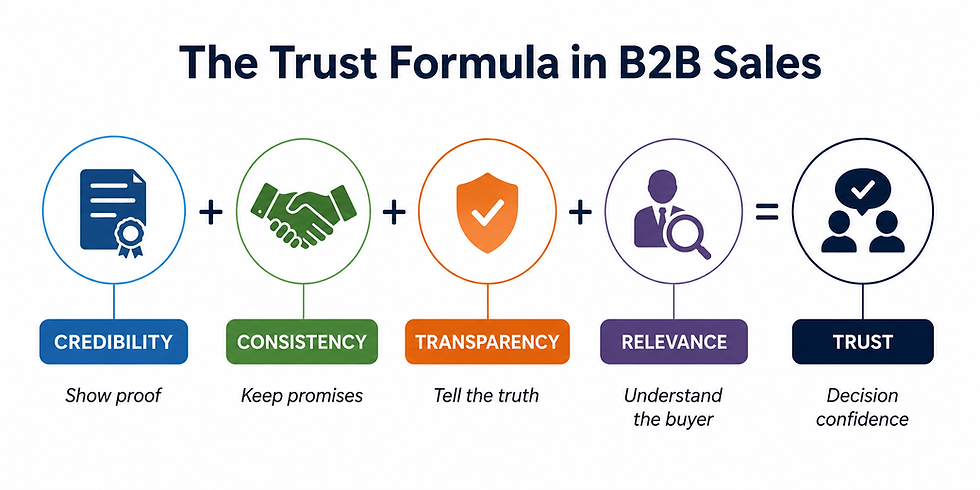
Trust is established through credibility, consistency, transparency, knowledge of the business, and building relationships. This occurs through actions and not words.
In an enterprise sales environment, this provides an enduring competitive advantage. Technology may deliver information quicker. AI may process and analyze data. The ability to earn someone's trust is inherently human.
The aim then should not be to get the buyer to trust you. Provide them with a reason to trust you.



Birthday wishes brother can include hopes that the coming year brings new adventures, career opportunities, happiness, and unforgettable memories.
Una guía de loterías bien elaborada puede ser muy útil para quienes quieren aprender antes de participar. Explicar las reglas, términos y características de manera sencilla ayuda a que el lector tenga una mejor comprensión del tema. Considero que la información educativa siempre aporta valor cuando se presenta de forma clara.