China Digital Digest Weekly: Exploring the Chinese Digital Landscape

Hi folks, we are back with our weekly edition of China’s Digital Digest, wherein we bring you weekly updates on China’s digital space. The report takes a quick glance at China’s complex and rapidly evolving social media landscape by providing updates on the latest happenings across the social media industry. Here are the major highlights of the report.
1. Many TikTok Videos on ADHD, Autism Are ‘Inaccurate’, Study Claims
Inaccurate social media posts about attention deficit hyperactivity disorder (ADHD) and autism have been linked to a rise in young people believing they have neurodevelopmental conditions, an expert has said after a study highlighted the levels of misinformation online.

Researchers say their findings present a clear need for action for more high-quality information to be shared on social media and strengthened content moderation. Experts from the UK’s University of East Anglia (UEA) and Norfolk and Suffolk NHS Foundation Trust set out to examine the quality of mental health and neurodivergence information on social media by reviewing all relevant studies on the topic relating to posts on YouTube, TikTok, Facebook, Instagram and X. The rate of misinformation ranged from 0 per cent for videos analysed on anxiety and depression from YouTube Kids to 56.9 per cent for claustrophobia videos on YouTube.
2. ByteDance Launches AI Short-Drama Agent Powered by Seedance 2.0
ByteDance has rolled out a new short-drama Agent on its AI content platform Xiaoyunque AI, enabling users to generate full video productions directly from scripts.

The tool supports scripts of up to 100,000 Chinese characters and is positioned as the first industry agent powered by the Seedance 2.0 video generation model. The system automates the full production pipeline, including script parsing, narrative structuring, character design, and storyboard generation. It supports multiple visual styles—including 2D, 3D, and photorealistic rendering—and can process multi-episode scripts in a single pass without requiring repeated uploads.
3. ByteDance to Sell Moonton to Savvy Games Group for Over $6 Billion
Saudi Arabia’s Savvy Games Group has reached a final agreement with ByteDance to acquire 100% of Moonton’s equity for over RMB 43 billion (approximately $6.0 billion).

According to multiple media reports, negotiations between the two parties began in the second half of 2025, with key terms finalized in early 2026. Industry analysts view the acquisition as a strategic move by Savvy to strengthen its presence in Asia’s gaming market. Moonton’s strong foothold in Southeast Asia is expected to give the Saudi investor a fast track into high-growth emerging markets and help complete its global gaming portfolio.
4. Alibaba Targets $100 Billion in Annual Cloud & AI Revenue Within Five Years
Alibaba aims to achieve over $100 billion in annual revenue from its cloud and AI businesses within the next five years, indicating a shift from a commerce-driven model to a technology platform, and while short-term earnings have declined, this goal reflects confidence in future growth.

In its latest earnings report, Alibaba reported approximately 36% year-over-year growth in cloud revenue, primarily driven by AI-related workloads, demonstrating that AI demand is becoming a significant part of the company's business, with AI-related revenue growing at triple-digit rates for multiple consecutive quarters. Analysts predict that the AI cloud market in China could reach $253 billion by 2033, with Alibaba facing intense competition from companies like Tencent, Huawei, and ByteDance domestically, while globally, it competes with established players like Amazon and Microsoft.
5. Siemens Expands Partnership with Alibaba Cloud to Bring Industrial Simulation to the Cloud
https://www.gurufocus.com/news/8737871/alibaba-baba-and-siemens-expand-ai-and-simulation-partnership
Siemens has announced an expanded strategic partnership with Alibaba Cloud, focusing on industrial infrastructure, automation, and AI-enabled applications.
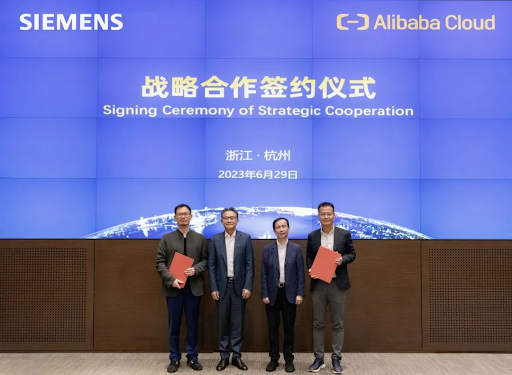
Under the agreement, Siemens will integrate its simulation software portfolio with Alibaba Cloud’s computing infrastructure to deliver cloud-based computer-aided engineering (CAE) services to customers in China via an infrastructure-as-a-service (IaaS) model. Siemens CEO Roland Busch said that bringing AI into real-world industrial applications requires an “industrial AI operating system” that connects data, software, and intelligent hardware. These capabilities will be delivered at scale through the company’s Siemens Xcelerator platform.
6. Alibaba’s Qwen Adds AI Ride-Hailing Feature
Alibaba’s Qwen has launched an AI-powered ride-hailing feature that allows users to complete bookings using natural language commands.

Within the Qwen app, users can specify preferences such as vehicle type, intermediate stops, and scheduling simply by speaking or typing. The system automatically handles intent recognition, vehicle matching, and fare estimation, with payments completed via Alipay’s “AI Pay” after the trip. The feature supports personalized constraints such as “under $3” (≈ RMB 20), “no taxis,” or “well-ventilated cars.” It can also process more complex requests, including multi-passenger bookings or route adjustments.
7. Tencent Steps Up AI Spending
Tencent Holdings reported full-year 2025 revenue of $104 billion (≈ RMB 751.8 billion), up 14% year-on-year, as the company continues to expand investment in AI.

Fourth-quarter revenue reached approximately $27 billion (≈ RMB 194.4 billion), with net profit rising 14% to about $8.1 billion (≈ RMB 58.3 billion). For the full year, non-IFRS net profit attributable to shareholders grew 17% to roughly $36 billion (≈ RMB 259.6 billion). Gaming remained a key growth driver. Domestic game revenue rose 18% to about $22.7 billion, while international gaming surged 33% to around $10.7 billion, surpassing the $10 billion mark for the first time.
8. JD.Com to Build World’s Largest Embodied AI Data Center
JD.com plans to build the world’s largest and most comprehensive embodied AI data collection center, with a target of accumulating over 10 million hours of high-quality data within two years.

The company has already established a leading robotics data collection facility and built a full-process data pipeline covering collection, annotation, training, and validation. This system spans five key scenarios—logistics and warehousing, industrial manufacturing, healthcare, home services, and urban operations—while capturing multi-dimensional data such as visual inputs, tactile feedback, and spatial trajectories.
9. Estée Lauder Appoints Xin Zhilei as Global Makeup Ambassador
Estée Lauder (雅诗兰黛) has elevated Chinese actress Xin Zhilei (辛芷蕾) to the role of global makeup ambassador, strengthening their ongoing association and once again highlighting the growing global appetite for Chinese talent in the luxury space.

The announcement follows years of Xin steadily building her presence across film, fashion, and international cinema. In 2025, she won Best Actress at the Venice Film Festival for her performance in Sun Hanging at Noon (日掛中天), cementing her status as one of China’s most compelling screen talents. Since then, she has seamlessly fused artistic credibility with high-fashion allure.
Wrapping Up
The vast and diverse nature of the Chinese Social Media space makes it incredibly challenging to keep a tab on the rapid developments taking place. However, China’s Digital Digest brings you all the latest updates from there to keep you abreast of all the evolving trends.
To delve deeper into the findings of our latest report, click here.


Comments