Embracing the Mess: How Elite AEs Succeed in Enterprise Ambiguity
- ClickInsights

- Apr 26
- 5 min read
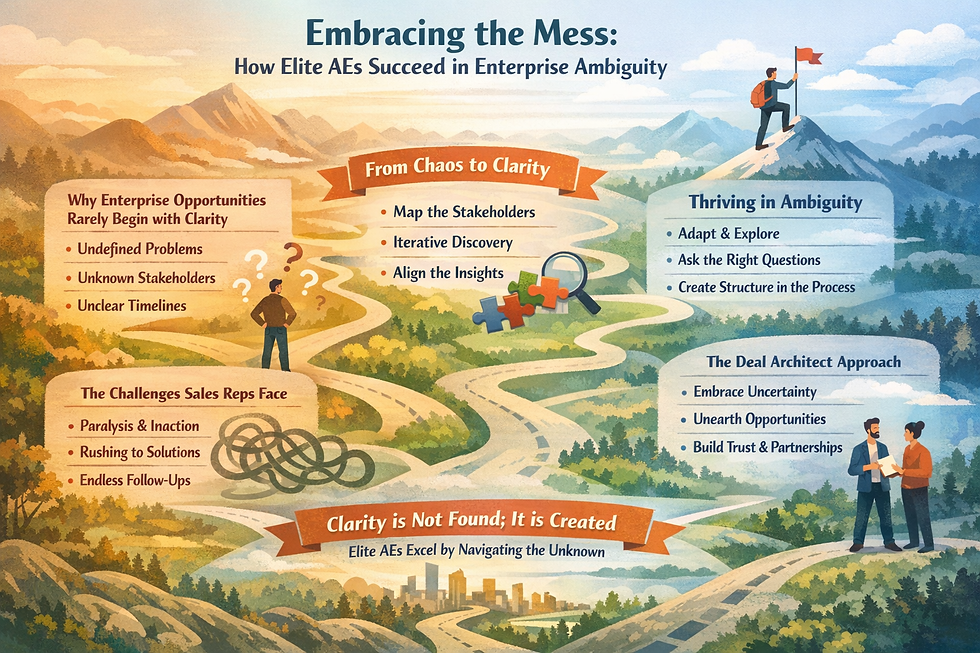
Introduction: Why Enterprise Opportunities Rarely Begin with Clarity
When you have experience in complex enterprise sales cycles, you understand this fundamental truth: everything is uncertain at the start.
The buying process is not set in stone. The decision-maker has not been identified. There is no agreement on what needs to be solved. Instead, you're presented with a patchwork of incomplete information, inconsistent perspectives, and disjointed insights.
For most salespeople, this is a stressful situation. They tend to hold back until they can define their next steps. Until they qualify further, collect more information, and feel ready to move forward.
However, in enterprise sales, such a point is hard to reach.
This is what sets apart the best from the rest. They don't sit around waiting for clarity. They work amidst ambiguity and establish clarity through systematic enterprise sales discovery.
It's more than a technique; it's an approach. And it's one of the key characteristics of the Deal Architect role.
Why Ambiguity Is the Default Position for Enterprise Sales
Ambiguity does not happen by chance during enterprise sales. Instead, ambiguity is the initial position.
Corporate clients are complicated entities with different parts pursuing different goals. There are many parties that hold conflicting views on what the problem actually is. Even in cases where there is agreement on the broad picture, there is no clarity in specifics.
In the early phase of a sale, it can be observed that:
The definition of the problem is uncertain
The stakeholders are ambiguous
The criteria for decision-making are unclear
The time frame for implementation is unknown
This is not an indication of weakness in the transaction. Instead, it is an indication that the deal is authentic.
An enterprise deal begins as an unstructured situation that must be explored to make sense. This explains why enterprise sales discovery is such an important part of the process.
Why Most Sales Reps Struggle in Messy Deals
Discomfort arises when there is ambiguity, yet very few sales professionals know how to navigate it.
They use linear sales processes where there is a predictable process starting from qualification to closing. They become uncomfortable when their expectations don't match reality.
There are three main ways this manifests itself.
Firstly, some salespeople may experience paralysis. They are unable to take the next step because of a lack of information. This leads to deals stalling or being abandoned.
Secondly, some may push to solve the problem even before the issue itself has been fully addressed. In other words, they try to impose a structured approach too soon.
Finally, many fall into the trap of increasing the amount of activity. Instead of waiting for clarity, they call more frequently, meet more often, and do more follow-ups. More often than not, this just causes even more confusion.
At the heart of each of the three approaches is uncertainty.
However, certainty should not be sought but created.
Deal Architect Attitude toward Ambiguity
Deal Architects have a different attitude toward ambiguity.
It is not something they try to avoid. It is their native element for enterprise deals. They learn to thrive in it rather than getting rid of it right away.
Such an attitude change is essential.
To begin with, they acknowledge the absence of clarity at the start. For them, the beginning of any deal is an exploration process.
Next, they embrace the idea that progress brings clarity. Through stakeholder engagement, questioning, and challenging their assumptions, they add structure to the process.
Finally, they trade assumptions for discoveries. Instead of using guesswork to fill in the blanks, they leverage enterprise sales discovery to find out what is going on inside the company.
This way, they remain productive in a situation without a clear road map ahead.
Operating without a Clearly Defined Path to Purchase
Perhaps one of the toughest parts about selling in an enterprise environment is that there is no clearly defined path to purchase.
Whereas a transactional sale follows a relatively consistent sequence of events, the enterprise sales process can be fluid, evolving as new players come into play, priorities shift, and internal forces move the needle.
The Deal Architect does not wait until the buyer has a clearly defined path to purchase before beginning their journey. Rather, they craft a pathway themselves.
First, they identify who is involved in the process, even if they have yet to meet everyone on the list. Next, they leverage early interactions not just to understand the prospect, but also to gain insight into how the organization functions.
Through iterative discovery, the Deal Architect learns more and more about:
Decision influencers
Priorities
Key performance indicators
As the process unfolds, patterns will emerge. A picture begins to form.
And while the process is far from linear, it is much more productive than passively accepting the buyer's defined pathway.
How Elite AEs Create Order inside Chaos
Chaos may be an illusion when it comes to elite AEs.
Elite AEs introduce clarity into uncertainty through methodical steps.
First, they map out the stakeholders. Though they may not know everything that's going on, they make a conscious effort to identify the different stakeholders within the company. This allows them to learn the political and operational terrain.
Second, they use iterative discovery. Rather than trying to get all the information up front, they build knowledge iteratively through each successive interaction.
Additionally, they align themselves. As they discover things, they make sure that they align their findings with stakeholders so that there are no misunderstandings in the deal.
However, what they do most effectively is exercise control through clarity. They do not force anything, but rather provide clarity to the process through each step of the way.
This is the difference between structured and unstructured selling.
Why Accepting Ambiguity Improves Win Ratios
Initially, ambiguity may appear to be an obstacle. Actually, it represents a chance.
As soon as there is uncertainty in a transaction, other companies fail to act. They simply leave the negotiation table or stick to superficial methods of closing deals. This leaves room for companies that can work through the chaos.
Here are some benefits of accepting ambiguity by Deal Architects.
Firstly, they discover things that remain unnoticed by others. Unlike most businesses that are only interested in solving apparent issues, they look for underlying reasons and potential opportunities.
Secondly, they establish more meaningful connections. The parties appreciate companies' efforts to comprehend the situation thoroughly before making any decisions.
Thirdly, they develop partnerships. By helping your customers sort out all the confusion and offering viable options, you become not just a seller but also an adviser.
All of these factors contribute to better coordination and increased winning ratios.
This is how enterprise sales discovery operates in ambiguous contexts.
The Discipline Required to Thrive in Uncertainty
It's difficult to operate in an ambiguous environment. This demands discipline.
You need to avoid being tempted by the quick-fix path. You must learn to question things even when you have no ready answers. And you need to keep moving forward without having all the facts.
This sounds like a contradiction in itself, particularly in the high-stakes world of sales.
But it is precisely discipline that keeps you on track. Rather than reacting to ambiguity, you choose to deal with it deliberately.
Ultimately, this becomes your strength.
Conclusion: Clarity Is Not Found; It Is Created
Enterprise sales is not a process that you follow. Enterprise sales is an environment that evolves, and you must learn how to understand and manage it.
The most successful Account Executives don't win by having more data. The most successful Account Executives win by knowing how to execute effectively without data.
They don't wait until they have clarity before they act. They create clarity by applying rigorous enterprise sales discovery techniques.
That's what being a Deal Architect all is about.
Because in the complex deal world, the people who win aren't the ones who steer clear of the chaos.
They're the ones who understand how to thrive in the midst of it.


Comments