The Power of Extreme Patience in a 12-Month Sales Cycle
- ClickInsights

- Apr 26
- 5 min read
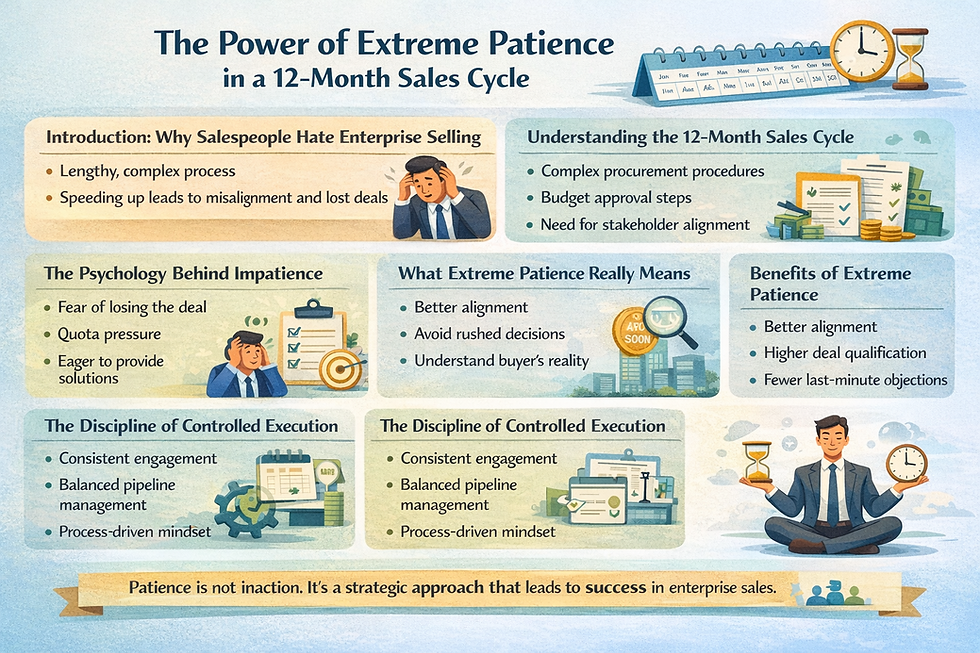
Introduction: Why Salespeople Hate Enterprise Selling
For highly motivated and effective salespeople, enterprise sales can be incredibly frustrating. The process is extremely slow and lasts for several months, even when the sales team manages to maintain momentum.
The lack of speed in the sales process triggers anxiety among many reps.
The tendency is to react and push further. Speed things up and make the prospect move faster towards closing. Unfortunately, this approach is counterproductive in complex sales scenarios.
Speed cannot lead to success in enterprise selling. Pressure will.
If used too early on, pressure will only lead to misalignment, poor discovery, and eventually lost deals.
That is why the best account executives think differently about enterprise sales. They know how to use extreme patience to create better deals.
Why 12-Month Sales Cycles Are Normal, Not Broken
One of the most common misunderstandings regarding enterprise sales involves long sales cycles.
In truth, long sales cycles are signs of complexities.
Big enterprises don't make decisions fast because their decisions are highly costly, risky, and impactful. A small mistake made during purchasing can have wide-ranging consequences.
There are many reasons why sales cycles become elongated.
Firstly, enterprises often have elaborate procurement procedures. Compliance and vendor assessment cannot be skipped just to move things along faster.
Secondly, budgets go through set approval processes. Regardless of the urgency of the matter, budgeting follows its own schedule.
Thirdly, stakeholder alignment also prolongs the process. Enterprises rarely make purchases without consulting all parties involved and obtaining their permission.
From this point of view, year-long sales cycles are natural and not overly long.
This should be the starting point of developing your patience with enterprise sales.
The Psychology Behind the Impatience in Enterprise Sales
Why are there so many sales failures caused by impatience despite lengthy selling processes being quite common?
Here's why.
The psychological conditioning to perceive speed as success is the main reason.
Many reps who are just starting their careers learn that quick replies, quick moves, and quick closings pay off.
In enterprise selling, however, it only causes damage.
One of the factors causing impatience among salespeople is the fear of losing the deal.
When the process slows down, they feel that competitors may be taking advantage of their opportunity, making the deal harder or impossible to close.
Quota pressure is another factor.
When quotas need to be met, urgent actions tend to follow.
Being helpful is yet another common source of impatience in sales.
Reps wish to provide assistance and show their expertise right away; thus, they jump into the solutions before identifying the problem and understanding customers' needs.
It all seems quite logical, but, in fact, counterproductive.
Enterprise deals won't benefit from this behavior pattern.
What Extreme Patience Really Means
Extreme patience is commonly mistaken for a lack of activity, which it definitely isn't. In fact, it may well be the most active and discipline-focused strategy in enterprise sales.
Essentially, enterprise patience means setting your own pace while letting the deal take place organically.
It starts with natural discovery. While impatient salespeople would like to hurry things up and get to closing quickly, patient ones know how important it is to learn more about the client's problems. To understand why it really is that something should change, sellers must take some time.
The next step involves avoiding any rush to make a decision. While other salespeople want to close the deal fast and make the prospect commit to something as soon as possible, those who practice extreme patience prefer to make sure that everybody's on board and the business case is fully covered.
Thirdly, this kind of patience involves understanding the reality in which the buyer works and operating within those limits, instead of resisting them.
This way, patience creates a safer atmosphere around the sale.
Patience Helps to Get More Wins
First of all, it ensures better alignment. If sellers invest time in engaging multiple people in the process and learning about their point of view, there will be no unexpected things at the end of negotiations. Everybody will know how the problem can be solved.
Secondly, it helps in better deal qualification. Patience makes it possible to have a thorough enterprise sales discovery and understand whether it makes sense to move further.
Thirdly, it reduces last-minute objections. In most cases, objections come up due to insufficient work done earlier in the process. Being patient helps to uncover and solve such objections.
Fourthly, it contributes to the development of a more effective business case. It is impossible to develop a proper business case quickly because it requires collecting evidence and getting internal buy-in. Otherwise, justification may be quite poor, thus, hard to sell.
Fifthly, it fosters trust. Sellers who are patient show buyers their desire to understand problems and provide solutions, rather than selling something as soon as possible. As a result, sellers create more trust.
In complicated situations, trust and alignment matter much more than speed.
The Discipline Behind Controlled Execution
Enterprise sales patience calls for discipline.
It involves remaining consistent regardless of a lack of progress. It entails keeping up engagement despite an unclear timeline. It involves process over outcome in one's thinking.
Discipline makes all the difference between exceptional performance and ordinary performance.
Ordinary sales professionals get impatient. They intensify efforts, drastically change plans, or lack faith in closing the sale.
Deal architects exhibit discipline. They recognize that enterprise sales go through various stages, which are not always straightforward. They account for periods of rest and use the opportunity to develop their relationship with prospects further or refine their sales approach.
They also remain balanced. Rather than getting emotionally invested in individual deals, they ensure balanced management of their pipeline. This decreases the temptation to rush matters.
Execution of any task controlled over time performs much better than hurried execution.
Why Speed Can Secretly Sabotage Your Business Deals
The use of speed is not inherently bad. The key issue is using speed without proper alignment.
A fast deal can bring about several problems.
The discovery process will be brief, resulting in incomplete information gathering. The stakeholders may get left out of the process, thus lacking necessary alignment. The business case may be insufficient to support decision-making.
Some buyers commit even though they are not yet ready for it. Such action causes problems down the line and leads to delays and deal breakups.
What appears to be progress turns out to be a source of trouble in the end?
That is why patience can become such an advantage. It will save you from all these troubles.
Conclusion: Patience Is Not Waiting, It Is Strategic Control
When you sell B2B software, time isn't the villain you're up against. Poorly managed time is
The duration of your deal cycle won't define your success. How well you use the time you've got will.
This is precisely why enterprise sales patience is such a vital skill to master. You can leverage it to control the process, align parties, and create a solid basis for decision-making.
Smart Account Executives never rush to conclude their deals. Rather, they concentrate on creating deals that deserve closure.
They know when to act quickly and when to pause and reflect. They understand the right moments to apply pressure and when to allow things to unfold naturally.
Patience, after all, is not about waiting for results in B2B software sales. It is about creating results at the optimal moment.
Which in a 12-month enterprise sales cycle, this is what will transform your unpredictable pipeline into a series of successful outcomes.


Comments