From Hunter to Architect: The C2 Competency Every Sales Team Needs
- ClickInsights

- Apr 25
- 6 min read
Introduction: The End of the “Hustle-Only” Sales Era
Enterprise selling was, for quite some time, all about hustle: speed in response, persistence in follow-ups, meeting numbers, and fast-moving processes.
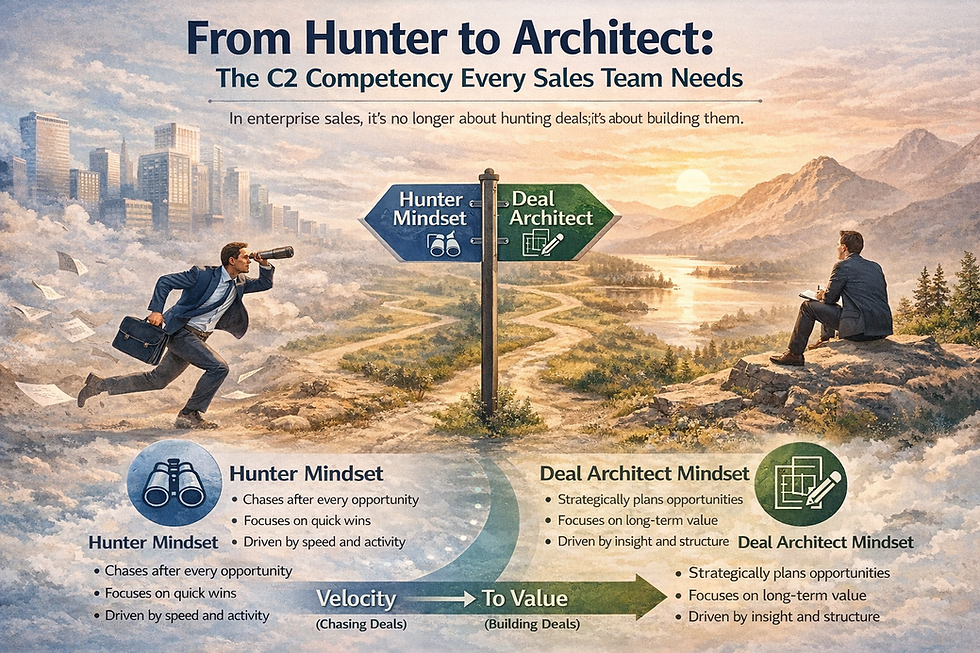
A certain persona took shape, that of the hunter, who was driven by speed, activity, and a need to find new prospects to reach out to.
However, times have changed.
Modern deals last longer, get more complex, and require the involvement of a multitude of decision-makers, who are usually better-informed, more cautious, and politically savvy than ever.
The sales process today calls for something more sophisticated than just hustling through deals.
Activity is not enough in this game. The shift in enterprise sales strategy can be clearly seen in this case.
Nowadays, it is less about pursuing deals and more about building value.
And this is where the transition from being a hunter to an architect happens, which explains the importance of the C2 competency, qualifying & discovery, in sales.
"Moving from Velocity to Value Rewrites Sales Success Standards"
Sales in an enterprise organization is not about how fast you move. It is about how smart you move.
Classic performance standards include such things as calls made, emails sent, and meetings scheduled. These metrics still have relevance, but they are not good indicators of deal success anymore.
The reason for that is very simple activity is not equal to understanding.
Reps are able to produce a robust pipeline without ever really comprehending underlying issues. This is a very deceptive state of affairs.
In the modern world, buyers do not care about the activity of sellers. In addition to that, they want reps to understand them better. In today's enterprise buying journey, value cannot be delivered through pitching. Sellers need to discover it first.
That's how we see the transition from velocity to value affecting sales performance standards.
Who is the "Hunter" in Modern Selling?
The old-school hunter is very familiar in many sales environments today.
Hunters are aggressive, competitive, and fast. They're great at breaking through, generating opportunities, and sparking early interest. Momentum is their strength.
When time is of the essence and decisions are straightforward, it works beautifully.
But not in enterprise selling.
Hunters tend to sell rather than discover. They rush to a solution without first taking the time to diagnose. Discovery is superficial, and positioning is off the mark.
The outcome is predictable. Sales that seemed good at the beginning turn out to be bad at the end.
The hunter is designed for motion. Enterprise sales require architecture.
Introduction of the "Architect": The New Way of Running Sales Operations
The Deal Architect is a new concept that revolutionizes the way enterprise sales are done.
Unlike hunters who chase opportunities, architects create them. While hunters thrive on urgency, architects build on structure.
Architects are more than concerned about capturing attention; they build alignment, identify business issues and align the issues with the financial outcomes.
While the hunter acts in response to a situation, an architect creates a solution.
A Deal Architect thinks systematically:
· Who are the true decision-makers?
· What is the core issue behind the opportunity?
· How does the issue affect financial results?
· What kind of alignment is needed for a decision?
This approach shifts sales from a reactive process to a systematic process.
Modern enterprise sales strategy has proven that the Deal Architect always outperforms the hunter.
C2 Competency (Qualifying & Discovery): What It Means
Central to this shift is C2 competency: Qualifying & Discovery.
It's more than deciding whether an opportunity is genuine. Rather, it's about assessing whether the opportunity makes sense and is structurally sound.
Key traits of high C2 competency include the following:
First, penetrating inquiry. It's not enough to qualify; you must dig deeper to determine the root cause of the issue.
Second, cross-threaded discovery. Enterprise-level opportunities have multiple threads, which means multiple angles of view.
Third, ongoing verification. It's not assumed that we understand the situation, but rather that we keep verifying and refining our knowledge.
When done right, C2 becomes the bedrock for successful enterprise-level sales discovery. It determines the caliber of all opportunities in the pipeline.
Without it, even the most robust pipeline lacks value.
Why Sales Teams Must Evolve from Hunters to Architects
It's not a choice. It's a necessity. To survive in enterprise sales, you need to evolve into an architect.
Deals in enterprise are not about individuals anymore. They involve many people within an organization, including finance, operations, IT, purchasing, and executive leadership.
This requires structure, not speed.
One thing that stands out is forecast accuracy. Poor qualification leads to over-forecasting because everything looks good until it falls apart.
Architect teams start with clarity. They know whether their deals are good enough before even thinking about forecasts.
Buyer expectation is another important element. Buyers do not want to be sold to anymore. They want to be consulted. They expect sellers to have a good understanding of their businesses in order to give insights rather than simply giving information.
Insight is now the real competitive advantage.
Hunters hunt deals. Architects create certainty.
Shifts in Behavior: What Is Different Between a Hunter and an Architect
It is not only about changing roles; it is about different behavior as well.
The first behavior shift: from pitching to diagnosing. It means that, instead of coming up with solutions right away, architects try to understand the situation thoroughly before offering any product.
The second behavior shift: from activity to intentionality. Every action has its own specific meaning and is targeted towards making deals more clear.
The third behavior shift: from features to problems. Architects do not start by telling customers what their product can do; they begin by finding out what customers want to achieve.
The fourth behavior shift: from closing to building. In other words, architects are concerned not about the outcome of the deal but about laying proper groundwork for it.
Impact on Organizations: The Importance of This Change for Sales Teams
For sales teams operating with the architecture mentality, the change goes further than just personal success.
Win rates increase due to better deal qualification. There's no need to chase deals that were doomed from the beginning.
Pipeline accuracy gets a boost as well, as the quality of the pipeline starts increasing. Deals are assessed based on depth rather than hope.
Executive alignment gets a boost, too. No longer do executives focus on products but rather on business transformation.
The sales process becomes faster. Even though enterprise deals take their time, unnecessary delays can be minimized.
Ultimately, enterprises adopting a new approach to enterprise sales discovery will establish stronger revenue streams.
The Transition Problem: What Hinders Most Hunters from Becoming Architects
Although this is true, this transition does not come easily.
First, there is the issue of overcoming the mindset of being fast-paced. Salespeople are trained to equate effort with achievement, so it's hard to slow down.
Second, there is the problem of overcoming dependence on pitches. It's typical for reps to be coached on how to quickly prove their worth, even without all the necessary context.
Third, there is the issue of overcoming impatience towards complexity. Enterprise sales is an ambiguous process, and sometimes answers aren't immediate.
However, the rewards of overcoming these problems far outweigh the difficulty.
Differentiators of Top-Performing Deal Architects
Highly skilled and highly performing Deal Architects differ from others in how they operate throughout the entire sales process.
They ask questions first and do not present information first. It's all about understanding first and then explaining later.
They map out the entire buying ecosystem early. They do not focus on a particular contact, but on all stakeholders in the decision.
They manage deals with clarity rather than urgency. Rather than making their deals urgent, they create alignment.
The most important difference of them all? They see every deal as a system, not a sequence.
Conclusion: The Future of Deals Lies in the Hands of Deal Architects
The transition from hunting to architecture marks a significant transformation in the field of enterprise sales.
Hunter salespeople are driven by quickness, activity, and pursuing their target. Architects of deals are guided by structure, focus, and alignment.
With current trends in buying practices becoming increasingly complicated, quickness is no longer a significant competitive advantage. Understanding becomes essential.
C2 competency (Qualifying & Discovery) has therefore been established as the critical selling skill for success in today's market environment. Its importance lies in measuring the ability of a sales representative to go deeper into the business.
Deals in enterprises are no longer closed by the hunters because they pursue them.
Deals are closed by the architects because they understand.
Enterprise sales require an architect, not a hunter.


Comments