Stop Pitching, Start Diagnosing: The Unfair Advantage of Deep Discovery
- ClickInsights

- Apr 25
- 5 min read
Introduction: The Practice That Silently Destroys Enterprise Sales
Enterprise sales aren't lost due to inferior products or poor pricing strategies. Instead, they are lost due to the common practice that destroys most of these deals without anyone realizing it, early pitching.
When a prospect states their issue, many representatives rush straight to solutions. They present slideshows, book demonstrations, or explain their offerings. It feels efficient. It feels like progress. However, in actuality, this move is among the quickest paths to losing any control over an intricate negotiation.
That's because, within modern enterprise environments, early pitching doesn't create clarity; it fosters assumptions.
Assumptions can be the silent killer of your deals.
Today's enterprise landscape is far too complicated for superficial approaches. With various parties involved, diverse priorities, extended decision-making processes, and meticulous financial evaluations, there is only one factor that can ensure victory over any other: how well you grasp the situation before addressing it.
This transition from pitching to diagnosing marks the point of divergence that leads to an unfair advantage in enterprise sales discovery.
The Shift from Pitching to Diagnosing: Where Real Value Is Created
Selling sounds like moving forward. You are delivering, informing, and creating value. However, in practice, you could still be fixing the wrong problem.
Very few enterprise customers have a clear problem statement. What they give you in the initial stages are merely symptoms:
"Our process is inefficient"
"We require better visibility"
"Our expenses are rising"
These are not issues. They are just indicators.
Without diagnosing properly, salespeople develop solutions based on symptoms, not underlying causes. This explains why so many promising projects fall through the cracks when going through procurement, technical validation, or executive evaluation phases.
Deep discovery makes all the difference.
As an enterprise sales discovery professional, you become a detective. It's not about finding answers fast. Instead, it's about finding out what is going on, why it is going on, and how much it is costing the business.
Value is not generated when you sell a solution. Value is generated when you identify a problem so well that no solution can escape it.
Why Early Pitching Undermines Your Positioning
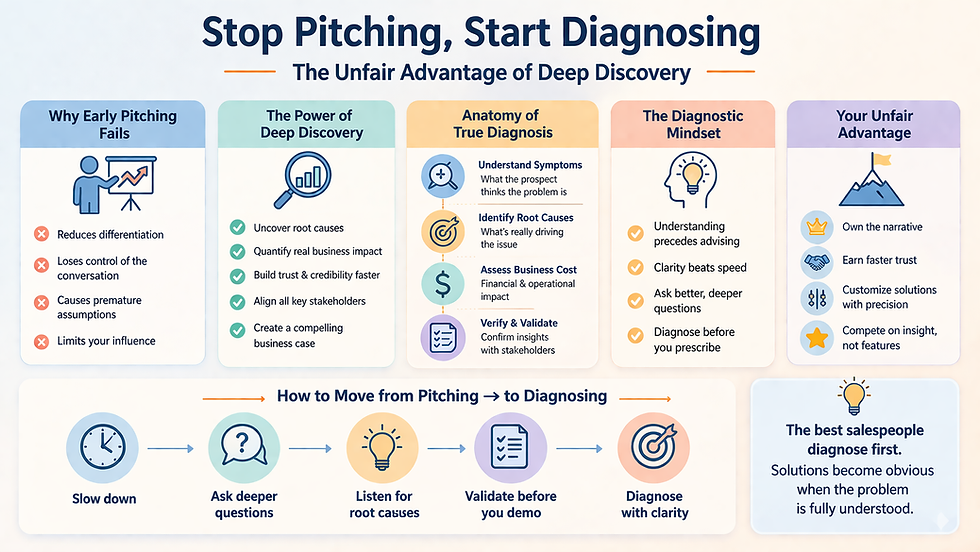
Pitching too soon can be one of the most costly errors in business-to-business sales because it secretly undermines three of your most important competitive edges: differentiation, control, and focus.
To begin with, it minimizes differentiation. As soon as you pitch your offering, you make yourself a commodity. The buyer is forced to compare you to other options based on functionality, cost, and delivery.
Secondly, it takes away control. Once you move into the discovery phase, pitching means losing control. The buyer goes from the process of discovery to that of comparison, and you no longer have the power to frame the problem.
Lastly, it causes premature anchoring. You are anchored by your first proposal, regardless of whether the problem has been fully articulated. This can severely limit your chances of renegotiating the deal down the line.
In essence, pitching too soon restricts the scope of your influence window. You stop expanding your understanding and start competing for it.
And in the context of enterprise discovery, attention alone doesn't translate into a sale.
The Diagnostic Mentality: How Top Deal Architects Work
Top sellers in enterprises do not work in the same manner as ordinary salespeople. While ordinary sellers view themselves as speakers of pitches, top sellers see themselves as diagnosticians.
They tackle every deal in a diagnostic fashion; no assumptions, no shortcuts, and no hasty conclusions.
Whereas most people who want to sell tend to convince others of the value of what they are selling, the top sellers tend to understand them.
These sellers have to possess certain qualities to succeed. This is because in almost all situations, it is easier to describe what you have for sale than it is to resist and ask questions.
There are three key principles of the Deal Architect mentality:
Understanding precedes advising
Clarity beats speed
Diagnosis sets the standard for all else
Anatomy of Deep Discovery: What True Diagnosis Is
True diagnosis in B2B sales discovery isn't about asking more questions; it's about asking better questions that dig deeper.
It begins with understanding the symptoms, that is, the problem your prospect thinks he has.
But it doesn't end there.
Next comes the root causes of that problem, which is where you start seeing actual insights, usually related to some kind of inefficiency in operations or processes or misaligned incentives.
After that comes an assessment of the cost of this problem on the business, where the conversation starts becoming urgent in nature because it goes from being merely functional pain to something that impacts the bottom line.
And finally, there is verification. The top sellers don't just trust their assumptions; instead, they verify them with the prospect.
That's what makes a true diagnosis different from a simple discovery process.
And that's where deals start differentiating themselves.
The Unfair Advantage of Deep Discovery
There's an inherent structure that makes deep discovery advantageous over the competition.
First, if you diagnose well, you own the narrative. You can position yourself in terms of problems that suit your capabilities.
Second, you establish faster trust. Customers aren't being sold to; they're being understood. And in enterprise settings, being understood is often more impactful than showing them a product.
Third, it enables customization. You're no longer selling your products' features but rather their unique relevance to a specific customer's situation.
Finally, deep discovery helps you create an unfair competitive edge. Other companies focus on beating you with better features and product capabilities, while you compete by being insightful.
This is what gives deep discovery its edge in enterprise sales.
Practical Signs That You're Pitching Too Early
Even seasoned professionals can fall back on old pitching habits. This is likely to happen if:
You bring out your product on the first call
You have trouble framing the customer's need succinctly
Discussions veer toward cost or functionality too quickly
You find yourself answering more than asking
You feel compelled to "bring value" by pitching early
None of these things are small problem. They are all signs of rushed discovery.
And when discovery gets rushed, deals become uncertain.
How to Move From Pitching To Diagnosis
This move is less about adopting new technology and more about adopting a different discipline.
The first thing you need to do is slow things down. Avoid the temptation to show off your product right away. Take your time with each new piece of information.
Ask deeper questions that get to the root of needs. Be comfortable with the silence. The best information tends to follow the first answer.
Make the demo a conscious choice, not something you do out of reflex. Think of it as an incentive for clarity.
But above all, change your perspective. You're not there to pitch. You're there to diagnose.
Conclusion: The Best Salespeople Diagnose Instead of Pitching
Sales in the corporate world are simple. Pitching comes easily. But diagnosing doesn’t.
Yet diagnosis alone will give you all the power you need.
Because when you know more about the customer’s problem than he knows himself, nothing else matters. Your communications become more pointed. Your offerings more apparent. You’re positioning more powerful.
It’s the key to modern sales discovery, not because it allows you to deliver value faster, but because it helps you pinpoint value so well that the product itself becomes clear.
The most effective salespeople aren’t the ones who speak the most.
They’re those who know the most.
They don’t come up with solutions immediately.
They begin with a diagnosis.
That’s their secret weapon.


Comments