The Discovery Code: Why Rigorous Needs Analysis Dictates Your Win Rate
- ClickInsights

- Apr 25
- 6 min read
Introduction: Opportunities Are Won and Lost During Discovery, Not During the Close
Most business opportunities do not fail due to price negotiations, the closing stage of sales, or even the signing of agreements. They fail far earlier during discovery.
Unfortunately, many salespeople view discovery as just another part of the sales process, a simple qualifying conversation leading into demonstrations and proposals. Such an approach works in transactional sales; however, in complex sales scenarios, it results in a weak opportunity that falls apart when pushed to the limit.
The harsh truth is that you do not lose deals near the close. You lose deals at the beginning.
Enterprise sales discovery, which involves rigorous needs analysis, is how you gain an upper hand over your competition. If done right, needs analysis is the difference between average performance and elite Deal Architecture.
This is the Discovery Code.
Enterprise Sales Move from Velocity to Value through Discovery
The current enterprise sales landscape has moved beyond velocity. While activity and velocity used to be key metrics for success, today they frequently conceal serious problems.
Quick sales look like progress, but without discovery, there's no meat behind them. Sales reps rush from first contact to demos, assuming that they already know what the customer wants. The truth is that they don't know as much as they think they do.
This is where many sales transactions go wrong.
Value doesn't come into being in enterprise sales by pitching. Value has to be discovered. Buyers don't always reveal all their issues right away. Their first description of the problem is usually just a surface one, a symptom rather than an actual problem.
In successful enterprise sales, top-performers discover the pain points, hidden internal conflicts, and strategic issues that buyers weren't even aware of themselves.
Each subsequent stage of the enterprise sales process is based on that foundation. When you lack deep discovery, all other steps become shaky and unreliable.
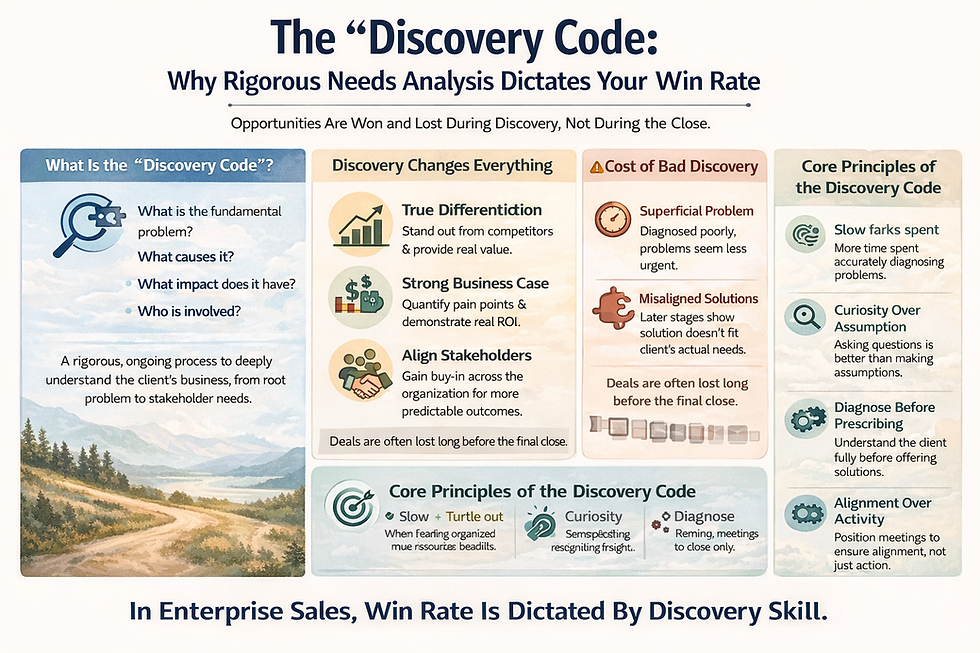
What Is "The Discovery Code"?
"The Discovery Code" is not a method or a system. It is a structured and consistent way of getting a deep understanding of the client's business.
It takes much more than just qualifying. Whereas classical methodologies look for budget, authority, need, and timing, "The Discovery Code" is aimed at understanding the context.
It asks important questions like:
· What is the fundamental problem faced by the business?
· What causes it?
· What impact does it have on the business in terms of money and/or operations?
· Who is involved in the problem, and what are their needs?
Such an analysis cannot be achieved without deep inquiry and discussion. The information collected needs to be analyzed in detail.
One should note that discovery is not a one-off task. It is an endless process. Whenever a new stakeholder enters the conversation or a new piece of data becomes available, it should be used to enrich and refine your understanding.
In an enterprise sales strategy, discovery is not a starting point; it is the thread that runs through the entire deal.
How Good Discovery Leads to Better Win Rates
There exists a direct correlation between discovery and win rate.
To begin with, good discovery provides the foundation for true differentiation. Instead of just describing your offerings, the Deal Architect takes on the role of an adviser and partner through the provision of insights. You differentiate yourself from other vendors when you know more about the customer's business.
The next way in which good discovery helps with winning more deals is by making your deal more attractive. In an enterprise context, decision-making is highly dependent on dollars and cents. Pain is the main driver behind all major business initiatives and projects. Once you manage to identify pain quantitatively, you make it possible to make a sound business case.
Effective discovery also helps to align different stakeholders within the organization. Many times, deals fall apart due to disagreements among various parties within the same company. Early discovery ensures that different points of view are considered ahead of time.
Finally, a good discovery makes the deal process more predictable. If you base your deal on accurate information, you can predict its outcome relatively accurately. The same does not apply to assumption-driven deals.
Cost of Bad Discovery: Where the Deals Really Fall Apart
Weak discovery can be observed all across the sales process.
On the surface, such deals appear less critical than they really are. When the problem hasn't been diagnosed properly, it is not seen as important to solve by the prospect, which causes delays.
More importantly, a bad diagnosis will likely result in misaligned solutions that won't meet the client's needs. These mismatches can be seen much further down the road when the proposal gets questioned by various decision-makers.
In fact, objections at the latter stages of selling are simply a manifestation of the problems left uncovered at the earlier stages of discovery.
What is even more problematic is the misleading nature of these deals that are part of your pipeline. On paper, these are still deals in motion with plenty of meetings scheduled and proposals sent out.
This is how many enterprise companies have their pipelines look: a solid list of opportunities on one hand, while in fact, they have a lot less going on.
A True Enterprise Sale: The Competitive Advantage of Discovery
The power of discovery-based selling is well-exemplified by the way Microsoft handles enterprise cloud migrations, where clients opt for its Azure platform.
Whereas most companies usually start off by highlighting product features, Microsoft Teams typically starts out by conducting discovery sessions that help it identify the issues faced by the customer. In many instances, the issue might just be about upgrading existing technologies, but through discovery, other problems, such as increased operational costs, security, and scalability, become apparent.
Through this method, the company can then change the entire proposition into one that is more oriented towards the benefits it provides in terms of cost savings, minimizing risks, and improving operational efficiency.
Whereas competitors might highlight the features at the early stages, the discovery process helps Microsoft align better with the client and makes its business case stronger, thus increasing its chances of winning the deal.
Core Principles Behind the Discovery Code
Several core principles lie at the foundation of efficient sales discovery, which determine how successful salespeople conduct their work.
The depth of inquiry surpasses its speed. Spending more time exploring the issue is more rewarding than hastily proposing a solution to it.
It is better to be curious than presumptuous. The most successful salespeople formulate insightful questions, while those who rely on assumptions fail to achieve success.
It is necessary to diagnose first and prescribe later. Offering an untested solution undermines one's credibility and decreases the impact of his or her proposals.
Achieving alignment takes precedence over taking action. In other words, salespeople should not focus on holding meetings but instead on aligning their positions.
Differentiating Deal Architects' Discovery Process
While the above questions can help us understand why the discovery process of Deal Architects is unique, what really distinguishes them is the way they approach the process.
Instead of using questions only to collect data, Deal Architects employ questions to shape the discussion and extract insights.
They involve more stakeholders from the beginning because they realize that the various perspectives enrich their understanding of the situation.
Furthermore, they continually validate throughout the process, not taking anything for granted but confirming that they correctly grasp the issue at hand.
As a result, Deal Architects create deals based on reality, not assumptions.
Conclusion: Your Win Rate is a Measure of Your Discovery Capability
In an enterprise environment, winning is not dependent on how good you are at closing. Winning in an enterprise environment depends on how good you are at discovering.
An enterprise deal doesn't go south toward the end; it goes south because right from the start, there hasn't been enough problem discovery, stakeholder alignment, or definition of value.
Enterprise sales discovery is thus arguably the most important skill set that any salesperson in a complex selling environment can have.
Discovery is not something you do; it's what the process is all about.
The deeper your discovery capability, the more effective your positioning and value communication. The result: Winning.
Become fluent in the Discovery Code, and everything changes.


Comments