Managing the "Rogue SE": When Deep Technical Dives Derail the Deal

Introduction
Technical knowledge is crucial for enterprise SaaS sales. However, an uncontrolled depth of technical understanding may turn into a serious issue very quickly.
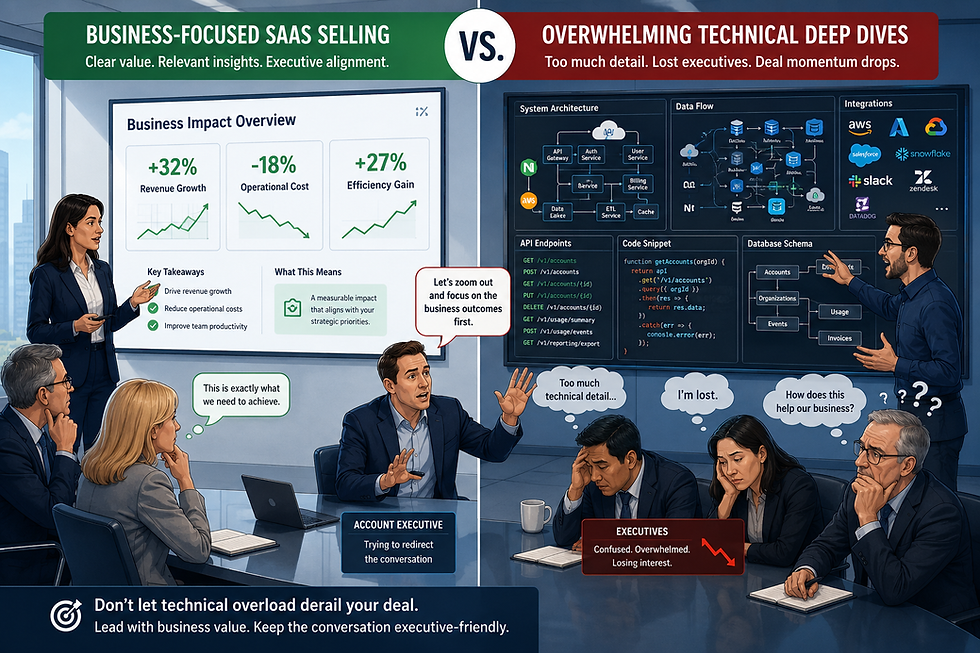
Too many enterprise demos are stopped by the fact that the Sales Engineer (SE) goes down the rabbit hole of the conversation way too fast. Where there was originally supposed to be a business-oriented negotiation, all of a sudden, there appears a very technical presentation, including complex architectural diagrams, integration capabilities, detailed API explanations and other stuff nobody has actually asked for.
This is when the idea of the "Rogue SE" comes up.
By no means should a Rogue SE be viewed as an employee with bad behavior or an incompetent technical background. On the contrary, they will often be found to be extremely smart and enthusiastic about the product. The key problem does not lie in technical knowledge – it lies in the lack of ability to use this knowledge wisely.
What Is a "Rogue SE"?
The phrase "Rogue SE" refers to a Sales Engineer who accidentally derails the sales discussion because of too many technicalities.
This is rarely due to malicious intent. Actually, the problem often arises due to passion or a strong love for the product platform. For some SEs, it feels like the more information they provide, the more trust they generate.
Others think that if they oversimplify things, they'll seem unprepared. Some SEs find themselves in this situation because of a lack of proper alignment with the AE prior to the presentation.
The consequences can be quite similar in each of these cases, however.
The demonstration moves away from any business benefits and becomes too technical in nature. Buyers feel confused, executives stop listening, and the whole storyline becomes blurred.
This is far from being just an effective communication issue.
Why Deep Technical Dives Can Derail Enterprise Deals
There is far more to consider when evaluating enterprise software beyond capability alone.
The buyer must weigh operational impact, the risk of implementation, strategic fit, and the value delivered to the business. If the demonstration gets too technical too soon, the reasons for considering the solution begin to fade. Too much technical depth can overwhelm the mind.
Executives have difficulty following along, and non-technical attendees simply tune out. Rather than boosting confidence, an excess of technical information can create greater confusion.
Technical dives can also hold up the selling process. Meetings meander, strategic discussions are put on hold, and decision-makers walk away without gaining clarity around the benefits to the business.
Most critically, too much technical information kills narrative flow. Successful enterprise SaaS presentations rely heavily on narrative-driven enterprise demos that keep buyers focused on business outcomes rather than technical overload. The purpose of a demo is not to showcase technology but to convey how that technology solves problems and drives results.
The Difference Between Technical Credibility and Technical Overload
Technical credibility is very important in selling enterprise SaaS. Potential clients have to be sure that the software will work well in terms of integration, scaling, and other operational aspects. Technical experts must get clear and knowledgeable answers from the sales engineer.
But it is worth mentioning that there is a very big difference between achieving technical credibility and flooding the discussion with irrelevant information.
Top-notch Sales Engineers know this difference perfectly well. They say everything needed to gain confidence, but stop before making things exhausting and taking them away from business issues. They explain complex notions in the simplest way possible without seeming vague or incomplete.
This is the main thing that distinguishes the true strategists among sales engineers from just lecturers on products.
The task of the presentation is not to prove the technical skills and intelligence of the sales rep.
Why Some Sales Engineers Go Too Deep During Demos
There are several reasons why Rogue SEs dive too deep when presenting solutions to enterprises.
One possible cause is the wish to prove technical prowess. Some SEs assume that their main value lies in being technically proficient and thus continue elaborating on details in order to demonstrate competence.
Fear could be another factor. An SE might be afraid of looking unprepared or incompetent if they try to reduce the amount of information presented.
If the discovery process were not done effectively beforehand, an SE would lack information about what really matters to the client, which could cause them to focus on overly extensive technical demonstrations.
The SE may be under pressure from a technical expert asking very detailed questions, which leads to discussions that stray farther and farther away from the actual selling points.
Emotional commitment to the product can become a problem if it overwhelms the ability to assess customer needs.
How the "Rogue SE" Impacts Buyer Psychology
Too much technical demonstration affects buyer psychology in key ways.
One, it creates confusion. It might be difficult for the buyer to distinguish between important and non-important details.
Two, it creates mental fatigue. The amount of energy needed by the brain to digest all this technical information is high, especially when the target audience consists of executives who do not play any active role in the implementation.
However, the most important effect is that too much technical information increases buyer perceived risk.
Instead of seeing it as a straightforward and easy-to-use platform, the buyer starts thinking of potential difficulties associated with its implementation.
Especially concerning enterprise-level selling, where confidence and simplicity matter, this is a critical mistake.
The AE’s Role in Preventing Technical Derailment
Technical depth control is not the sole responsibility of the SE alone. The Account Executive plays a crucial role in controlling the demo process and narrative discipline during the demo.
An excellent AE creates the expectation from the very beginning of the demo and sets a direction for both parties regarding what must be talked about.
During the meeting process, an excellent AE keeps track of the level of interaction taking place. When technical conversations get too much, they shift the focus back to the point without compromising the SE. It requires teamwork.
An AE must never look like a confrontational person. Rather, they should try bringing conversations back to business impacts.
The best enterprise demo is where both people work hand in hand.
How Elite SEs Control Technical Depth Strategically
Elite Sales Engineers know how to manage depth strategically.
They assess the room throughout their presentations. They assess levels of executive involvement, the reactions from the audience, and the nature of the questions being asked.
But most importantly, they align their level of technical depth with stakeholder interests.
When discussing with executives, they emphasize outcomes, impact, and benefit. If technical experts demand deeper validation, they provide clear answers without going into unnecessary depth. And elite SEs know that sometimes it is better not to overdo things.
They don't always provide the highest level of technical detail because they can. They provide just enough to keep confidence high. It greatly enhances the demo experience.
The Importance of Demo Guardrails and Safe Words
Teams that excel at AE-SE collaboration set demo guardrails prior to the demo itself.
Demo guardrails set boundaries around the types of subjects that will be discussed, the level of technical detail that will be provided, and whether certain discussions will add any unwarranted complexity.
It is common practice for many teams to make use of certain signals, known as "safe words," during demos that facilitate a smooth redirection of conversation.
Safe words enable the AE and SE to manipulate the pace and flow of discussion without making others feel uncomfortable in front of the customer.
Guardrails do not limit expertise; they limit customer disruption.
Turning Technical Expertise Into Strategic Influence
The greatest Sales Engineers realize that technical knowledge alone is not enough for winning enterprise deals. Effective communication is just as crucial.
Top SEs blend technical know-how with business acumen, storytelling skills, and audience sensitivity. They have the ability to make things simple, stay focused, and steer conversations to business decisions.
Strong enterprise sales organizations prioritize effective sales communication to ensure technical discussions remain aligned with business priorities.
In other words, they turn themselves into strategic advisors rather than mere products. It makes all the difference.
Customers don't select their vendors based on the amount of technical information they convey. Instead, customers select vendors who build trust, clarity, and consensus in their sales process.
Conclusion
Technical skill is perhaps the most prized attribute in an enterprise SaaS sale. However, when technical depth gets out of hand, it has the potential to completely torpedo the entire process.
The issue with the rogue SE is neither intelligence nor technical know-how, but rather the lack of discipline in communications and the understanding of who one is talking to in those conversations.
The best sales engineers have a keen sense for balancing technical acumen with clarity. They know when to dig in, when to streamline, and when to reorient their conversation to value propositions.
Enterprise customers don't need a mountain of technical information to make informed decisions. They require only clarity and context.
In today's SaaS sales environment, the best SEs aren't those who provide the most technical information; rather, the best SEs are those who help their customers make confident decisions.


Comments