The “Two-in-a-Box” Model: Building an Unstoppable AE and SE Partnership

Introduction
Modern enterprise software as a service (SaaS) agreements have become increasingly complicated, necessitating a collaborative effort between all parties involved.
Today's buyers require a conversation that will include discussion about strategy, technical validation, operational confidence, and executive alignment. In other words, modern enterprise software selling is not just about great relationship skills or deep product knowledge – it is about forming a partnership with the buyer.
Even today, many companies continue to operate with a disconnected model in which the Account Executive’s role is confined mainly to customer relationship management. In contrast, the Sales Engineer enters the game only when necessary (for instance, for demos or technical questions).
The most efficient enterprise sales teams are immune to such problems thanks to the "Two-in-a-Box" methodology.
What Is the "Two-in-a-Box" Model?
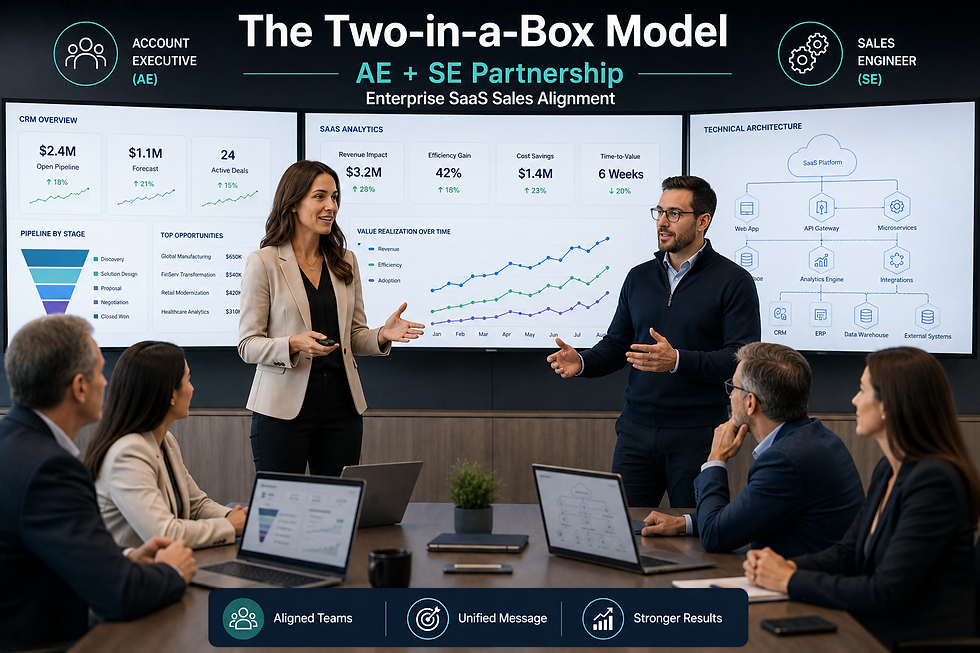
The "Two-in-a-Box" model is a collaborative enterprise sales process where both the Account Executive (AE) and Sales Engineer (SE) work as a joint team all along the deal journey.
Instead of working alone, both the AE and SE take collective ownership of moving the customer through their journey. The AE manages the commercial side and the deal movement. In contrast, the SE manages technical aspects and aligns them with solutions and products.
The strength of this model comes from the level of coordination between teams.
Rather than looking at technical aspects separately, both AE and SE coordinate their efforts during discovery sessions, demonstrations, overcoming objections, and conversations with executives. For the customers, this joint effort does not look like two different functions to them.
Both these aspects generate more trust since buyers will be getting strategic business advice and technical validation at the same time.
In the context of enterprise SaaS sales, this model has become necessary.

Why Enterprise SaaS Sales Require AE and SE Alignment
Today, enterprise buying decision-making extends beyond product assessment.
Customers analyze how well your product will help them achieve their strategic goals and improve operations, whether it will work with their existing systems, whether the integration is viable, what the costs are going to be, etc. One person simply cannot answer all these questions successfully.
Your AE understands every detail of the deal and has deep insight into the political dynamics within the account. But technical people still need to be convinced that the architecture is sound and everything you say is really possible.
On the other hand, while technically savvy, an SE simply cannot handle account management, deal strategy, and negotiating. This is why you need alignment between AE and SE.
Together, these two professionals will create a much smoother buying process for the customer. All the messages will be consistent; any objections will be countered efficiently, creating additional trust.
The Distinct Roles of the AE and the SE
A collaboration between the AE and the SE will succeed when roles are clearly defined.
The AE is expected to lead the selling process, which includes stakeholder management, stakeholder navigation, deal qualifying, commercial negotiation, and keeping the sales effort moving forward.
The AE makes sure that the selling effort proceeds in the right way and the proposed solution is aligned with the broader business needs.
The SE is expected to handle all aspects of technical selling, including technical discovery, solution creation, product demonstrations, discussions about product integration, and handling technical objections.
The SE communicates the benefit of the technology while building technical credibility with the client.
Issues can emerge where roles start overlapping, such as when the AE butts in where there should be a technical discussion or when the SE starts discussing products in an environment not conducive to that type of discussion.
Why the Best AE-SE Teams Operate Like Co-Pilots
The top enterprise sales teams don't work with a lead and support mentality. They work like co-pilots.
The AE and the SE both participate fully in crafting the customer experience, have joint responsibility for results, and communicate extensively during the process.
There are a number of benefits that arise from this joint ownership.
First, meetings will run more smoothly. The AE can drive the business conversation, and the SE can add technical support when appropriate. Second, the approach builds credibility, making the team look unified and coordinated.
Most importantly, however, it makes for consistency.
The customer does not have separate business and technical conversations. She has one consistent story in which business and solution are seamlessly intertwined.
The team should be seamless to the customer. The meeting needs to be smooth, coordinated, and purposeful.
Importance of Pre-Call Alignment
Good enterprise demos are won prior to the meeting taking place.
Excellent performing AE-SE teams spend considerable time aligning themselves prior to talking to the customer. This allows for alignment on the message, priorities, goals, and concerns.
Pre-call alignment is normally based on the following: reviewing discovery findings, highlighting business pains, allocating who should speak when, and addressing possible concerns.
This eliminates misunderstandings from occurring during conversations.
Without alignment, meetings can easily get off track. People will repeat each other, interrupt each other, or veer off-topic. The buyer knows when this happens.
Alignment creates a sense of professionalism. Additionally, it ensures that the focus remains on what is important to the customer and not what we assume to be important to them.
Building a Unified Narrative During Demos
Good demos always come across as one coherent discussion rather than two different presentations.
This is where the collaboration between an AE and an SE is crucial.
While the AE will provide the business problem statement and strategic context, the SE will demonstrate how the technology addresses the needs mentioned above.
In other words, consistency and coherence will be created.
For instance, the AE will introduce the client's problem with pipeline visibility and forecasting discrepancies. Then, the SE will show the reporting workflows and dashboards that address the issues.
Such a consistent approach helps maintain a focus on results in the buyer's mind during all demonstrations.
With consistency in narrative flow, buyers concentrate on goals rather than lose focus on details.
Common Problems That Break the AE-SE Partnership
Even the most seasoned teams might have problems when it comes to partnerships.
The first one would be a lack of preparation for a meeting. Unpreparedness makes demos spontaneous and unstructured.
The next problem would be role ownership issues. There are cases where AEs try to take control of technical conversations that they cannot manage. Similarly, there are cases where SEs get into conversations that require sales strategy rather than technical expertise.
Over-explanation of technical details can also be an issue. In some cases, SEs might accidentally ruin a demo through excessive explanation of technology that was not asked for.
Finally, internal tension can affect the perception of customers instantly. When disagreement happens during a call, customers might start questioning the professionalism of the organization as a whole.
The most significant mistake that organizations make is not using SEs as partners but rather as support in demos.
Managing Communication inside the Partnership
Effective AE-SE partnerships require clear communication and mutual respect.
Successful teams always provide feedback after meetings, openly talking about what went well or not in client interactions. They continuously learn from their experiences.
Trust also matters greatly.
The AE must trust that the SE understands the technology behind the solution. The SE needs to trust the strategy suggested by the AE. Lack of trust leads to inefficiency.
Proper communication creates a safe environment for both partners, allowing them to make corrections on the spot when something goes wrong.
The enterprise sales process is dynamic. Successful partnerships thrive when both sides work together, rather than separately.
How the “Two-in-a-Box” Model Improves Win Rates
A "Two-in-a-Box" approach increases the success rate of enterprises in their business transactions because it results in a higher level of cohesion in the buying experience.
Buyers have confidence if both the business discussion and technical discussion sound cohesive. The executives are confident about the strategy, while the technical evaluators are confident about the feasibility.
Cohesion also makes evaluations smoother.
Questions get answered quickly, messaging is consistent, and concerns get addressed. They will not waste time dealing with contradicting information from within.
In highly sophisticated business transactions, this can become the key competitive edge.
Many companies are able to perform successful product demonstrations. Very few can offer cohesive partnership discussions between commercial and technical aspects of a transaction.
Building a Culture around AE-SE Collaboration
The companies that effectively engage in enterprise sales always consciously cultivate a culture of collaboration.
This begins from the top down. Businesses need to incentivize collaboration, not individualistic efforts that foster isolation.
Collaboration is something that should be taught during training programs. Joint training sessions between AEs and SEs facilitate better communication and understanding between departments.
Consistent pre-call planning for calls also contributes to collaboration.
But above all else, organizations need to value the contribution of their Sales Engineers as a source of potential revenue.
Once collaboration becomes the culture, customers benefit immensely.
Conclusion
SaaS sales for enterprises have come a long way from simple selling methods.
Modern-day buying processes demand both business acumen and technical competence to work hand in hand at all stages of the buyer's journey. That is the reason why "Two-in-a-Box" has emerged as an extremely efficient model for contemporary enterprise sales operations.
The most effective AE-SE collaborations function as one single team. They synchronize their efforts prior to calls, maintain clear communication, and generate demo videos that tie in business needs with technical features.
Such a collaboration enhances the trustworthiness of the buyer, boosts the confidence of stakeholders, and results in better overall sales.
In the upcoming era of enterprise software sales, it will not be individual players but highly-aligned AE-SE teams who will clinch the best deals.


Comments