The Pre-Game Sync: Mandatory Steps Before Every Joint Sales Demo

Introduction
Too often, enterprise SaaS demos falter before the meeting even starts.
It may seem tempting to blame factors such as product, price, or competition. However, more frequently than one would suspect, the culprit for a subpar sales demo lies elsewhere - namely, internal misalignment between an Account Executive (AE) and Sales Engineer (SE).
Without proper planning and preparation, an unprepared AE and SE tend to provide their prospect with a disjointed experience.
These types of disconnects do not go unnoticed.
In today's market, prospects have come to expect vendors to act as a strategic partner. A lack of preparation and coordination between an AE and SE will quickly erode confidence.
This is where the Pre-Game Sync comes into play.
The Pre-Game Sync is essentially an alignment process that occurs prior to every joint sales demo.
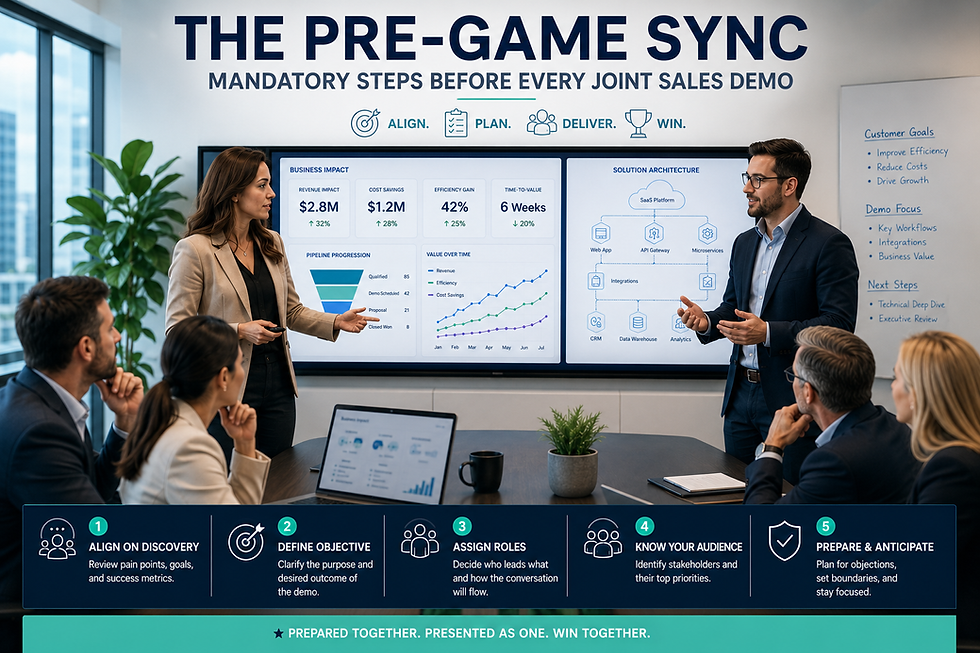
Why Most Joint Sales Demos Fail Before the Meeting Starts
Sales teams often overlook the importance of preparing for joint calls.
While the AE thinks that the SE will know all the necessary information about the customer, the SE expects the AE to manage the discussion at the call. The result of these misconceptions is that each participant starts the demo with certain presumptions that differ from one another.
Such issues become evident right away on the call.
For instance, both parties tend to repeat themselves throughout the demo because they mention the same things in their presentations. Another problem might be that discussions go too technical without taking the strategy into account. There may also be important things that neither of the participants took into consideration because nobody thought about including them.
Unprepared calls reflect poorly on the vendor. Enterprise software buyers want to see that the vendor's teams work well together.
Buyers evaluate not only the product but also the vendor itself.
What Is a Pre-Game Sync?
A Pre-Game Sync is a deliberate preparation process conducted between the Account Executive and Sales Engineer prior to the interaction with the client.
A Pre-Game Sync intends to build alignment around strategy, messaging, goals for the meeting, priorities, and the sequence of events. This is a purposeful and replicable process.
The aim is not just a "check-in" before the meeting. The objective is to ensure that the client perceives a single unified team versus two different individuals acting separately.
Effective Pre-Game Syncs allow the team to predict potential objections, eliminate any confusion during demos, and deliver consistent messaging throughout the entire conversation.
This alignment can sometimes be the difference between a strategic discussion and chaos within the SaaS sales process.
Why AE-SE Alignment Is Critical Before Every Demo
Enterprise buying groups have become increasingly complex, with multiple stakeholders involved in software decisions, a challenge frequently highlighted in Gartner research on modern B2B purchasing behavior.
Buyer teams at the enterprise level have grown increasingly complicated.
It's possible for the same discussion to involve executives, technical evaluators, operational heads, and end users, each having distinct agendas and requirements. The need for proper alignment between the AE and SE becomes evident in such cases.
Alignments can result in a number of positive outcomes.
To begin with, they ensure smoother communications during discussions. This is because both participants will know precisely what topics belong to whom and the timing of their switches.
Next, they lead to consistent messaging across the board. The former highlights the business aspect, whereas the latter emphasizes the feasibility aspect without conflicting with the overall theme.
Lastly, they build customer trust through increased perceptions of preparation and strategy.
Effective demos cannot be winged and need proper alignment beforehand.
Step 1: Discuss Discovery Insights as a Team
Discoveries alignment is the bedrock of any great Pre-Game Sync.
Prior to the demo, the AE and SE should align on all pertinent information discovered in the process. This includes business pain points, goals, priorities, challenges, and measures of success.
The SE must be aware of why the customer is reviewing the software, not just what capabilities it has. Strong discovery alignment also helps Sales Engineers better understand buyer emotions, operational frustrations, and business priorities before diving into technical details. This people-first approach is increasingly important in enterprise SaaS sales, especially when building trust through empathy rather than immediately leading with technical expertise, as discussed in Why the Best Solutions Architects Lead with Empathy, Not Technical Chops.
Lack of discovery insights leads to demonstrations that lack relevancy and feel like a generic review of a software package devoid of business context.
Alignment of discoveries helps both the AE and SE deliver a demonstration that is more relevant than voluminous. Technical demonstrations can also be more compelling, thanks to alignment with business insights gained in conversation with the customer.
Step 2: Determine the Purpose of the Joint Demo
Each joint sales demo requires a well-defined purpose.
There may be demos that serve the purpose of confirming the technical requirements. Other demos will revolve around the executive fit, process, security review, or progressing the deal towards procurement.
A lack of defined goals usually leads to lengthy, unproductive demos.
For the joint demo to be effective, the AE and SE need to be on the same page as to what the objective is prior to the call. It would help with pacing and the elimination of unnecessary information.
Having an objective will also allow for more efficient decision-making within the conversation since both individuals will know how to steer the discussion back onto the intended path.
Step 3: Determine Responsibilities and Who Owns the Conversation
Lack of clear role responsibility is the cause of many awkward demonstrations.
Without preparation, both the AE and SE can interrupt one another, repeat themselves, or stumble during the transitions. This negatively impacts the flow and professionalism of the demonstration.
During the Pre-Game Sync, the team needs to determine who will be leading the meeting, covering the discovery insights, facilitating the demo, responding to questions and objections, and handling follow-up action.
Clearly defining responsibilities leads to better teamwork.
Typically, the AE owns the strategic part of the conversation, while the SE owns the technical side, but both need to know when their part starts.
Step 4: Identifying Stakeholders and Their Priorities
Each stakeholder will come to the demo with their own concerns.
Technical directors may look at integration and security. C-level executives may emphasize ROI and efficiency. End-users may consider usability and simplicity.
The AE and SE should identify these concerns ahead of time.
Knowing your audience allows you to determine how much depth there should be in the discussion, what workflows should be covered, and what kind of business value should be stressed.
It also allows for greater personalization. The buyers will get a lot more out of the demo if it's tailored to their interests and job functions.
Awareness of your audience is the most critical component of a good demo.
Step 5: Plan for Objections and Set Presentation Boundaries
Top-tier sales teams prepare for potential roadblocks even before the session begins.
The AE and SE can consider possible objections related to costs, security concerns, integration challenges, implementation issues, competitive factors, or missing product features. Anticipating and preparing for these objections enhances their confidence in handling the conversation in real time.
Similarly, it is equally essential to set presentation boundaries.
The sales team can agree on what needs to be demonstrated and what needs to be avoided at all costs. Avoiding such pitfalls allows the presentation to stay focused without overwhelming the client with too many features.
Why Preparation Becomes a Competitive Advantage
Preparation impacts customer perceptions of the vendor.
If the AE and SE are prepared with well-coordinated efforts, consistent communication, and a compelling story, the buyer will gain confidence in the professionalism and ability of the team to execute.
Teams that prepare together also have better success handling tough discussions since they are already aligned within their own team regarding strategy and the needs of all stakeholders involved.
With regard to enterprise SaaS sales, where there is stiff competition and large buying groups, preparation is critical.
There are many vendors with excellent solutions. Fewer vendors consistently provide well-coordinated experiences for customers.
Teams that excel at preparing together will succeed together.
Conclusion
Rarely is a successful enterprise demo achieved through luck alone.
It comes from alignment, preparation, and strategy that takes place well before the demo ever takes place. This is precisely what makes the Pre-Game Sync so vital to enterprise SaaS sales in today's market.
By aligning on objectives, stakeholder priorities, messaging, and demo flow, the experience for the prospect becomes far more efficient and effective.
As such, there will be greater engagement, better communication, and ultimately more confidence during the entire buying cycle.
For those seeking to close big deals in enterprise software sales, the difference between success and failure may come down to who it betters.


Comments