The Executive Summary Demo: Giving the C-Suite Exactly What They Need to Buy

Introduction
While most enterprise SaaS demos are designed with users and technical stakeholders in mind, they usually lack the content needed to engage C-level executive decision makers.
They either provide too much information, introduce too many technical concepts or fail to deliver on their promised value. The result is that when C-level executives finally become involved in the decision process, they are presented with something they cannot relate to.
C-level executives simply do not have the time or patience for a comprehensive walkthrough of every feature and functionality available within a product. They do not care whether the product offers all of its features through buttons, workflows or other means of interaction.
Instead, executives are more interested in how the product can be used to drive business performance and provide an acceptable ROI. This is exactly why the concept of an Executive Summary demo was introduced.
It is an effective way to show executives the right information.
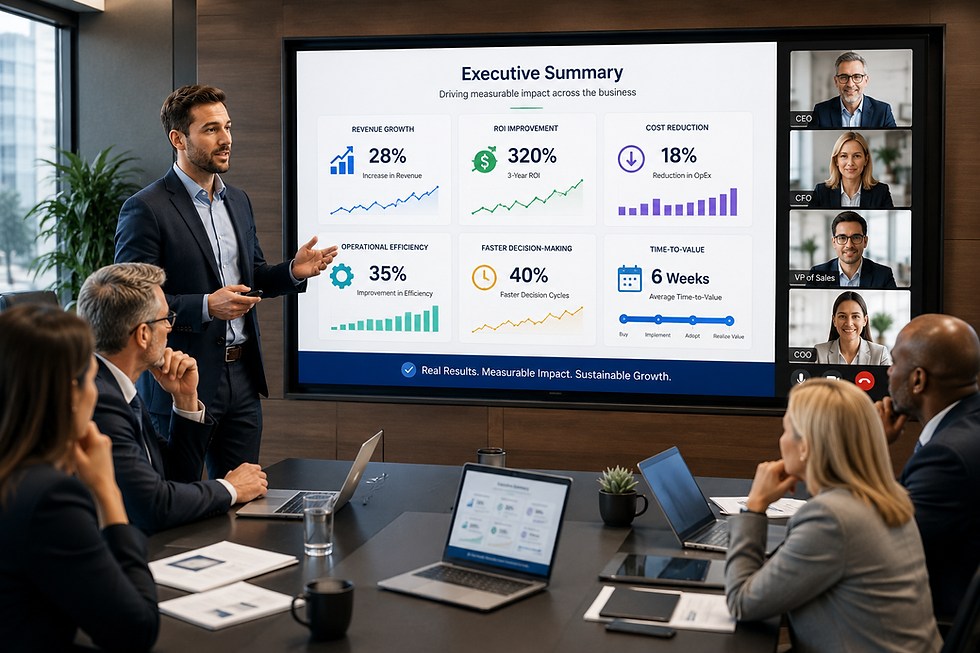
Why Traditional SaaS Demos Fail with Executive Audiences
Traditional software demonstrations are geared towards illustrating the capabilities of the product. The demo follows the logical path of features, functionality, configurations, and even technical aspects in its quest to illustrate what can be done with the software.
However, executives do not approach a product evaluation this way.
An executive, such as the Vice President, CFO, or CEO, is trying to determine whether this software will deliver better performance, save costs, mitigate risks, be strategic for the organization, and yield ROI in a shorter period of time.
As a result, an overly technical demonstration will turn off most execs fast.
While the demo might prove valuable to the engineering and IT team, the message being conveyed is not effective when it comes to influencing key decision-makers.
It is among the most common reasons why enterprise sales cycles tend to get stalled despite initial enthusiasm.
What the C-Suite Actually Wants to See in a Demo
The c-suite judges your software with a strategic eye, rather than a functional one.
They judge by how well it serves the company, in terms of its value, efficiency, reduction of risk, scalability, and time to value. They want to know how the product helps the business, rather than how the interface works.
Furthermore, executives value simplicity and brevity. If your pitch lacks relevance, they'll lose interest very quickly.
The c-suite is uninterested in unnecessary details. They need assurance that you've solved a real business issue and will produce tangible results. Therefore, relevance trumps comprehensiveness in their eyes.
An excellent executive summary demo is highly selective in what it presents.
What Is an Executive Summary Demo?
An Executive Summary Demo is a compressed, highly effective version of a regular product demo, customized for executives.
It does not cover all features but rather addresses business issues, desired outcomes, and solution mapping. It is not a product tour; it is a decision discussion. It is purposely concise.
It starts with the basic business problem that the customer must solve. It links that problem to quantifiable results like efficiency gains, cost savings, greater visibility, or faster growth. And it highlights only the most important components of the product that help achieve those outcomes.
Its aim is not to describe the capabilities of the platform comprehensively. Its objective is to make clear why the platform is important to the business.
Such an approach honors the limited availability of executives' time and energy while generating robust buyer confidence.
Structuring an Executive Summary Demo for Maximum Impact
Effective Executive Summary Demos have a definite structure intended to keep them clear and to the point.
They start by describing the business issue and giving it some significance. In this way, the audience will see why the discussion is important.
Afterwards, rather than enumerating all of the software features, they present the outcomes that can be expected from their use. Examples include improved performance, fewer bottlenecks, and enhanced decision-making abilities.
The product itself is only mentioned once the context has been provided and the benefit of using it explained. At best, a very brief introduction to what it can do is made.
It's all about pacing. The discussion should flow smoothly from one topic to another.
When properly structured, executives aren't struggling to understand the software at all. They're assessing its strategic importance.
Translating Product Capability Into Executive Value
One of the key abilities needed for crafting an Executive Summary Demo is translation.
Features don't speak directly to the needs of executive audiences. They need to be translated into business results.
For instance, dashboards aren't just pretty pictures on a screen. They allow for faster decision-making. Integration isn't just about connecting systems. It makes operations more efficient. Automation isn't just another feature. It saves money and boosts productivity.
This step changes how executives think about the product's value.
Rather than viewing the product as a bunch of features, executives start to see it as an entire system that will help run their business better. And that's the key to engaging them and winning their buy-in.
The Importance of Storytelling in Executive Demos
Storytelling is essential to ensure effective Executive Summary Demos.
Executives comprehend stories more readily than technical descriptions. A compelling story will link the business issue, its consequences, the solution, and the anticipated results in an intuitive manner.
The story does not dwell on how a product works but highlights how it transforms the business.
For instance, a story about the inefficiency caused by late reporting can illustrate how the reporting system enables real-time visibility.
Storytelling ensures that the value is clear. It also enhances memory. It is easier for executives to recall a business story than technical details.
Common Mistakes in Executive-Level Demos
Most organizations inadvertently sabotage their efforts by committing easily avoided mistakes in preparing their Executive Summary Demos.
One of the more frequent mistakes is having too much information regarding the product itself. It should be noted that even when the aim is to provide all the necessary information, excess information becomes confusing.
Focusing the presentation on product features rather than outcomes is another error. By discussing how a product works rather than what it accomplishes, one alienates the executives.
Yet another mistake is not setting up the business context. This means that a failure to establish what the problem is results in a lack of connection.
Using the language of products/technology rather than business also tends to turn off executive audiences.
All of the above mistakes inevitably lead to informative presentations.
How Sales Engineers Should Prepare for Executive Demos
Unlike getting ready for a demo covering all parts of the product, preparing for the Executive Summary Demo requires another approach.
Sales Engineers should begin by discovering insights about executives' goals. They should learn about strategies, issues, and objectives.
After this, Sales Engineers should focus on the few aspects of the product that fit these goals. Nothing unnecessary will be presented.
The story of the demo should be centered on business benefits, not on features. All of its elements should drive home the idea of benefits.
Close collaboration with Account Executives will be important during preparations. Both parties should be aligned in their messages and objectives.
The aim of the process is not to show everything but to show only the necessary things to make a good decision.
Why Executive Summary Demos Improve Win Rates
The reason why Executive Summary Demos increase winning percentages is that they directly correspond to the way senior stakeholders make decisions.
Enterprise buying decisions increasingly involve multiple stakeholders, making clarity and alignment critical — a challenge frequently highlighted in Gartner research on modern B2B buying behavior.
Executives do not require additional data. They require insight. By keeping the presentation concise, goal-oriented, and understandable, executives can make their decisions in a much quicker manner.
This method also helps decrease internal conflict. If executives fully comprehend value, they will have an easier time relaying value throughout their organizations.
Insight is not about diminishing impact but about increasing it by cutting out superfluous elements in the decision-making process.
Clarity is an essential advantage in competitive enterprise SaaS spaces.
Building a Culture of Executive-Ready Presentations
Companies that regularly win over enterprise customers use Executive Summary Demos as their norm, rather than an exception.
For this to happen, it is necessary to train Sales Engineers to focus on results rather than features and to streamline messaging without diluting it strategically.
It is also necessary to have good alignment between the sales team, the product team, and the pre-sales team to ensure consistent messaging throughout the buyer journey.
Ultimately, such companies develop a culture of focusing on relevant and result-oriented discussions with executives.
Conclusion
Corporate executives don't need to be walked through the entire process in order to make a decision.
What they require is clarity, relevance, and conviction regarding their business needs.
And that is precisely what the Executive Summary Demo can provide. This eliminates excess information, concentrates on value, and makes sure that only what is essential to the decision-making process is shown to senior-level decision-makers.
When it comes to today's SaaS selling, it is no longer a case of showing more. It is a case of showing more effectively.
Those organizations that learn how to do that will succeed not just in communicating their message better, but in enabling the buying process.


Comments