Why the Tracking Pixel is Dead (and What It Means for B2B Marketers)

Introduction: The Technology That Used to Drive Marketing is Losing Its Power
The tracking pixel has been one of the most important tools in digital marketing for years. It helped marketers to know who came to their website, which campaigns drove conversions and how the buyer interacts with the content. In combination with cookies and other analytical tools, tracking pixels ensured marketers that almost everything about the customer journey could be measured.
This certainty is being eroded.
Privacy laws, privacy settings, blocking software, the decline of the third-party cookie and other factors are making it increasingly hard to capture comprehensive behavior data. Meanwhile, corporate buyers are spending more time in private communities, direct messaging tools, podcasts and peer networks where tracking pixels cannot see. Much of the discussion taking place in these places determines buying behavior before ever visiting the company website.
The tracking pixel isn't going anywhere overnight, but its significance as the core of marketing attribution is evolving very fast. The modern B2B marketer needs to let go of the idea of flawless tracking and understand buyer behavior in the world of privacy-first and community-driven web.

What is a Tracking Pixel and What was Its Significance?
The tracking pixel is a tiny piece of code embedded into a website, email or digital ad to gather user data. Even though users don't see it, the tracking pixel is one of the most important technologies of digital marketing for years now.
The tracking pixel enables marketers to track site visits, campaigns, email interactions, create retargeting lists, and tie customer actions together within various marketing touchpoints. By clicking an ad, visiting a landing page or filling out a form, users trigger actions recorded by the tracking pixel, which helps evaluate campaigns' performance.
The technology was a game-changer for businesses. For a long time, businesses have been using tracking pixels to make reports on channel traffic sources, campaign influence and sales funnel entry points.
But the context within which the tracking pixel flourished has shifted greatly. It's not about whether tracking pixels work anymore, but whether they still capture a full spectrum of contemporary buyer behavior.
Why the Biggest Change Isn't the Tracking Pixel, It's the Buyer
There is plenty of talk about marketing attribution around technology; however, the greatest shift lies within buyer behavior.
The enterprise buyer doesn't just use websites or search engines to vet vendors anymore. Now, the buyer does months of research independently prior to reaching out to a salesperson. The buyer consumes industry podcasts, participates in private Slack groups, sends out recommendations via LinkedIn direct messages, speaks about the vendor in WhatsApp chats, and asks for advice from their peers.
All these conversations take place outside of the realm of tracking pixels.
So, the buyer hears your CEO on a podcast, gets a recommendation from a colleague in a Slack community, discusses your company privately with the rest of the stakeholders, and only then visits your website to ask for a demo.
If you think about the customer journey from the point of view of your analytics platform, then the first step is the visit to the website. In fact, the process of making purchasing decisions began much earlier when the buyers were involved in conversations that remained unseen by your tracking system.
It is this change in behavior that explains why today marketing specialists find it harder to grasp how the decision-making process works.
Why the Tracking Pixel Loses Its Efficiency
Changes in buyer behavior are not the only ones that have made the process of tracking much more complicated for marketers. Changes in digital privacy have made the process of tracking less effective as well.
In fact, new privacy regulations like GDPR and CCPA have increased restrictions in terms of collection and use of user data, so now companies need to get user consent for many types of tracking. Web browsers have done their job as well. Many browsers limit the usage of third-party tracking technologies, which makes it harder to track the user's activity. Millions of users use ad blockers and other privacy tools that block tracking pixels altogether.
Moreover, the reduction in the usage of third-party cookies has only made the process of digital attribution even more difficult because of the lack of reliable cross-site tracking that allows seeing how prospects interact with the content before converting.
All of the abovementioned does not make tracking pixels useless. It means that the collected information becomes less representative of the whole buyer's journey.
Why Pixel-Based Attribution Creates a False Sense of Accuracy
One of the biggest problems with traditional attribution is that marketing dashboards tend to look much more detailed than they really are.
Tracking pixels keep on collecting all the relevant information about measurable digital interactions. These interactions include website visits, campaign clicks, email engagements, and online conversions. The fact that such reports have detailed charts and percentages makes it easy to think that they show the whole customer's journey.
However, many of these interactions remain outside of these reports.
Recommendations that happen in a closed Slack community, a discussion at a trade show, podcast interviews, or LinkedIn DMs will have an effect on a purchase decision, while the activity will not result in any attribution data. When a customer goes to a company's site, its analytics will register organic, direct traffic, or pay-per-click campaigns instead.
Thereby, this leads to the illusion of certainty since the dashboard shows the right numbers, but it doesn't explain all factors that drove a potential customer to purchase the product or service.
It is critical to understand the difference between measuring activity and influence on customers' buying behavior.
What This Means for Modern B2B Marketers
As the tracking pixel's role changes, marketers need to re-examine their approach to evaluating marketing performance.
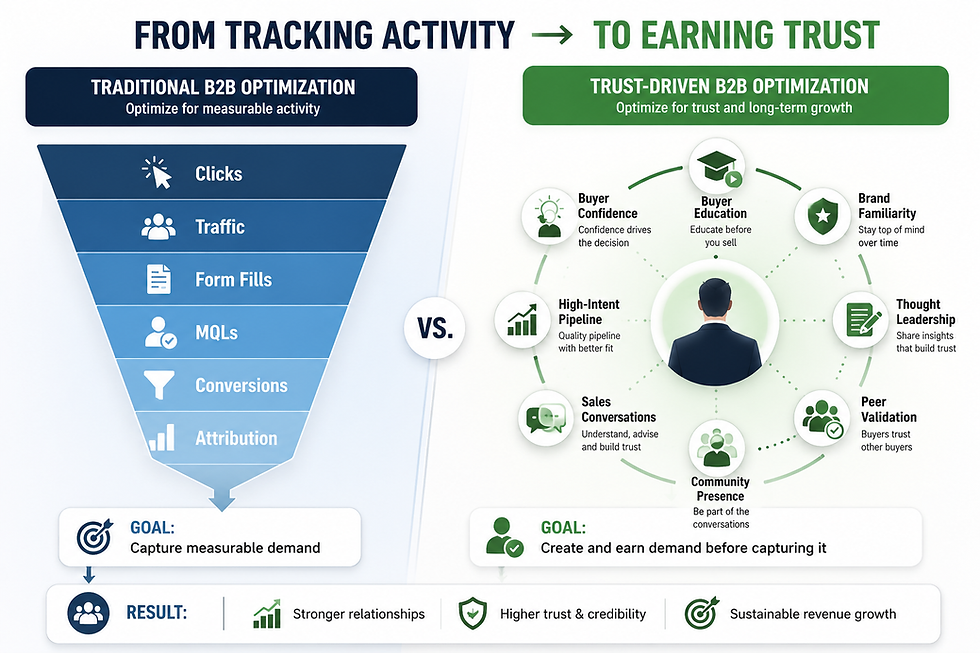
Instead of analyzing solely website analytics, a business should realize that its buyers are influenced by much more than just measurable online actions. Awareness, thought leadership, educational resources, community involvement, customer advocacy, and referrals also play a key role in customers' purchase decisions, even though they don't generate any attribution data.
Marketing success is not about tracking accuracy anymore. Instead, it's about the ability to impact consumers before the buying journey starts.
Companies that keep focusing on metrics that can be recorded through their software will find themselves undervaluing some of their best marketing efforts.
Creating a Privacy-First Attribution Strategy
As tracking loses its comprehensiveness, marketers have to look for a different way to attribute marketing success.
The privacy-first approach starts with improving the quality of first-party data that comes straight from customers in the form of website interactions, CRMs, and customer connections. This type of information is usually more accurate and sustainable than using tracking technologies.
Another step companies should take is to introduce self-reported attribution and ask their prospects how they learned about their brand. More often than not, they will share the information about podcasts, community talks, referrals, executives' content, etc.
Discovery conversations, customer interviews, and win-loss analysis provide yet another invaluable level of insight. With the help of website analytics and pipeline data, these insights build a much more comprehensive picture of the buyer journey.
Such an approach acknowledges both the power and the weaknesses of classic analytics, but instead of looking for a perfect solution, marketers get a much more realistic perspective on what happens during the buying process.
The Future of Marketing Is Understanding Buyers, Not Tracking Every Click
The future of business-to-business marketing is going to belong to those companies that understand their buyers better than the dashboard.
New technologies will keep coming up, the demand for privacy will keep growing, and new ways to communicate will appear. It will become increasingly hard to achieve perfect visibility into everything that customers do.
But instead, marketers need to focus on learning more about the intention behind the actions, gaining trust, and delivering a good experience through various channels. Education, participation in communities, high-level visibility, and advocacy can be very powerful drivers of influence even without being able to track everything.
Successful companies will see privacy issues not as barriers but as chances for improving buyer relations and developing new methods of studying buyer behavior.
Finally, the aim is not tracking all clicks. The aim is understanding why people prefer some companies over others.
Conclusion: The End of Perfect Tracking Marks the Start of Good Marketing
The advent of the tracking pixel revolutionized digital marketing with the ability to see what customers were doing. Although still useful, it is not enough anymore as it cannot serve as a primary source of knowledge about the current buyer journey.
Today's B2B purchasers engage in private conversations, discussions in professional communities, listen to podcasts, send DMs, and get recommendations from peers – all things that cannot be fully tracked with the existing technology. In addition, regulations and changes in browser settings limited the scope of behavioral data collection, making it clear that software attribution has its own limitations.
Visionary organizations understand that modern marketing requires an understanding of experiences, which creates trust in the minds of prospects before they even visit your website.
Organizations ready to move forward will learn that perfect tracking does not equal good marketing. They will stop thinking about tracking pixels as an end and start seeing it as a means. By using qualitative insights gained through customer conversations and buyer feedback, they will understand much more of the true sources of B2B growth.


Comments