Cookies, UTMs, and the Illusion of Perfect Marketing Attribution

Introduction: The Numbers Look Accurate, But are They Telling the Truth?
Nowadays, marketers get to know everything from their dashboards. They see who came through the site, what campaigns produced leads, and what channels have a connection to sales. Cookies and UTMs collect valuable information to show this to the marketer. Still, in some cases, the illusion created by cookies and UTMs makes people believe in false data.
An anonymous visitor could seem to be a visitor coming from organic search or a conversion made through paid campaigns, but this interaction might be the last one in the series of activities performed by the potential customer. Before clicking a tracked link, the buyer could listen to a podcast, participate in discussions about your company in a Slack group, get recommendations from coworkers, or interact with executives' content on LinkedIn.
The issue with marketing attribution nowadays is not that cookies and UTMs are providing wrong data; the issue is that people are sure that cookies and UTMs provide all the information about the buyer journey.

What are Cookies and UTM Parameters?
The emergence of cookies and UTM parameters was significant because these technologies helped marketers to understand consumer behavior on digital campaigns. A cookie is a small file containing data on Internet usage stored on a user's browser that enables websites to keep some information about the visitors. Cookies allow marketers to gain knowledge about the activity on the website, personalize the experience for the customers, evaluate the performance of the advertisements, and create an audience for future campaigns.
UTM parameters have a different function. These are additional codes inserted into URLs to help marketers know where the traffic on the website comes from. For instance, using UTM parameters, a company may find out if people come from LinkedIn campaigns, emails, ads, or content promotion.
These technologies provided a base for modern measurement in the digital environment. They enabled marketers to ask several key questions: what campaigns draw attention; which channels produce leads; which pieces of content cause conversions.
But these tools were intended to measure digital conversations, recommendations, and building trust between people.
Why Cookies and UTMs Were so Effective in Traditional Marketing?
For many years, cookies and UTMs allowed marketers to have quite a precise picture of what the customer's journey looks like since the purchasing behavior was rather predictable.
A common buyer journey in the B2B sector usually looked like this: a buyer performed a search for the solution on Google, then went to the website, downloaded some report, entered into the email campaign, and finally asked for a sales call. Each of these actions generated a digital footprint that marketing systems could track.
In such a way, attribution was rather easy. Marketers could see what campaigns were responsible for lead generation and budget accordingly on the basis of performance metrics. SEO, paid search, email campaigns, and content campaigns – all could be tracked in terms of measurable interactions.
The point is that this system was developed according to the idea of a linear buyer journey that implied certain movement from one stage to another via measurable digital interactions.
Today's B2B Buyer Journey Is Not Completely Traceable
The B2B buyer journey of today has become far more complicated than traditional attribution methods would tell us. Buyers do not usually make up their minds after a visit to one website or interaction with a particular marketing campaign. They gather information from many different sources and make sure that their decision is correct using contacts and relationships.
A buyer will learn about the firm via a podcast episode, become interested in the company's executives on LinkedIn, join a private industry community, get recommendations from colleagues, compare vendors, and only then go to the website.
Typical tracking tools cannot capture such activities. The discussion within a Slack community does not yield any UTM parameters. Sharing recommendations through WhatsApp does not leave any cookies behind. A coworker sending a helpful article through email cannot be seen as a referral source.
This is called Dark Social. All such buyer influence takes place in places where tracking technology cannot get to.
There is an increasing discrepancy between attribution software and actual influences on buying decisions.
The Myth of Absolute Marketing Attribution
One of the key problems with current analytics solutions is that the dashboards give people the illusion of completeness. The figures seem accurate, but sometimes accuracy isn't equivalent to completeness.
Your marketing platform can inform you that the client converted via organic search. Your analytics tool may report that Google was the one who generated the lead. Yet, the actual path of that client could start much earlier.
Think about the situation when your company's CEO gives an interview on a podcast. Then the client sees the ideas your experts shared in a LinkedIn discussion group. They hear from their peers about your solutions in a closed community. Finally, the client goes to your website via a Google search and schedules a demo call.
Your analytics platform attributes the conversion to organic search because it was the last action you could measure.
However, organic search didn't generate the trust. The podcasts, community discussions, and peer recommendations did.
The Hidden Cost of Relying on Incomplete Attribution Data
Organizations that depend too much on incomplete attribution data face risks of implementing incorrect strategies. Marketing teams will assume that channels attributed with a high degree of measurability are also the most valuable. Unfortunately, this thinking pattern will result in an unbalanced focus on short-term performance and not long-term demand generation.
For instance, businesses might increase budgets allocated to channels such as paid search, which provide the highest amounts of measurable results. Meanwhile, other channels, such as podcasts, thought leadership of executives, community engagement, and brand campaigns, which are difficult to measure, may receive reduced budgets.
Unfortunately, businesses risk cutting the channels that are responsible for creating awareness and trust prior to people entering the measurable funnel.
In addition, relying on incomplete attribution creates conflicts between marketing and sales teams. Sales reps will hear prospects speak about recommendations, communities, and conversations that were instrumental in influencing their decision-making process. On the other hand, marketing reporting may say something else.
Leadership that depends only on dashboard data will optimize for what is easily measurable and not what drives revenue.
Moving Beyond Cookies and UTMs
The answer isn't to stop using cookies and UTM parameters. They still offer important information and are a key part of modern measurement efforts.
The problem is comprehending their limitations.
What is required is a combination of more traditional approaches and other means for gaining buyer insight. Self-attribution can be one of the most powerful. When you ask prospects how they first came across your brand, you gain visibility into factors that remain invisible in standard attribution systems.
Other sources include CRM data, conversations from sales discovery, interviews, and win/loss analysis. They enable organizations to know why customers selected them, and not which click happened right before conversion.
This yields a blend of attribution techniques that brings together quantitative and qualitative information. The software gives the marketer what occurred. Conversations with the buyer tell them why. In a complicated B2B world, both are needed.
Measuring Influence Rather Than Just Interactions
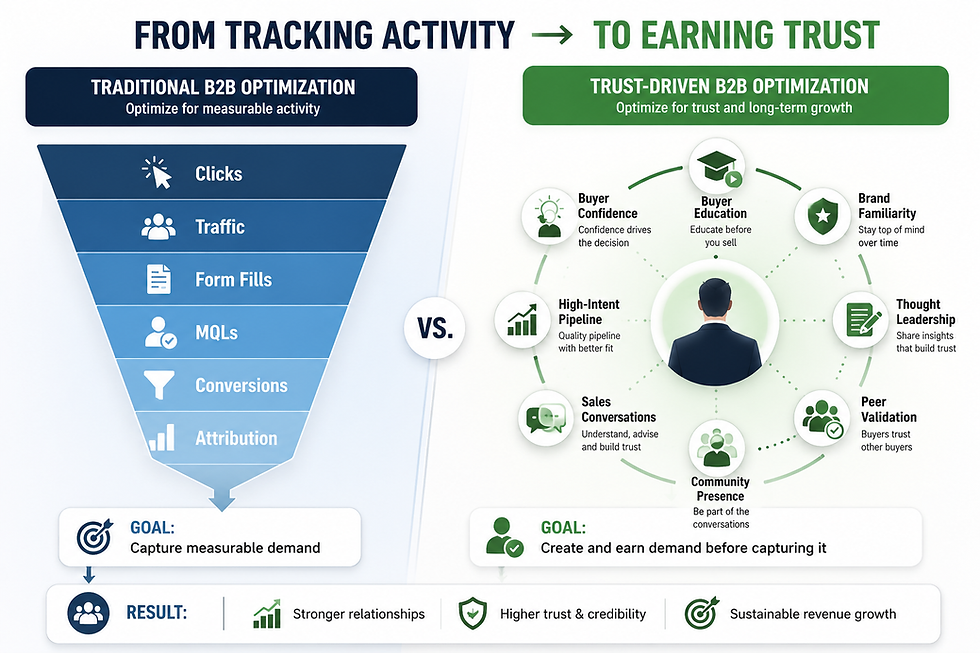
For attribution to have any future value, marketers will have to look beyond simple interactions like clicks, sessions, and conversions. These metrics provide valuable information, but they are only part of the buyer journey.
The challenge is no longer identifying the source of a lead, but understanding the interactions and experiences that influenced the buyer along the way.
Influence typically comes through repetitive exposure and credible interaction. Buyers may consume a number of articles and podcasts, follow industry leaders, and interact with colleagues on solutions prior to qualifying as an opportunity.
While these may not necessarily produce trackable interactions, they are contributing to the overall perception and building credibility.
The modern marketer will have to look at the influence of content, executive presence, community involvement, and customer advocacy beyond the usual campaign metrics.
The aim of attribution shouldn't be in capturing every single click in a perfect record. It should be about understanding the true process of building trust and making decisions.
Conclusion: Better Attribution Requires Asking Better Questions
Innovations like cookies and UTMs have changed the face of digital marketing because they give organizations valuable insights into the online activity of their users. Nonetheless, these innovations were invented at a time when the buyer journey was much simpler than it is now.
These days, the decisions made by the buyers of B2B products and services are affected by multiple conversations, communities, recommendations, podcasts, and private discussions that cannot be tracked with the help of cookies and UTMs.
Modern analytics platforms allow organizations to monitor a lot of different activities performed by the users online, but they do not provide any insights into the reasons behind these activities.
The way forward for organizations in the sphere of attribution lies in the combination of the use of technology and better knowledge of the buyer journey.
Therefore, the use of cookies, UTMs, and analytics tools should go along with listening to customers and working together with sales teams in order to collect qualitative data about the buyer journey.


Comments