How to Implement Self-Reported Attribution (And Why You Need It Yesterday)

Introduction: The Missing Piece in Your Attribution Strategy
Your marketing dashboard shows one version of the story. Your buyers see another one.
For instance, your marketing analytics system shows that a new customer from the enterprise market has been acquired through Google Organic Search. This means that SEO has driven this buyer acquisition. However, the customer mentions during their first discovery call that they were initially attracted to the CEO's podcast interview, have been following LinkedIn articles for months, had conversations about your product with colleagues in a Slack group, and finally Googled and visited your website.
Which story is true?
Both stories are true, and there is a discrepancy between the data captured by your marketing system and real buyer behaviors that have led to a purchase.
This is the reason why Self-Reported Attribution has become an integral component of a contemporary attribution approach. The only thing you need to do to get insight that cannot be obtained using analytics platforms is to ask customers one question: "How did you actually find us?" This article will shed light on what Self-Reported Attribution is, why it is important, and how to implement it effectively.

What is Self-Reported Attribution?
Self-Reported Attribution refers to asking customers to report, using their own words, the source through which they learned about your brand. In contrast to the use of software, companies ask customers to give an explanation of how they discovered your business themselves.
In contrast to other attribution methodologies, Self-Reported Attribution puts emphasis on the role played by the influence of buyers and does not measure online engagements only.
Some examples of answers provided by customers might be:
"I have heard about your CEO during his speech on a podcast."
"My coworker has told me about your platform."
"I have been following your LinkedIn content for some time now."
"Somebody talked about your company in our Slack channel."
"I have discovered your educational videos on YouTube."
This approach helps to understand the influence factors missed by the marketing software. Therefore, it can be used as a complement to the analytics platforms.
Why Self-Reported Attribution Changes Everything
A single question changes everything about how companies assess marketing success.
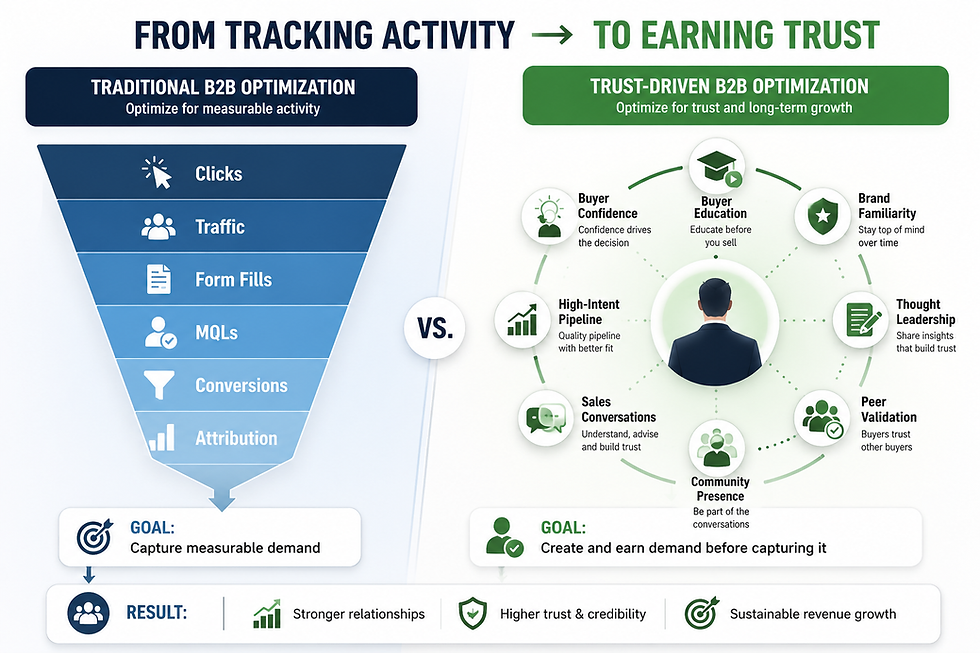
Attribution software tracks website visits, advertising clicks, email engagement, and conversions. While all these data points are critical, none of them can answer the question of why buyers were motivated to perform any action at all. Self-Reported Attribution offers those answers in uncovering the buyer journey up until that action is taken.
Let's look at a common scenario.
The CRM shows a new opportunity coming in through Organic Search, and your marketing team determines SEO has to take all the credit.
What the buyer tells you is that they had been listening to your firm's podcast for six months, reading your CEO's LinkedIn articles, and getting a referral from an industry colleague prior to performing that search. Both responses are correct.
The software identified the place of the conversion. The buyer described the trigger for the conversion confidence.
This difference provides a lot of business value as well. It allows companies to identify new marketing channels, evaluate their investments into building brands, allocate budgets effectively, align Marketing and Sales, and understand better how B2B buyers make purchase decisions.
Now companies don't optimize their marketing based on partial reports; they make decisions based on the whole picture.
Step 1: Incorporate Self-Reported Attribution into High-Intent Forms
The first thing you need to do to incorporate Self-Reported Attribution is decide where you will ask the buyer for their response.
The best results can be expected from high-intent forms because at this point, the prospect is already at the end of their research process and is seriously thinking about a purchase. The prospect is capable of remembering the influences on them.
Examples of where to put Self-Reported Attribution questions include: Demo Request Form, Contact Sales page, Free Trial sign-up, Consultation booking form, and Enterprise Pricing Request Form.
Do not try to use it in every single newsletter subscription or low-intent download form. A person downloading an educational piece of content may not be ready enough to give you any real attribution.
That way, you will get information from leads who are closer to being your clients.
Step 2: Formulate the Correct Question
Self-Reported Attribution is entirely reliant on the question formulation.
Most businesses ask the question: "How did you hear about us?" It is an acceptable question that may lead to useful feedback. However, such a question often makes buyers provide brief and insufficient answers.
A more effective question is:
"How did you really hear about us?"
Incorporating the word really prompts buyers to think not only about the last website or ad click. Instead of mentioning the last interaction with the company, they describe their first experience with the company.
Wherever possible, always opt for the open-text question rather than offering some predefined choices to buyers. Dropdowns will be easier to analyze; however, the context will be hidden.
For example, selecting "Google Search" in the dropdown, a buyer could write:
I first heard about your CEO through a podcast. After following your LinkedIn posts for several months, I used Google to find your website."
It changes the picture of the buyer's journey completely.
Simple and open questions always work better than form fields.
Step 3: Organizing and Categorizing Buyer Responses
Response gathering is just the first step towards gaining insight; companies need a standardized way to organize their data.
Instead of looking at each response individually, similar answers can be aggregated together into larger reporting categories while maintaining the buyer's voice.
Some standard categories could be podcasts, LinkedIn, referrals, Slack, YouTube, events, partner referral, founder marketing, employee advocacy, and SEO.
As time goes on, certain patterns start to arise.
For example, marketing teams might find that executive thought leadership is always what impacts enterprise buyers or that customer referrals create higher quality opportunities than advertisements.
Such consistent patterns often uncover opportunities that normal attribution reports fail to see.
Through combining structure with authenticity, organizations have a win-win situation.
Step 4: Merge Self-Reported Attribution and Marketing Analytics
Among the most common misunderstandings related to Self-Reported Attribution is the idea that it can replace traditional marketing analytics.
This shouldn't be the case.
The key benefit lies in the fusion of the two types of data for Hybrid Attribution Framework creation.
Assume that your marketing software attributes the lead generation to Google Organic Search. The consumer tells you that he learned about your brand from your podcast and then interacted with your learning materials for several months before visiting your website.
There are no mistakes here. While the analytics platform shows the point of conversion, Self-Reported Attribution sheds light on the reasons for the buyer's choice.
Both pieces of information combined give much better insights into the effectiveness of marketing efforts than any of them considered on its own.
Rather than trying to argue about whose attribution model is right, it is essential to acknowledge that they answer different questions. The analytics platform describes what has happened in measurable digital channels. Self-Reported Attribution explains why buyers decided to interact.
Common Pitfalls When Using Self-Reported Attribution
While Self-Reported Attribution is quite easy to use, some common pitfalls may diminish its efficiency.
First, many companies make the mistake of using multiple-choice answers only. It makes the process easier, but not using open-ended answers means missing out on important context buyers add to their answers.
Second, it's crucial to analyze collected answers. Without analysis, such data doesn't have much value.
There are companies that mistakenly consider Self-Reported Attribution a way to substitute for analytics tools. It is yet another incomplete picture of buyers' behavior. The goal is to merge qualitative data with quantitative data and not pick either of the two options.
Lastly, it's important to remember that all gathered attribution insights should not stay within the marketing team. All departments should get to know what buyers think and say.
Incorporating Self-Reported Attribution into Your Business Strategy
The biggest advantage of using Self-Reported Attribution is incorporating it into your day-to-day business strategy.
Marketing can uncover which channels drive customers without being measured through traditional attribution. The sales team will be well-informed about what happened before the prospect discovered the business, giving them great context to engage in the discovery conversation. RevOps can get their reports right by mixing data analytics and buyer insights, while executives can make better investment decisions from a fuller picture of marketing performance.
Not only will the tool become one more marketing metric; Self-Reported Attribution will become a source of customer insights used by the entire organization.
Conclusion: One Simple Question Can Transform Your Attribution Strategy
The deployment of Self-Reported Attribution does not involve any additional software purchase or full overhaul of your marketing technology stack. All you need is a simple question that enables buyers to share their story.
In the current B2B landscape, buying decisions are impacted by podcasts, executive thought leadership, private communities, word of mouth, and so many more interactions that are impossible to track via standard attribution systems. Ignoring these factors means basing your strategy on an incomplete picture of the buyer journey.
By including Self-Reported Attribution questions into your high-intent forms and combining them with marketing analytics, you will obtain much more accurate information about how customers really get to know about, evaluate, and buy from your company.
Those organizations that adopt this method will make wiser marketing decisions, achieve better collaboration between Sales and Marketing, and develop attribution models that take into account actual human behavior rather than measurable clicks. Self-Reported Attribution is not a new method of reporting. It is your first step to creating a Modern Hybrid Attribution Framework.


Comments