Moving Beyond the Last-Click Myth in Complex B2B Sales

The Attribution Model That Gives Credit to the Wrong Moment
Marketers have used the last-click attribution model to understand what channels drive leads and revenue for decades. The model looks simple. A customer interacts with a brand through a link, fills in the form, and the very last touchpoint gets the attribution. But modern B2B buyer journeys are more complicated than that.
It's rare for an enterprise buyer to discover the solution and buy after interacting once. They might listen to podcasts, read the advice of industry leaders, explore thought leadership material, discuss the solution with other buyers, and interact with various marketing materials before reaching out to Sales.
When it's time to search for a company and ask for a demo request, the very last interaction takes all the credit.
This is the Last-Click Myth. This belief assumes that the final measurable touchpoint has the greatest influence on a buyer's decision. But often, the last click is nothing but capturing existing demand.
Understanding modern B2B sales means going beyond the last click attribution.

What Is the Last-Click Myth?
The last-click myth is defined by the idea that the last engagement is what is responsible for creating the customer. According to the last-click attribution, the marketing channel where the last click happens gets all of the credit for the conversion.
To better understand this, imagine an enterprise buyer first discovers a company through a podcast interview, follows its CEO on LinkedIn, reads several articles, discusses the solution with peers, and ultimately searches for the company on Google to schedule a demo.
In such a case, according to last-click attribution, all of the credit would go to Google Search. And yet, Google Search did not actually bring the client. It just got him when he was already there.
The appeal of the last-click approach lies in the fact that it is simple. Simple to measure, simple to report, and easy to correlate with conversions. The marketing department is going to find out which channels generate leads.
Unfortunately, sometimes simplicity equals inaccuracy.
Why Last-Click Attribution Fails in Complex B2B Sales
The process of making a purchasing decision for a corporation involves several individuals, numerous interactions, and several stages of evaluation. As a result, it becomes hard to pinpoint which interaction actually made the deal possible.
A B2B purchaser may be doing research for several months before interacting with a company's representatives. During this time period, they may consume some educational materials, participate in industry networks, engage in online conferences, and ask their professional friends for help.
All these actions shape their perceptions, but many of them are not easy to track.
Thus, the person might hear about some software company from one of their colleagues who participates in a private Slack network. As their research continues, they watch interviews with the founder on YouTube, explore customer success stories, and eventually reach the company's website through an organic search.
In the last-click attribution model, traditional attribution systems are based on the visible action. The actions that are invisible yet more significant for building trust are overlooked.
The Last-Click Myth arises due to the confusion of companies between measurable and meaningful influences.
The Difference Between Demand Creation and Demand Capture
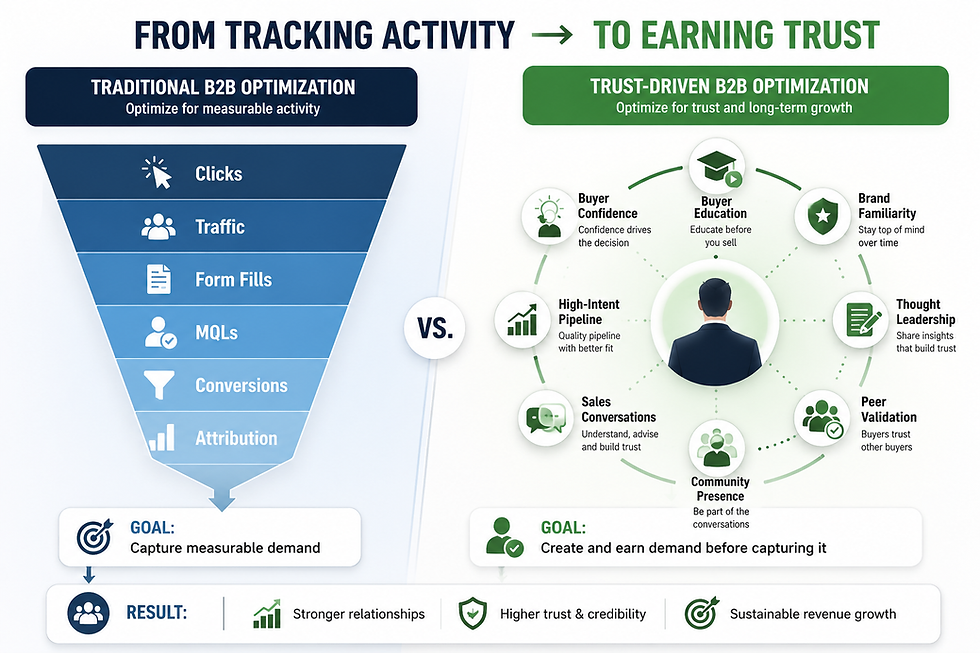
One of the major flaws in last-click attribution lies in the inability to distinguish between demand creation and demand capture.
Demand creation is all about the introduction of the company, its awareness building, and establishment of credibility through a number of initiatives. Those include executive thought leadership, podcasts, education, community involvement, and customer advocacy.
Demand capture, on the other hand, involves turning an existing demand into a measurable one by means of search, forms, pricing pages, and website visits.
Both aspects are equally important; however, each serves a different purpose.
A podcast can reach thousands of potential buyers of a particular product. A LinkedIn post can encourage someone to follow a brand long before they are ready to buy. A positive review can be the source of credibility necessary for future purchase.
Once a customer conducts a Google search and fills out a form, it is search that gets the credit.
Here, it is not about search attribution being wrong; it is just about ignoring those early activities that generated demand.
Moving beyond the Last-Click Attribution Myth requires companies to realize the differences between demand creation and demand capture.
Why Dark Social Makes Last-Click Attribution Even Less Accurate
The rise of Dark Social has made attribution even more difficult. Dark Social is the term for all the buyer interactions that take place using private or hard-to-track sources.
Private Slack groups, LinkedIn messages, WhatsApp chats, peer conversations, and industry forums are examples of such dark social.
More and more enterprise buyers turn to such trusted networks because they are looking for impartial opinions from those who know their situation.
The buyer asks peers for advice, discusses possible vendors, and gathers opinions without going to a vendor's site.
All these interactions do not show up in a traditional marketing dashboard.
When a buyer finally uses one of the trackable channels, many decision-making steps are taken behind their back.
That is why last-click attribution results are often misleading. They consider only the visible part of the buyer's journey, ignoring the conversations that have preceded them.
Recognizing the existence of Dark Social requires a marketer to see the real conversations behind the clicks.
Moving Beyond Last Click With the Hybrid Attribution Model
However, the solution is not to eliminate software-based attribution altogether. Digital analytics provides valuable information. However, the problem lies in creating an improved model for measuring success: the Hybrid Attribution Model.
The Hybrid Attribution Model uses three crucial sources of information.
Software attributions include measurable data provided by platforms like Google Analytics, CRM applications, and marketing automation systems. This source shows where the buyers used the digital channels.
Self-Reported Attribution includes the buyer's perspective. In fact, asking questions, such as "How did you hear about us?" It enables companies to understand the influences that traditional software cannot capture.
Finally, sales discovery will help companies to get additional context. For example, the Account Executives will be able to learn what prompted the buyers to look for a solution, who the influencers were, and what information prompted them to continue.
All this information together allows organizations to get a better picture of the buyer's journey.
Instead of wondering which channel deserves the attribution, companies will be able to know which experiences generated revenue.
How Self-Reported Attribution Helps Break the Last-Click Myth
Self-Reported Attribution is one of the best methods for getting to know what really affects buyers.
Just one question can provide you with some information that cannot be obtained by using traditional analytics:
"How have you actually found out about us?"
The buyer may say something like this:
"I've heard your CEO talking about your product on a podcast six months ago."
"I've seen your team talking about industry issues on LinkedIn."
"A co-worker of mine has mentioned your company in a private network."
This kind of information cannot be obtained through traditional tools and will give you a hint about where the demand comes from.
If you check your CRM report, you'll see that the opportunity came from Organic Search. However, in reality, the buyer only searched because he knew about you beforehand thanks to a podcast or recommendation.
Self-Reported Attribution is not an alternative to software analytics. It's just additional context needed to understand the reasons for buyers' actions.
How Sales Discovery Reveals the Real Buyer Journey
Sales teams have a major role to play in solving some of the issues related to the use of last-click attribution models. For example, account executives often learn valuable insights from customer conversations that no analytics platform can capture.
Questions asked during the discovery process include the following:
"How were you introduced to our organization?"
"What tools did you use to make comparisons?"
"Whom else was your decision-making influenced by?"
"Why did you think of exploring this solution at this time?"
Through such questions, one is able to understand the experience of the customer.
With this strategy, sales teams are turned into attribution partners. They are not just the end of the funnel but a source of customer insights.
When Sales, Marketing, and Revenue Operations teams collaborate on sharing this information, they gain greater knowledge about their revenue process.
Building a Better Attribution Strategy for Complex B2B Sales
An up-to-date approach to attribution must shift from credit attribution to influence measurement.
Companies should leverage the data from software along with the feedback and observations from buyers and sales reps. It's necessary to find patterns rather than looking at the attribution reports individually.
Marketing departments should measure both demand creation and demand capture. The efforts that a brand makes via the program, thought leadership, community building, and education might not bring immediate conversions but can certainly contribute to future revenues.
Perfection in attribution is impossible in the case of a complex B2B buying process that includes a lot of touches.
What is more important is effective decision-making.
Conclusion: The Future of B2B Attribution Is About Influence, Not Just Clicks
The Last-Click Myth has dominated marketing analytics for decades, but it is no longer a good model for how B2B buyers make purchasing decisions in today's world.
B2B buyers do not have a clear linear path from advertising to purchase. Buyers get educated through podcasts, communities, referrals, thought leadership, and conversation well before they actually take action.
Last-click analytics still matter, but it is not the whole picture.
In order to move forward in terms of B2B attribution, organizations need to see the bigger picture. Using software analytics, self-reported attribution, and sales discovery information, the true buying journey can be understood.
Organizations will not win by counting clicks alone. They will win by knowing the stories behind the clicks.


Comments