Software vs. Reality: Why Traditional B2B Marketing Playbooks Are Breaking Down

Introduction: What Your Software Sees Isn't the Whole Story
Each week, marketing teams sit down to analyze their dashboards to understand their campaigns. Traffic, conversion rates, leads, and attribution reports help them see what is working and where they should allocate budget. Everything seems clear, objective, and reliable.
Until they talk to a client who shares their experience with a brand, they found out about the company through a podcast, followed the CEO on LinkedIn for months, got recommendations from friends on Slack, and searched for the brand's website to book the demo. All of this effort goes unrecorded by marketing software that gives full credit to organic searches.
Why does that happen? It happens because of a gap that exists today in the world of B2B marketing: Software vs. Reality. Marketing software sees only the interactions it can measure. However, it cannot see the conversations, recommendations, and moments of building trust that happen outside the software and influence the buyer's decision-making process.

Traditional B2B Marketing Playbooks Formation
There was a time when traditional B2B marketing playbooks yielded predictable and measurable results. The buying journey took place in a relatively structured manner, enabling marketers to guide prospects through well-defined stages.
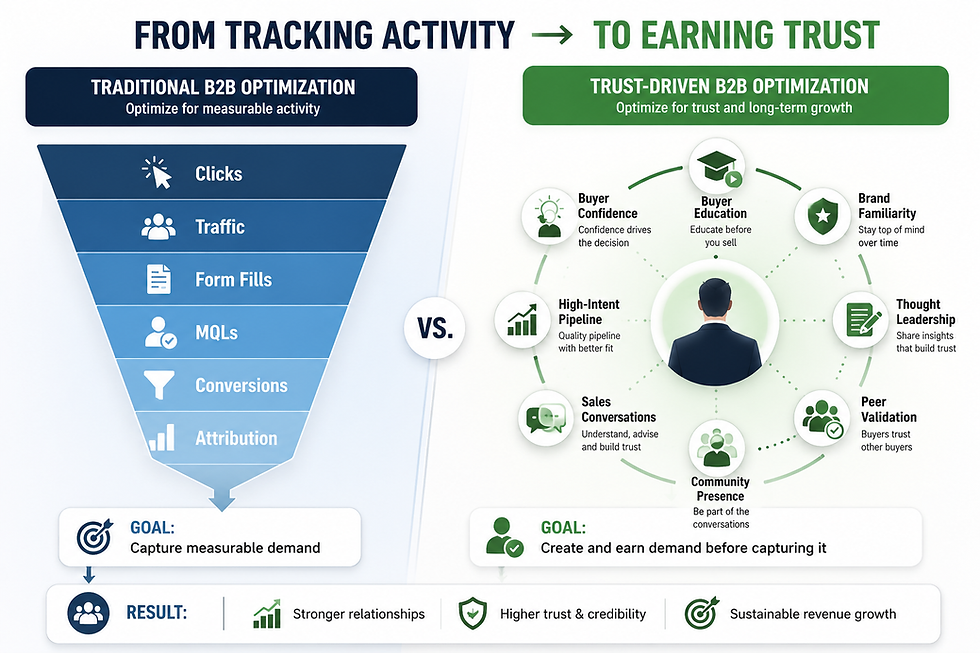
For instance, the process started with a prospective client using Google to look for information on a business problem. The visitor went to the company website, downloaded some material, filled out the contact form and became an MQL. Marketing continued nurturing the MQL with emails until handing over to Sales, with all interactions recorded by attribution software.
The method was effective because the vast majority of the buyer journey took place in measurable digital channels. The source of most information was search engines, company websites, and email marketing, making attribution relatively easy.
The result was the formulation of marketing strategies based entirely on software visibility. The effectiveness of such a marketing strategy was directly linked to predictable metrics like clicks, website sessions, number of leads generated and conversion rate.
The question is that buyer behavior has changed much faster than marketing strategy.
Software vs. Reality: Changing Trends in Buyer Behavior
Enterprise buyers today don't look to the company website as their main channel for obtaining information about the solution being considered. They independently perform a lot of research prior to reaching out to any vendor.
Buyers listen to industry podcasts when commuting, read articles by experts and founders on LinkedIn, watch educational videos, get newsletters, and join private Slack or Discord groups. They talk to colleagues and peers, gather internal feedback from vendors long before taking an actionable step.
A lot of this research happens in places that are invisible to most attribution tools.
It's also an example of changing buyer preferences. Rather than just consuming marketing materials, buyers are actively seeking expert advice from people who really know about the subject matter. Expertise is valued over marketing, and buyers tend to trust peer recommendations more than any vendor's content.
Buyer journeys today are much more fragmented than they are reflected in the conventional marketing model.
Software vs. Reality: Where Traditional Marketing Playbooks Fail
It is easy to see how the widening divide between Software vs. Reality occurs when organizations take a look at their attribution reports in comparison to the experience buyers had.
Traditional marketing playbooks are based on the assumption that all buying journeys can be measured, that leads naturally generate more revenue, and that the last measurable interaction is an accurate depiction of the buyer's thought process.
Modern buyer behavior calls each one of these into question.
It could very well be that the buyer went through several months' worth of reading your company's executive thought leadership pieces, listening to podcast interviews, and getting references from other people in their professional environment, long before they landed on any company websites, and then requested a demo. In such instances, attribution software marks the last measurable action as having come from either organic search or direct traffic.
While it is correct from the software standpoint, it fails to capture all the interactions that truly drove the buying decision.
It encourages organizations to prioritize measurable marketing channels over those that drive awareness and trust.
What Is Measured by Marketing Software and What Isn't
Marketing software is still one of the most important tools for today's businesses. This software allows tracking such parameters as website traffic, campaign performance, advertisement effectiveness, emails, form fill rate, and conversions. This information is needed for marketing optimization and improvements.
However, software has inherent limitations. It can measure actions but cannot assess their impact on buyers.
A dashboard can tell you that a person clicked on an ad or downloaded a report. It will not be able to tell you whether a podcast interview boosted the client's confidence, whether a post on LinkedIn by an executive created credibility, or whether a referral from a loyal customer made any impression on the buyer.
Additionally, software cannot track private conversations.
Chats within Slack communities, WhatsApp groups, LinkedIn messages, buying committee internal discussions, and customer referrals all play an important role in the decision-making process and leave no measurable footprint online.
Such private conversations do not represent an exception but a routine part of business buying today.
Recognizing this distinction allows companies to understand that software gives important insights into marketing actions but not a full picture of buyer behavior.
Why Modern B2B Marketing Needs a Different Playbook
With changes in the way buyers behave, forward-thinking businesses are changing their marketing game plan and basing it around experiences rather than software.
Instead of optimizing marketing campaigns for clicks alone, businesses focus more on education, credibility, and trust. Businesses write zero-click content on LinkedIn and YouTube, have executives blog about industry insights, foster employee advocacy and participate in professional communities.
Also, these businesses realize that alongside attribution software, they need qualitative insight. Self-Reported Attribution, interviews with customers, discovery calls with the sales team, and win/loss analysis can provide insight into the impact of influences that are missed by traditional software.
Such an approach allows marketing teams not just to track which channels brought clicks but also learn which experiences influenced the purchase decision.
Instead of optimizing marketing campaigns for dashboard metrics, the goal now is to create buyer experiences that establish trust prior to the sale.
Closing the Gap Between Software and Reality
In order to bridge the gap between Software vs. Reality, companies will need to fundamentally change the way in which marketing performance is being assessed and measured.
The first step to take is viewing software as just one data source, as opposed to the full picture. Although dashboards will serve as guidance in decision-making, they will not be the sole point of departure for strategic planning.
The second step is the addition of human insights into the assessment process. Self-Reported Attribution enables the buyers to tell the story of how they have found the company. Salespeople can learn a great deal of information during the discovery call, while customer interviews and win/loss analysis help uncover the insights that any platform cannot provide.
Finally, companies must switch from looking at marketing metrics and start focusing on the business outcome. Such as qualified pipeline, revenue growth, buyer confidence, customer retention and brand influence.
By combining the quantitative data with the qualitative insights, businesses get a much clearer view of the customers' purchasing process.
The Companies That Adapt Will Develop the Most Robust Competitive Advantage
The gulf between software and reality will only continue widening as enterprise purchasing becomes more community-oriented and relationship-focused
Firms that insist on sticking to their existing marketing game plans run the risk of optimizing for measurable actions instead of paying attention to the real influences on buyers. Firms that make investments in executive thought leadership, education, customer advocacy, and communities will begin developing better brands and stronger reputations.
Some of the advantages of companies that adapt are as follows:
They will know how their buyers behave, develop a better pipeline, align Marketing and Sales better, optimize budgets, and implement marketing programs for growth.
However, the most important advantage is that they will finally stop measuring whatever the software measures and try to understand what buyers actually feel.
That is quite an essential advantage in today's competitive environment.
Conclusion: Software vs. Reality—Time to Rewrite the Marketing Playbook
The question of Software vs. Reality doesn't imply the choice of one over another. The usage of marketing software is an integral part of any B2B marketing strategy nowadays. It provides relevant information, which helps to analyze the results and enhance marketing efforts. The problem appears when companies interpret software reports in the wrong way.
Buyers today get information from podcasts, private groups, executive thought leaders, recommendations from other customers, and numerous other conversations, which take place outside the traditional attribution model. All this shapes their trust, confidence, and decisions before any action is taken.
Companies that stick to traditional marketing playbooks will face problems trying to find out the cause of discrepancies between their reports and reality more often. Companies that incorporate analytics with buyer insights, self-attribution, and sales intelligence will have a better understanding of the decision-making process of their customers.
The future of B2B marketing belongs to those who optimize their business not for marketing dashboards but for buyers. In the time of Dark Social, it implies closing the gap between marketing software and buyers' realities.


Comments