Stop Optimizing for Dashboards and Start Optimizing for Buyers

Introduction: When the Dashboard Becomes the Customer
Everyone who works in marketing today uses dashboards. They analyze website traffic, conversion rates, campaign performance, cost per lead, Marketing Qualified Leads (MQLs), etc. There are many other metrics on the dashboards that give great insights and allow organizations to know what happens within the marketing channels.
Nevertheless, there arises a problem with dashboards as the main thing that influences marketing decisions.
Many teams pay more attention to optimization of metrics than to understanding the audience itself. While they make click-through rates better, increase the number of form submissions, and lower acquisition costs, they forget about buyers' processes of learning about their problems, evaluating potential solutions, and choosing the best one.
The modern B2B buyer does not have a linear digital journey. He learns from podcasts, LinkedIn discussions, private communities, peer recommendations, and internal meetings that are never reported in marketing dashboards.
The dashboard shows some actions, but it does not tell what the intention behind them was. It is necessary to turn the attention from dashboards to buyer-centric marketing.
Why Dashboards Became the Center of Modern Marketing
Marketing dashboards have altered the way organizations assess their performance. Prior to the emergence of digital analytics, marketing success was challenging to measure. Organizational teams had to rely on assumptions, surveys, and general metrics of brand awareness.
Dashboards offered a different kind of accountability. Marketers were able to measure website traffic, marketing campaign results, advertising effectiveness, engagement via emails, and lead generation activities.
For many organizations, dashboards have become indispensable decision-making tools, helping marketing teams report their results to executives and show the effects of their programs.
There is nothing wrong with using dashboards per se. Data-driven marketing is highly valued and essential. What causes issues is when organizations confuse measuring something with actually understanding the situation.
A dashboard can tell you that a certain person has clicked on your ad or downloaded a whitepaper. It will not give you any information on why that person decided to trust your business, what motivated him to do so, or what experience he had previously.
Dashboards are supposed to help marketers develop their strategies, but not replace customers' experience understanding.

The Problem with Optimizing for Metrics Instead of People
When the success of marketing campaigns is judged based on dashboard metrics, marketing teams automatically begin working towards maximizing these easily quantifiable metrics.
As a result, marketers start focusing on increasing clicks, form submissions, email open rate, and conversion rate. Such an approach might produce impressive numbers but doesn't necessarily lead to creating a great customer experience.
For instance, it might be easy to increase content downloads with an industry report that requires entering personal information to access. It looks like the campaign was successful since lots of people submitted their data, but if the contacts don't have any immediate need for the offer, the business has produced activity without any real potential.
This is the issue when working only with metrics.
The role of marketing is not just creating measurable interaction. Marketing has to help customers find solutions to their problems, build trust, and make smart choices.
A buyer will not choose a certain vendor just because they had a high conversion rate.
Buyers Don't Experience Marketing the Way Dashboards Report It
The most prominent drawback of traditional marketing dashboards lies in the fact that they measure only the visible aspects of the buyer journey.
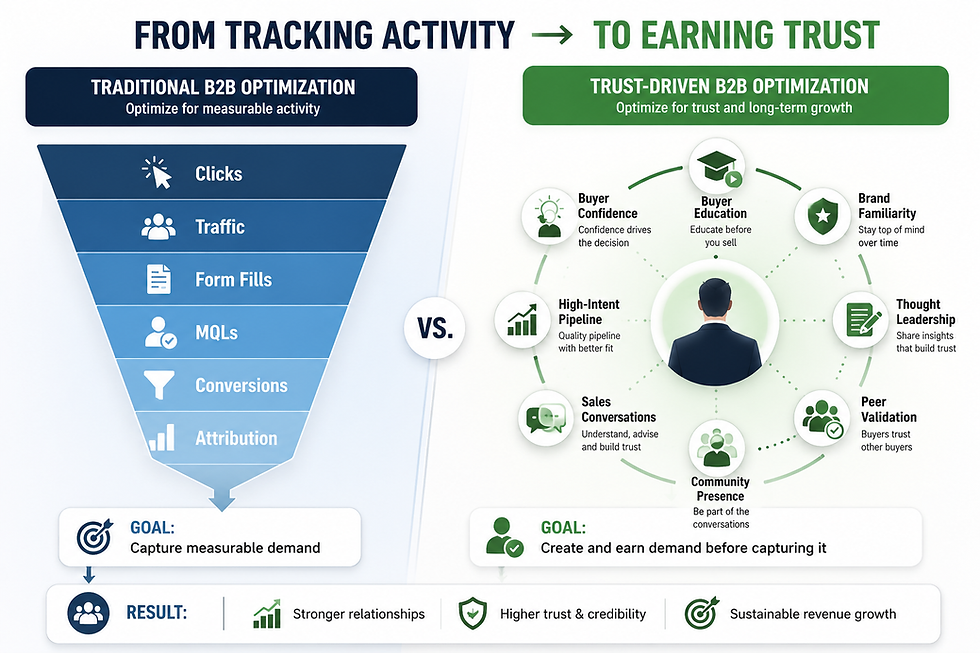
Contemporary business-to-business buyers investigate the offered solution using channels that are hard or even impossible to track. These include listening to relevant podcasts, following specialists on LinkedIn, joining private Slack groups, exchanging contacts via WhatsApp, and discussing the vendor internally.
All of these activities may have an impact on the decision much earlier than the buyer reaches out to a company's website.
For instance, the company founder's message may be heard by the executive at the podcast and remembered for a couple of months. The relevant recommendation may be given to a buyer by a colleague from a private group. The buying team may discuss a certain vendor internally before filling out any forms.
When the time comes for the buyer to search for the company and request a demo, the dashboard will state that the traffic came from organic search.
This information is accurate; however, it is not comprehensive enough.
Why Buyer-Centric Marketing Creates Better Business Results
Buyer-centric marketing starts with a different approach. The focus should shift from boosting engagement metrics to understanding what buyers need to know before they are ready to buy. It all revolves around creating real value during the buyer's journey.
Companies that adopt a buyer-centric approach develop educational, expert, customer, and practical content that helps people address their issues. They create content that offers useful answers instead of collecting contact information from prospects.
Such an approach fosters trust before the sales conversation even happens.
As buyers identify an organization as a trustworthy source of valuable information, the sales team usually deals with leads who have already understood the importance of a particular solution.
Thus, it saves the time of both parties and improves chances for a positive outcome.
Marketing initiatives should be centered around helping buyers wherever they may be on the buyer journey, not forcing them through some artificial marketing funnel.
The Hidden Cost of Dashboard-Driven Decisions
Making only dashboards perform can lead to strategic issues.
As a company prioritizes results above anything else, it tends to cut spending on activities that affect customers but cannot be easily measured.
Activities such as building brands, thought leadership of executives, podcast interviews, community involvement, and education do not look important when their effects are not reflected in the attribution.
The consequence of this strategy is that companies spend most efforts on capturing existing demand and ignoring building it.
Thus, there is a tendency towards short-term marketing strategies that work in terms of generating leads but do not build competitive advantage.
Incomplete data might also mislead businesses to take incorrect decisions. For instance, a marketing campaign fails to generate conversions, but influences buyers and affects their purchasing decisions positively.
Marketing involves measuring results and their influence on customers' behavior.
Steps for Developing Buyer-First Marketing Strategies
To develop a buyer-first strategy, organizations have to change their approach to developing, measuring, and optimizing marketing programs.
First, focus on buyer challenges instead of campaign KPIs. Content needs to speak to the challenges customers face, give them solutions, and show the organization's expertise.
Second, measure outcomes that help drive business growth. It is important to move away from tracking clicks and leads and measure qualified pipeline, revenue influence, customer voice, sales intelligence, and self-attributed results.
Third, enhance collaboration between the teams. Collaboration between Marketing, Sales, Customer Success, and RevOps will bring more insights into the buyer's behavior and customer needs.
Finally, make an investment in trustworthy channels. These include executive content, communities, podcasts, and customer advocacy. They do not necessarily provide immediate attribution, yet many times affect buyers before they go through the measured sales funnel.
A buyer-first strategy does not exclude data, but uses it together with human insights.
Better Questions Mean Better Marketing Strategy
The most fundamental shift in marketing in the modern era is not about technology. It is about strategy. Companies need to stop asking just performance-related questions and start asking buyer-related questions. Rather than asking "Which campaign brought us this lead?" companies should be asking:
What problem were the buyers looking to solve?
What information was used to make a decision?
What content did the buyers share with their colleagues?
What experience gave them confidence?
Why did they end up picking us?
These questions yield answers that are beyond the realm of metrics. Metrics tell you what happened. The buyers tell you why. This is one of the key differences that companies that realize it will use to formulate a better marketing strategy.
Conclusion: Great Marketing Optimizes for Buyers, Not Reports
Dashboards continue to play an important role in marketing in the modern-day world. They allow the teams to measure their performance and draw conclusions based on trends that appear. Nevertheless, dashboards must not become the end goal itself.
Marketing is not supposed to be about making better reports; it is supposed to be about creating better experiences for buyers.
Today's buyer environment is influenced by conversations, communities, recommendations, and the expertise of the person. Many of these factors are outside of the tracking system.
When companies adopt the approach of buyer-focused marketing, they come to the realization that success does not depend on how many clicks, downloads, or leads you managed to generate. It depends on how much trust and education you give to your buyers and what kind of influence you generate.
The winners of the future will be the companies that know their buyers better than everyone else.


Comments